
AI Receptionist for Small Business: 5 Options Compared
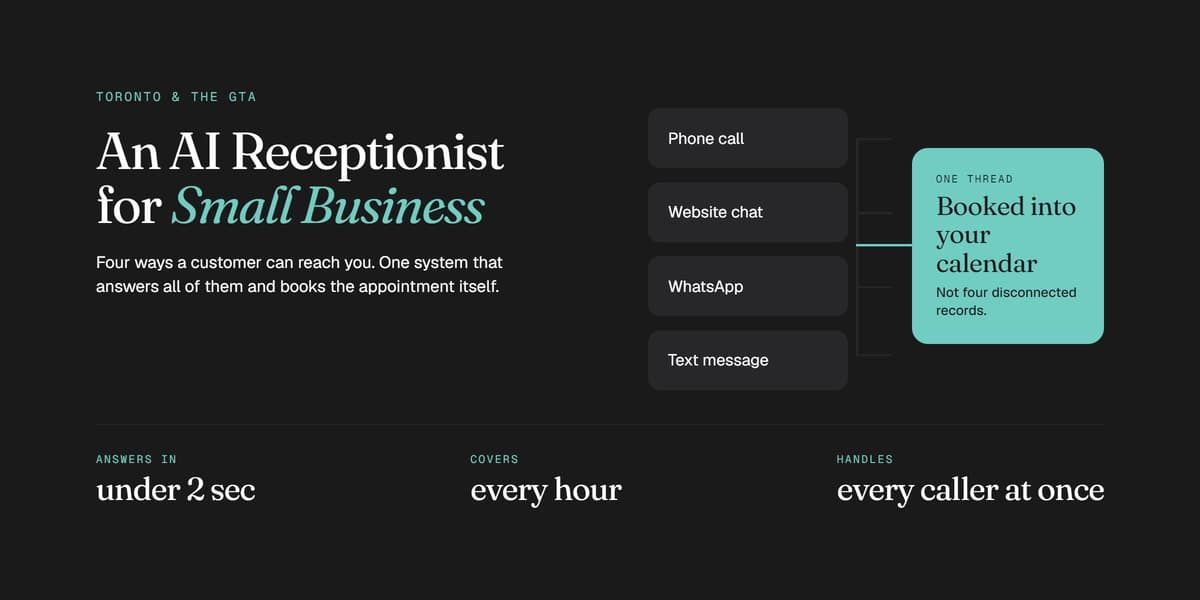
An AI receptionist for small business picks up every call, website chat, WhatsApp message and text, day or night, and books the appointment straight into your calendar instead of leaving you a list of callbacks. For an owner who is also the plumber, the hygienist or the lawyer, that is the difference between a booked job and a lead that called the next name on Google.
The hard part is choosing one. Some tools only answer the phone, some bill by the minute, and some are not AI at all. This guide compares five well-known options on the things that matter to a small team: which channels they cover, how they bill, how much setup they need and who each one actually fits. If you want the technical background first, our explainer on what an AI receptionist is and how it works covers the mechanics, and our wider AI receptionist software comparison reviews nine platforms in more depth.
Short answer: if you want one system that answers calls, chat, WhatsApp and SMS on a flat monthly bill, Patrick is the strongest all-round fit. If some of your calls need a live person, look at Smith.ai. If you only need the phone covered on a tight budget, Goodcall or AIRA will do the basic job. If you want a human voice on every call and can absorb per-minute pricing, Ruby is the live option.
Missing calls while you are with a client or on a job? Hear how Patrick handles a real booking call before you read any further.
What an AI Receptionist Handles for a Small Business Front Desk
An AI receptionist is conversational software that answers inbound calls and messages for your business, understands what the person wants in plain language, and completes the task. The most common task is booking an appointment, but it also answers questions about hours, services and service areas, qualifies new leads and routes urgent calls to a person.
That is what separates it from a phone tree or a voicemail greeting. A phone tree asks the caller to press 2. An AI receptionist hears "my furnace stopped working and I have kids at home," recognises an urgent service call, checks your real calendar, offers an open slot and confirms it while the caller is still on the line.
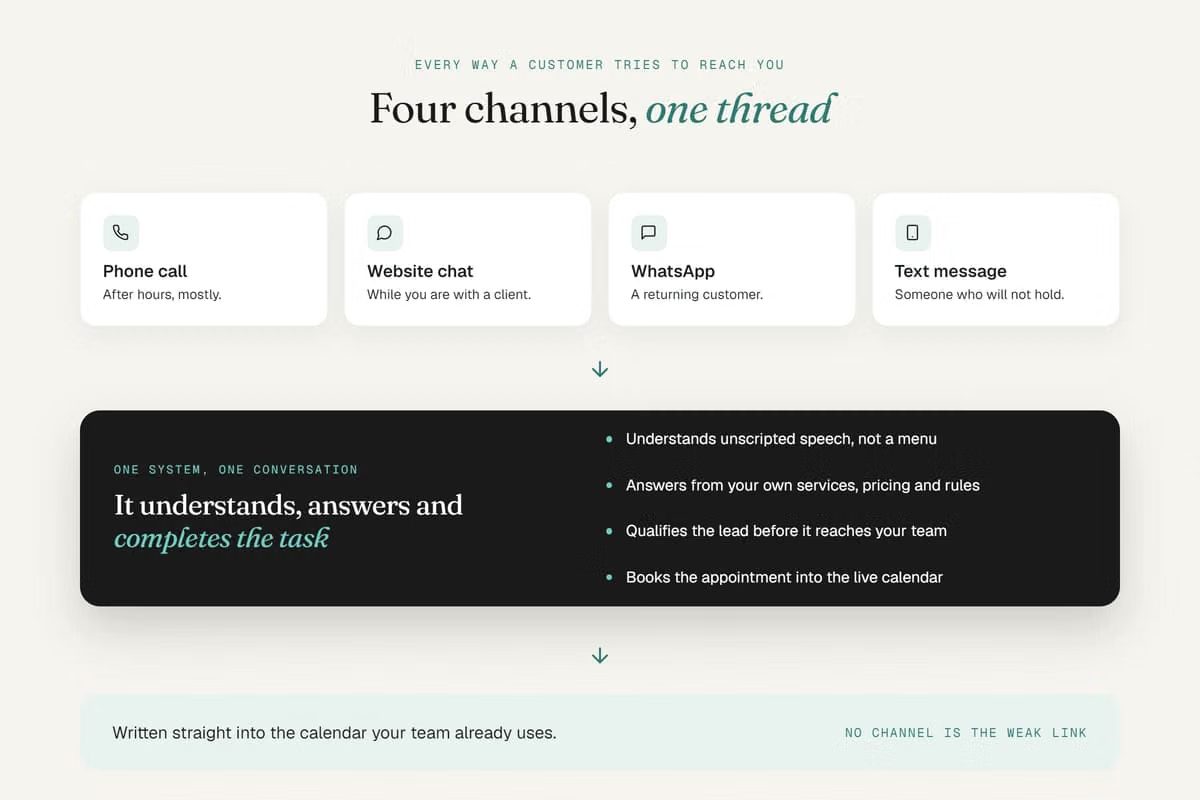
For a small business, the value is coverage across every channel a customer uses: a call after hours, a text from someone who does not want to wait on hold, a WhatsApp message from a returning client, or a website chat while you are busy with another customer. It is one of the most practical pieces of AI automation for small business operations, because scheduling and lead intake get handled without adding headcount.
Why Missed Calls Cost Small Businesses More
A large company has a call centre. A small business has the owner, maybe one front-desk person, and a phone that rings at the worst possible moment. When nobody picks up, most new callers do not leave a voicemail. They call the next business on the list, and the first one to answer usually gets the job.
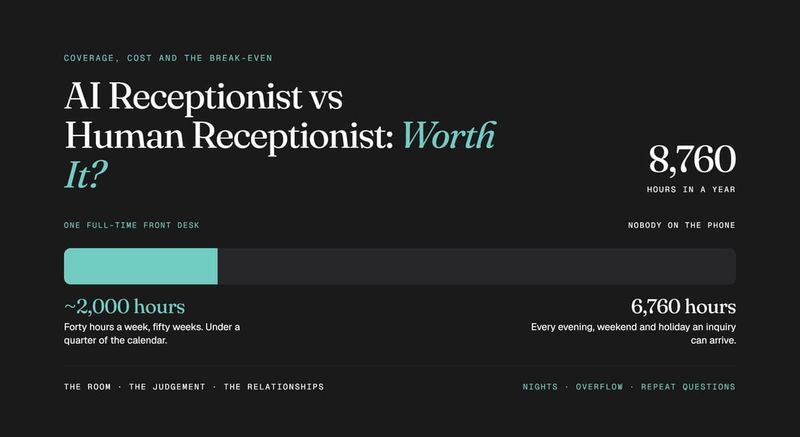
The alternative most owners consider is hiring. A full-time receptionist in Toronto typically costs $42,000 to $55,000 a year before benefits, and still covers roughly 40 hours a week. Evenings, weekends, lunch breaks and sick days stay uncovered, which is exactly when many service calls come in. We broke down the numbers in detail in AI receptionist vs human receptionist.
That is why small businesses tend to see the fastest return from an AI receptionist. One recovered booking a month can cover the subscription, and the after-hours calls that used to go to voicemail become appointments.
7 Features to Check in a Small Business AI Receptionist
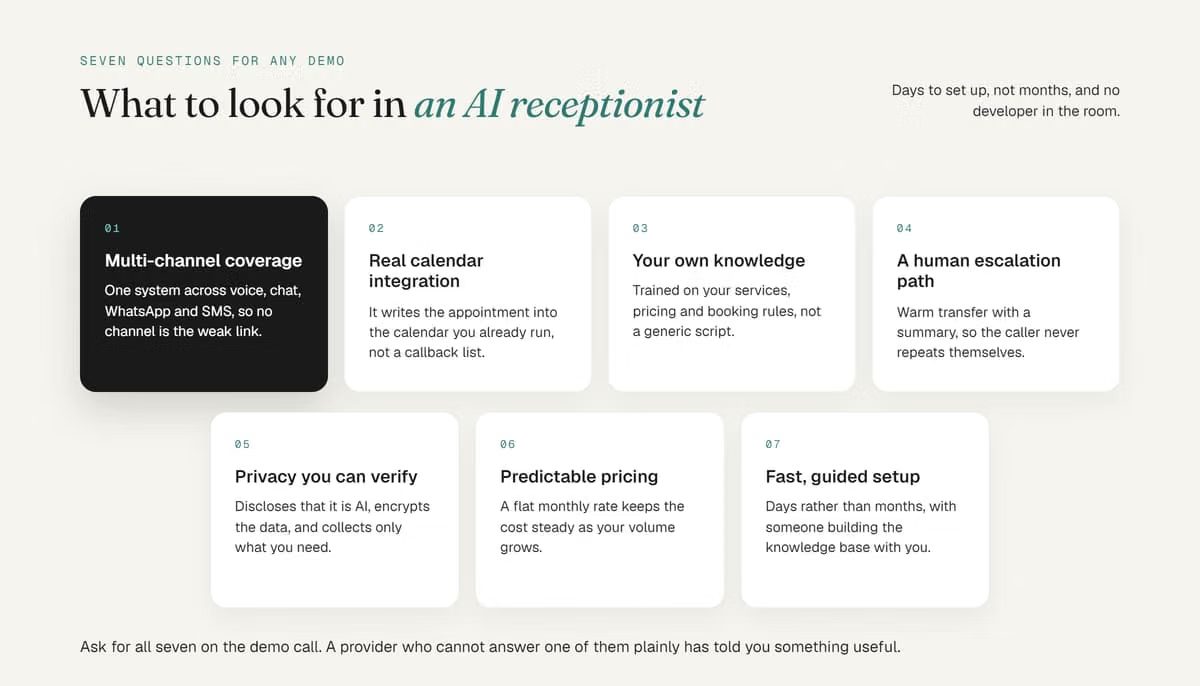
Before comparing brands, set your criteria. These seven checks separate a tool that books work from one that only takes messages.
1. Coverage Across Every Channel
A phone-only tool still leaves website chats, texts and WhatsApp messages unanswered. One system across voice, chat, WhatsApp and SMS means no channel becomes the weak link, and every conversation lands in the same inbox.
2. Real Calendar Booking
The AI should read your live availability and book directly into Google Calendar, Outlook or industry software like Jane App or Mindbody. A tool that only collects "please call me back" requests just moves the work to you.
3. Training on Your Own Business
A dental clinic, a law firm and an HVAC company get completely different questions. The AI should be trained on your services, FAQs, service areas and booking rules, not a generic script.
4. A Clear Human Escalation Path
When a caller needs a person, the AI should brief your team and warm-transfer the call, so the caller never has to repeat the story or hit a dead end.
5. Privacy and Data Handling
Any system that collects a caller's name, phone number, health details or reason for booking handles personal information. Ask whether the provider encrypts data in transit and at rest, limits what it collects, and is honest with callers when asked if they are speaking with an AI.
6. A Bill You Can Predict
Per-minute and per-call charges grow fastest in your busiest months, which is exactly when the receptionist is doing its job. A flat monthly rate or a clear per-customer model is easier to budget against.
7. Fits Into Your Website and Local Search Setup
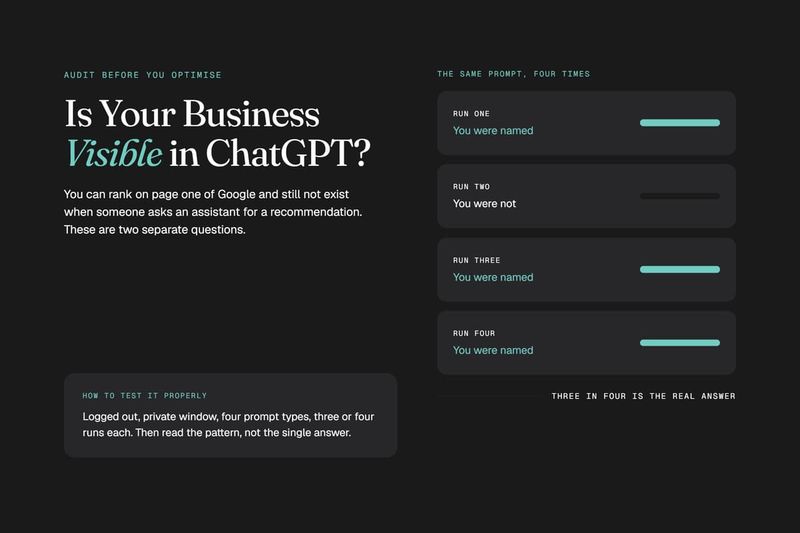
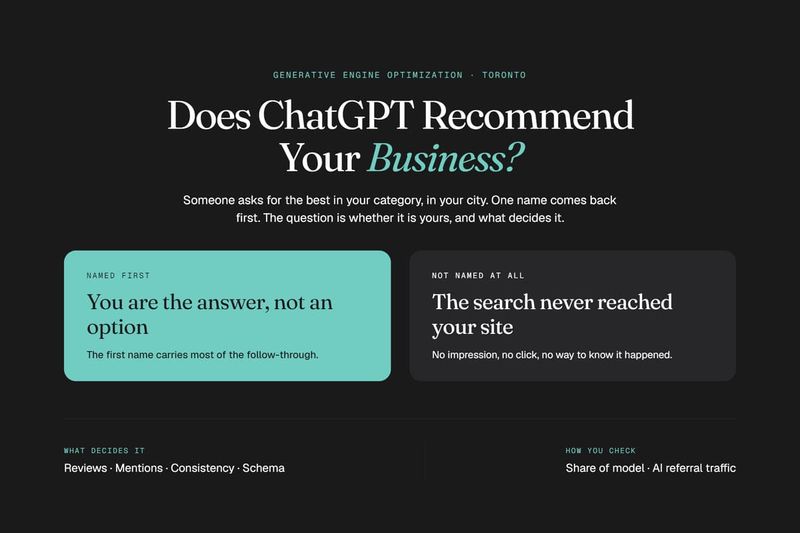
An AI receptionist only works once someone is already calling or messaging you. The chat widget needs a properly built business website to sit on, and getting found in the first place still comes down to local SEO and Map Pack visibility and AI search visibility, since more customers now pick a business from an AI answer rather than a results page. Setup should also be fast: days, not months, with no developer needed.
5 AI Receptionist Options for Small Business, Side by Side
Here is how five well-known options compare on the points above. Patrick is our own product, so we have listed exactly what it does and what it costs, and kept the competitor details to their own published plans.
| Option | Type | Channels | Billing Model | Starting Price | Best For |
|---|---|---|---|---|---|
| 1. Patrick (Mehrana) | AI | Voice, web chat, WhatsApp, SMS | Flat monthly, unlimited calls within fair use | $299/mo founding rate, $499/mo Core | One AI front desk across every channel |
| 2. Smith.ai | AI with live-agent backup | Voice (chat sold separately) | Per call | Free for 25 calls, Pro $150/mo for 75 calls | Calls that sometimes need a live person |
| 3. Goodcall | AI | Voice | Per unique customer, unlimited minutes | $79/mo for 100 unique customers | Phone-only coverage on a steady budget |
| 4. AIRA | AI | Voice | Per call | $24.95/mo for 30 calls | Very low call volume |
| 5. Ruby | Live human receptionists | Voice, chat add-on | Per minute | $250/mo for 50 minutes | A human voice on every call |
Competitor prices are in US dollars as published on each provider's pricing page in October 2026. Plans change often, so confirm current pricing directly before you sign.
1. Patrick by Mehrana: One AI Front Desk for Calls, Chat, WhatsApp and SMS
Patrick is the AI receptionist we built to run our own agency in Toronto before we offered it to clients. It answers voice calls, website chat, WhatsApp and SMS from one system, and it covers every item on the checklist above:
- Answers every call in under 2 seconds, 24 hours a day, including simultaneous calls
- Books directly into Google Calendar, Outlook, Jane App, Mindbody, Acuity or Calendly
- Trained on your services, FAQs and booking rules, which you review and approve before it takes a live call
- Warm-transfers to a teammate with a summary of the conversation, so nothing gets repeated
- Sends a missed-call text-back within 30 seconds if a call ever slips through
- Connects to 30+ business tools, including HubSpot and Salesforce, with no manual data entry
- Encrypts data in transit and at rest, applies HIPAA-aware handling for medical, dental and legal clients, and never sells or shares customer data
- Goes live on all channels within 48 hours with a guided setup team
Pricing: the Core plan is a flat $499 a month covering voice, chat, WhatsApp and SMS, with no per-minute charges and no setup fees. A Founding Partner rate of $299 a month is open to the first 10 businesses and locked for 12 months. Multi-location groups start on Plus from $899 a month. Every plan begins with a 7-day pilot on your real phone line, you pay nothing until day 8, and you can cancel anytime.
In practice: a four-location dental group in the GTA was losing about 30% of inbound calls to voicemail at peak times. After connecting its phone lines, Jane App calendar and website chat to Patrick, it recorded 47% more bookings and zero missed after-hours calls over 90 days, with an estimated $41,000 in annual savings against added staff.
Watch for: Patrick is built for businesses that want full front-desk coverage. If you only get a handful of calls a month and none after hours, a cheaper phone-only tool may be enough.
Want to see Patrick on your own phone line? Start a 7-day pilot and pay nothing until day 8.
2. Smith.ai: AI Answering With Live-Agent Backup
Smith.ai sells an AI-first receptionist that can hand complex calls to North America-based human agents. Its AI plans bill per call: a free tier covers 25 calls a month (then $3 a call), and Pro starts at $150 a month for 75 calls, with overage from $2.50 a call. Its separate human receptionist plans start at $300 a month for 30 calls, and features like appointment booking are billed per call on top.
It is a strong fit for law firms and professional services where some intake calls genuinely need a person. The trade-off is cost at volume: per-call billing climbs fast in a busy month, and the human tier gets expensive quickly.
3. Goodcall: Phone-Only AI on a Predictable Bill
Goodcall is a no-code AI phone agent that bills by unique customer rather than by the minute, so a long booking call costs the same as a short one. Starter is $79 a month for 100 unique customers, Growth is $129 for 500 and Scale is $299 for 2,000, with a local number included and a free demo agent to test first.
It covers the phone only, so website chat, WhatsApp and SMS stay unanswered. Reviews also mention a voice that can feel scripted next to newer conversational platforms. It suits a solo operator with straightforward calls who wants a predictable bill.
4. AIRA: The Lowest-Cost Entry for Low Call Volume
AIRA has one of the lowest entry prices in the category: $24.95 a month for 30 calls, $59.95 for 90 and $159.95 for 300, with per-call overage. Plans include call transfers, a built-in CRM, Zapier connections and support for 31 languages.
At that price, expect a phone-focused tool with fewer native practice-software integrations and less industry-specific setup than platforms built for clinics or law firms. It works for a solo business testing whether an AI receptionist is worth it.
5. Ruby: Live Human Receptionists, Not AI
Ruby is a human virtual receptionist service, and it sells that as the point: live, US-based receptionists on every call. Plans are metered by the minute, starting at $250 a month for 50 minutes and rising to $1,725 for 500 minutes.
At about two minutes per call, the entry plan covers roughly 25 calls a month, so costs rise quickly for a busy business. It is a fit for owners who want a human voice on every call and can absorb the price.
Matching an AI Receptionist to Your Type of Business
Find the row that sounds like your front desk.
| Your Situation | What Matters Most | Start With |
|---|---|---|
| Trades or home services, calls come in while you are on a job | 24/7 answering, emergency routing, booking from the call | Patrick |
| Clinic or practice with leads on phone, chat and WhatsApp | Multi-channel coverage, practice software booking, privacy handling | Patrick |
| Law firm with sensitive intake on many calls | Human backup for complex calls | Smith.ai, or Patrick with warm transfer |
| Solo operator, simple calls, phone only | Low monthly cost, quick setup | Goodcall or AIRA |
| Every call must reach a live person | Human receptionists | Ruby |
| Several locations or a franchise | Multi-location routing, CRM integration | Patrick Plus |
AI Receptionist Use Cases by Industry
The job an AI receptionist does changes with the industry. Here is what it typically handles in the sectors we work with most.
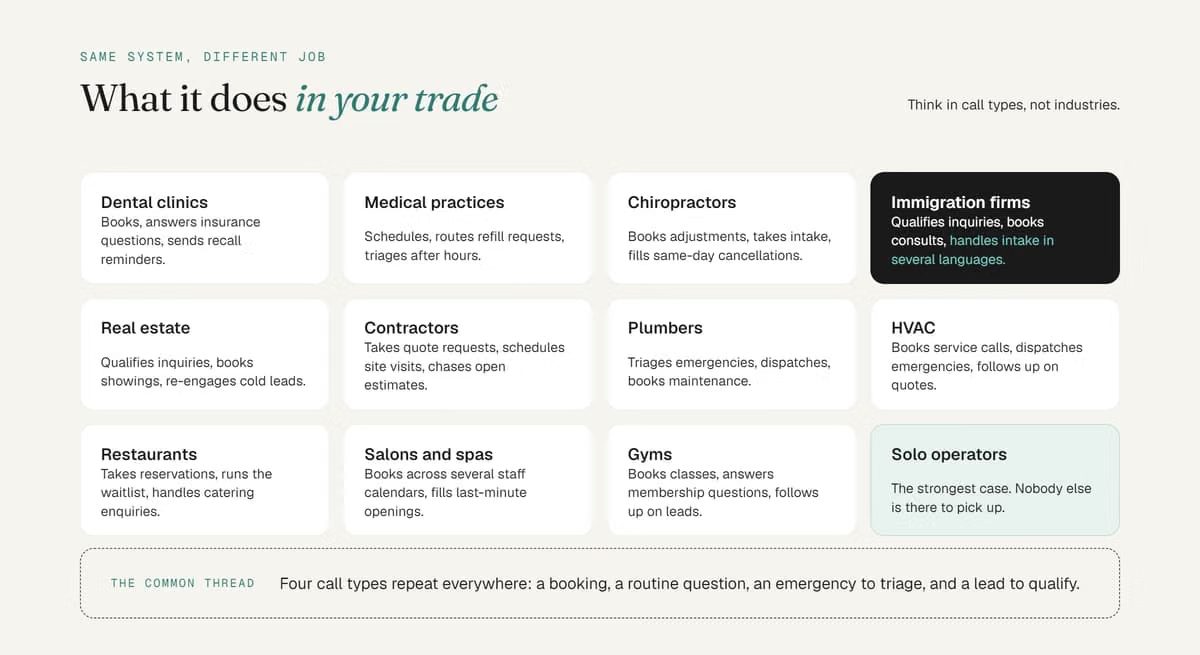
AI Receptionist for Dental Clinics books hygiene and treatment appointments, answers insurance questions and sends recall reminders, so no one has to step away from a patient to answer the phone. For a dental-specific shortlist, see our dental AI receptionist comparison.
AI Receptionist for Medical Practices schedules appointments, routes prescription refill requests and handles after-hours triage, keeping front-desk staff on in-clinic care.
AI Receptionist for Chiropractors books new patient consultations and recurring adjustments, collects insurance details and fills same-day cancellations.
AI Receptionist for Law Firms qualifies new inquiries by practice area, schedules consultations and captures case details before the first call with a lawyer.
AI Receptionist for Immigration Firms qualifies visa and permit inquiries, books consultations and handles multilingual intake around the clock.
AI Receptionist for Real Estate qualifies buyer and seller inquiries, books showing requests and re-engages leads that went cold.
AI Receptionist for Contractors handles quote requests, schedules site visits and follows up on open estimates, so a slow callback never hands the job to a competitor.
AI Receptionist for Plumbers triages burst pipes and no-hot-water calls outside business hours, dispatches the on-call technician and books routine maintenance.
AI Receptionist for HVAC books service calls, dispatches emergency technicians during peak season and follows up on open quotes.
AI Receptionist for Restaurants takes reservations, manages waitlists, handles catering inquiries and answers menu or hours questions during the rush.
AI Receptionist for Salons and Spas books across multiple staff calendars, handles cancellations and fills last-minute openings from a waitlist.
AI Receptionist for Veterinary Clinics books wellness exams and grooming appointments, with after-hours emergency routing for pet owners.
AI Receptionist for Gyms converts membership inquiries, books free trials and answers class schedule questions at any hour.
AI Receptionist Pricing Models and What They Mean for Your Bill
The sticker price matters less than how a tool bills. There are four common models:
- Per minute: common with live receptionist services like Ruby. Long calls and busy months push the bill up fast.
- Per call: used by Smith.ai and AIRA. Predictable at low volume, but every new lead your marketing brings in moves you up the meter.
- Per unique customer: Goodcall's model. Repeat calls from the same person count once a month, which smooths out the bill.
- Flat monthly: Patrick's model. The bill is the same in a record month as in a slow one, so the receptionist never costs more for doing more work.
Weigh any of these against two numbers: what a missed booking is worth to you, and what a part-time or full-time hire would cost. Then check the overage rate, the cancellation terms and whether there is a trial on your real phone line before you commit.
Setting Up Patrick in 48 Hours: What the First Week Looks Like
Setup should not pull a small business owner off the tools for weeks. With Patrick, it runs in four steps:
- Connect your channels. Forward your existing number, add the chat widget to your site and link WhatsApp. Guided setup takes under 20 minutes, and customers keep dialling the number they already know.
- Train it on your business. Your services, FAQs, service areas and booking rules are loaded in, and you review and approve the answers before anything goes live.
- Go live. Once you approve the training, Patrick starts answering on every channel with a human escalation path already in place.
- Monitor and adjust. Every call, booking and lead appears in your Patrick OS dashboard in real time, and responses get tuned as your business changes.
During the 7-day pilot, the useful test is simple: count booked appointments, not answered calls, and listen to a few transcripts from your busiest day.
Where an AI Front Desk Still Needs a Human
AI receptionists are good and getting better, but they are not a full replacement for judgment. Being clear about the limits is how you avoid a bad first month.
Unusual calls need a fallback. Routine questions and bookings are handled well. An angry customer, a complex complaint or a question nobody anticipated is where a warm transfer to a person matters, so set that path up before launch.
Some callers want a person. For a high-value first consultation or a sensitive matter, some callers will ask for a human. Routing those calls to your team is a strength of the setup, not a failure.
Setup quality decides accuracy. An AI trained on your real services, terminology and booking rules performs far better than a rushed configuration. Review transcripts in the first few weeks and correct anything it gets wrong.
Privacy obligations stay with you. In Canada, collecting a caller's details falls under PIPEDA's requirements for businesses or the provincial equivalent. Choose a provider that encrypts data, limits collection to what you need and will not sell or share it.
Choosing the Right AI Receptionist for Your Small Business
An AI receptionist is no longer an experiment for small businesses. Customers expect an instant response, and the businesses that answer first win the work. Compare the five options above against your channels, your call volume and how your bill should behave in a busy month. If you want every call, chat, WhatsApp message and text handled by one system on a flat rate, Patrick was built for exactly that.
If you are building this alongside a wider SEO and marketing plan, get in touch and we can map out how more calls and better call handling fit together.
Ready to stop sending customers to voicemail? Patrick can be live on your phone, chat, WhatsApp and SMS within 48 hours.
FAQ
Frequently asked questions
What Is the Best AI Receptionist for a Small Business?
It depends on your channels, call volume and budget. For most small businesses that want one system across voice, chat, WhatsApp and SMS with calendar booking and a flat monthly bill, Patrick is the strongest all-round option. Smith.ai fits when some calls need a live agent, Goodcall and AIRA cover phone-only needs at a low price, and Ruby is the choice if every call must reach a human.
How Much Does an AI Receptionist Cost a Small Business?
Entry-level phone-only AI plans start around $25 to $80 a month in US dollars, usually with call or customer limits. Full multi-channel coverage costs more: Patrick's Core plan is a flat $499 a month, with a $299 founding rate for the first 10 businesses. Live human receptionist services start around $250 a month for 50 minutes. A full-time receptionist in Toronto typically costs $42,000 to $55,000 a year.
Is an AI Receptionist Better Than a Human Receptionist?
Each has strengths. A human receptionist brings judgment and warmth but works set hours and handles one call at a time. An AI receptionist answers every call at once, around the clock, and books directly into your calendar. Many small businesses use AI for after-hours, overflow and routine calls and keep a person for complex conversations.
Is an AI Receptionist Worth It for a Solo Business?
Usually, yes. A solo operator is the person most likely to miss calls, because there is no one else to answer while you are with a client or on a job. If an AI receptionist saves even one booking a month, it often covers its own cost.
Can I Keep My Existing Business Phone Number?
Yes. Setup normally means forwarding your current number to the AI, so customers keep dialling the number they already know. With Patrick, your website chat and WhatsApp Business account are connected in the same setup.
Can an AI Receptionist Handle More Than One Call at a Time?
Yes, and this is one of the clearest advantages over a single front-desk person. An AI receptionist can hold several conversations across phone, chat, WhatsApp and SMS at once, so a busy morning does not push callers to voicemail.
Will Customers Know They Are Talking to an AI?
Many callers do not notice on routine calls, because modern voices sound natural and reply in seconds. Patrick is configured with your business name and tone, and it always answers honestly if a caller asks whether it is an AI.
What Happens If the AI Cannot Answer a Question?
A good AI receptionist escalates instead of guessing. Patrick follows a backup path set before launch: a live warm transfer, a notification to your team, or an offer for the caller to request a callback.
Do I Need a Long-Term Contract?
Not with most AI receptionist plans. Patrick has no long-term contract, starts with a 7-day pilot at $0 until day 8, and can be cancelled anytime. Check each provider's cancellation terms before you sign.
Will an AI Receptionist Replace My Front Desk Staff?
Not necessarily. Most small businesses use it to cover after-hours calls, overflow and routine questions, which frees existing staff for in-person work. Some solo operators use it as their only front desk.
Discussion