
9 Best AI Receptionist Software Platforms for 2026
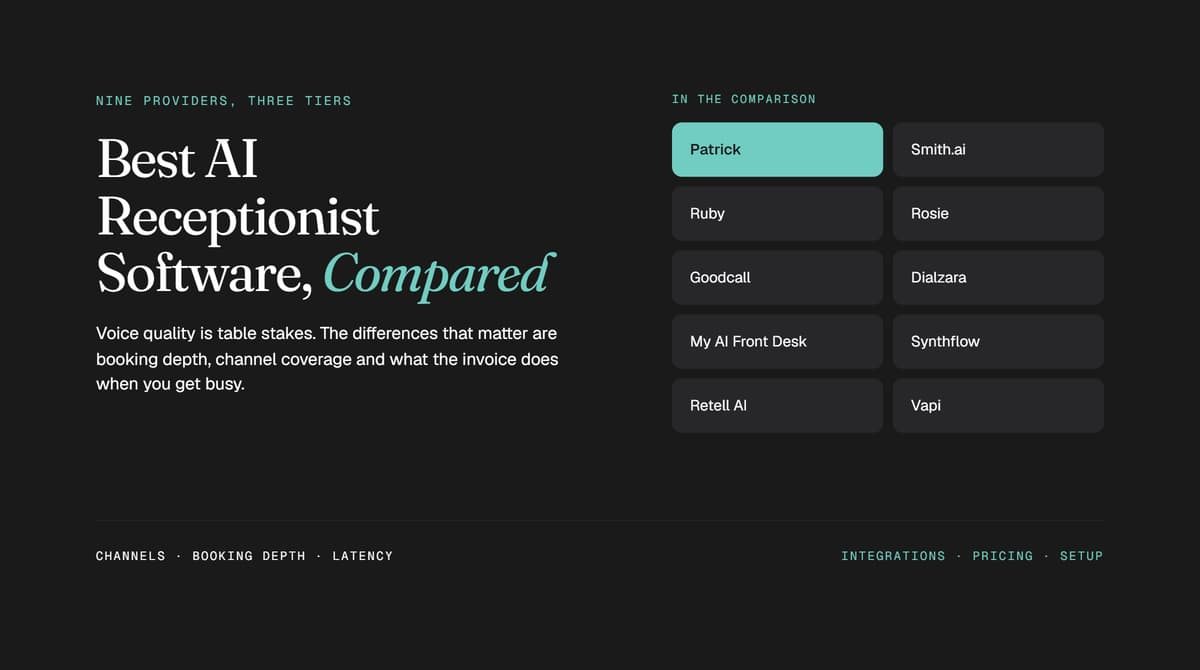
Choosing the best AI receptionist software in 2026 is harder than it was a year ago, and not because the technology got worse. It got better, and the category split into three very different kinds of products that all use the same name. One provider sells you a managed AI receptionist that runs your front desk. Another sells you an app you configure yourself over a weekend. A third sells you raw voice infrastructure and expects you to build the receptionist on top of it.
This guide compares nine AI receptionist providers across all three tiers, with each vendor's published pricing, the trade-offs we see in practice, and a test script to run before you sign. If you are still deciding whether you need one at all, start with what an AI receptionist is and how it works, then come back here to compare providers.
AI Receptionist Software at a Glance: 9 Providers Compared
| # | Provider | Tier | Best for | Pricing model | Starting price | Channels |
|---|---|---|---|---|---|---|
| 1 | Patrick (Mehrana) | Managed | One managed front desk across every channel | Flat monthly | $299/mo founding rate, $499/mo Core | Voice, chat, WhatsApp, SMS |
| 2 | Smith.ai | Managed hybrid | Firms that want human agents behind the AI | Per call | Free for 25 calls, then $3/call | Voice, chat |
| 3 | Goodcall | Self-serve | Simple, repetitive inbound calls | Per unique caller | $79/mo for 100 callers | Voice |
| 4 | Rosie | Self-serve | Trades and home services on a tight budget | Minute bundles | $49/mo for 250 minutes | Voice |
| 5 | My AI Front Desk | Self-serve | Low-volume local businesses wanting a bundle | Flat monthly plus credits | $99/mo, or $79/mo billed yearly | Voice, chat, SMS |
| 6 | Dialzara | Self-serve | Very low call volume, entry budget | Minute bundles plus overage | $29/mo for 60 minutes | Voice |
| 7 | Synthflow | Enterprise voice AI | Contact centres with large call volume | Annual contract | Quote only | Voice |
| 8 | Retell AI and Vapi | Developer platform | Teams with engineers building custom flows | Per minute, usage-based | Retell from $0.07/min; Vapi $0.05/min hosting plus components | Voice (Retell also chat) |
| 9 | Ruby | Human service | Businesses that specifically do not want AI | Minute bundles | $250/mo for 50 minutes | Voice, chat add-on |
Source: each vendor's public pricing page, checked November 10, 2026. Competitor prices are in USD. Patrick pricing is from Mehrana's AI receptionist pricing page. Pricing in this category changes often, so confirm current rates directly with each provider before you buy.
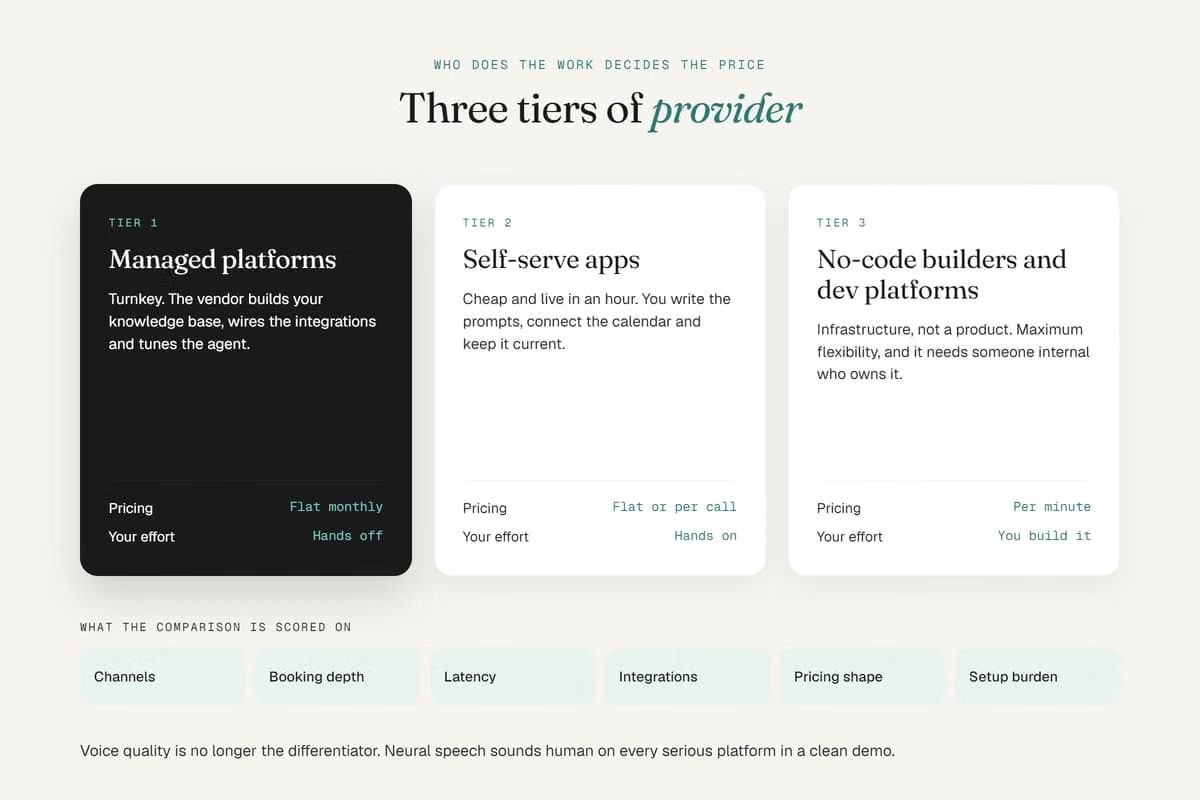
Three Types of AI Receptionist Software: Managed, Self-Serve and Voice AI Platforms
Before comparing individual tools, understand which shelf you are pulling from. Most buyer regret in this category comes from picking the right product on the wrong shelf.
Tier 1: Managed AI receptionist platforms. Someone else builds your knowledge base, connects your calendar and CRM, configures escalation rules, and keeps tuning it after launch. You get a working front desk, not a builder. Pricing is usually flat monthly or per call. This is where a business that wants an outcome rather than a project should be shopping.
Tier 2: Self-serve AI receptionist apps. You sign up, paste in your business hours and services, forward your number, and go live the same afternoon. Cheap and fast. The ceiling is lower: shallow integrations, limited industry logic, and support that is mostly documentation. Good for a solo operator with simple calls. Our guide to AI receptionists for small business goes deeper on this tier for owner-operated shops.
Tier 3: Voice AI platforms and builders. These are toolkits, not receptionists. Retell AI, Vapi and Synthflow sell you the speech pipeline and a place to design conversation flows. You supply the prompts, the integrations, the testing and the ongoing maintenance, or you pay for an enterprise deployment. Powerful, but you are now running a software project.
Comparing a Tier 1 platform against a Tier 3 per-minute rate is comparing a finished kitchen against a pile of lumber. Both are legitimate purchases, not competing offers.
How We Ranked Each AI Front Desk Platform
Every provider below was assessed on the same six criteria:
- Channel coverage. Phone only, or voice plus web chat, WhatsApp and SMS from one system. Most tools in this category are still voice only.
- Booking depth. Does it read live calendar availability and confirm the appointment, or does it collect a callback request and call that a booking? This is the single biggest quality gap in the category.
- Voice realism and interruption handling. Response speed, how the agent behaves when a caller talks over it, and whether it recovers when the conversation leaves the script.
- Integration reach. Native connections to CRMs and industry scheduling software versus Zapier-only connections that break quietly.
- Pricing predictability. Flat monthly, per minute, per call, or per unique caller. Each behaves very differently in a busy month.
- Setup burden. Days with a guided team, or weeks of your own configuration time.
Nothing on this list is a paid placement. Patrick is our own product and we say so plainly wherever it appears.
The 9 Best AI Receptionist Software Tools, Reviewed
1. Patrick by Mehrana: Best Managed Omnichannel AI Receptionist
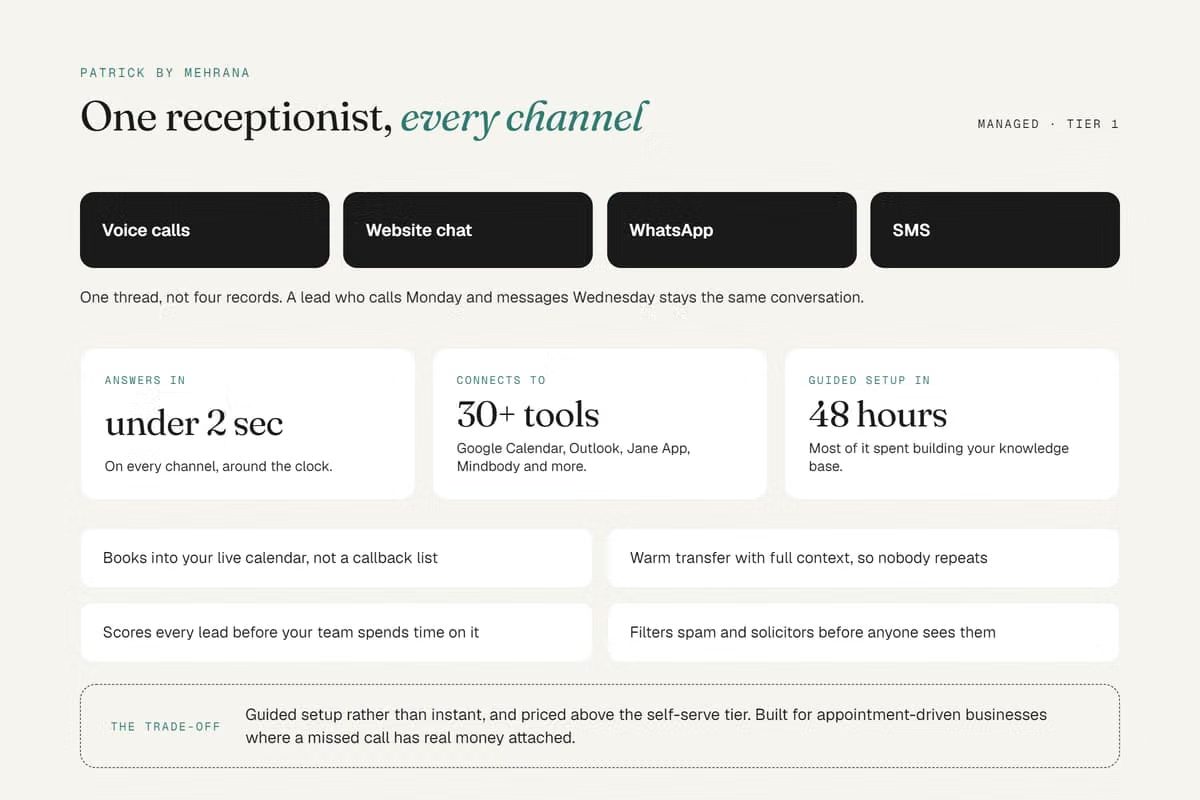
Patrick is our own AI receptionist. We built it to run Mehrana before we ever sold it to a client, which meant it had to work across every channel our own leads actually used, not just the phone. Most providers answer calls. Patrick answers voice calls, website chat, WhatsApp and SMS from one system, with every conversation landing in a single thread per lead. A prospect who calls on Monday and texts on Wednesday is one conversation, not two disconnected records.
What it does:
- Answers in under two seconds across all four channels, around the clock
- Reads live availability and books directly into Google Calendar, Outlook, Jane App or Mindbody, rather than taking a callback request
- Runs on a knowledge base built from your real services, FAQs and booking rules, reviewed and approved by you before it takes a live call
- Warm-transfers to a human with full context when a conversation needs one, so the caller never repeats themselves
- Scores every lead hot, warm or cold and filters spam before it reaches your team
- Connects to 30+ tools including HubSpot, Salesforce, Jane App and Mindbody
- Handles multilingual calls as standard, including callers who switch languages mid-sentence
Pricing. Flat monthly with no per-minute charges, no setup fees and no long-term contract. Core is $499/month, the Founding Partner rate is $299/month locked for 12 months, and multi-location Plus starts from $899/month. Every plan starts with a 7-day pilot on your real phone line.
The trade-off, stated honestly. Patrick is not the cheapest option on this page and it is not self-serve. Setup is guided by our team over roughly 48 hours because the knowledge base and escalation rules get built properly rather than pasted in. If your call volume is a handful of simple questions a week, a $29 self-serve app will serve you fine and we will tell you so on the call. Patrick earns its price when missing a call actually costs you something: a dental chair, a legal consult, an emergency HVAC job.
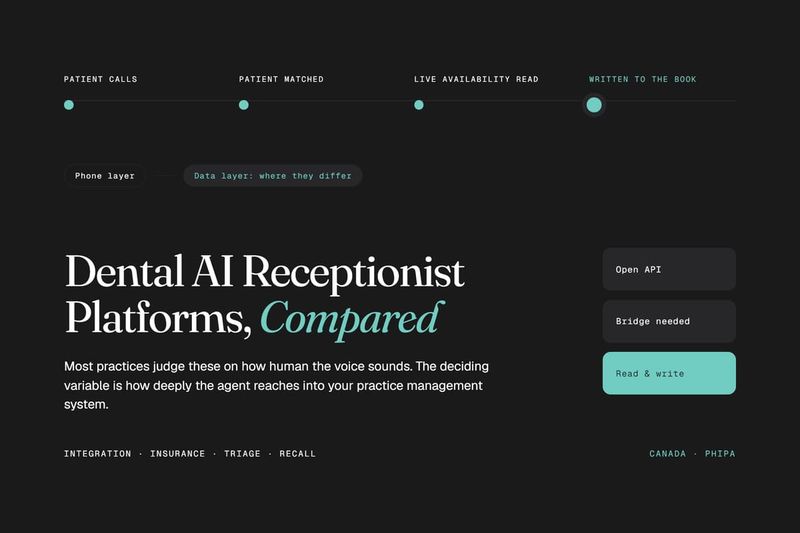
Where it is strongest. Regulated and appointment-driven industries. We apply HIPAA-aware data handling for medical and dental clients, practice-area qualification logic for law firms, and emergency dispatch routing for HVAC and trades. Dental practices comparing options can also see our breakdown of the best dental AI receptionist platforms.
Hear how Patrick handles a real call before you read any further.
2. Smith.ai: Per-Call AI Answering With Human Backup
Smith.ai is the strongest established option for firms that want people behind the AI. Its AI plans are priced per real call: a free tier covers 25 calls a month and then charges $3 per call, Pro starts at $150/month for 75 calls, and Enterprise starts at $500/month for 300 calls. Human receptionist plans are sold separately on their own pricing page.
Best for:
law firms and professional services where some calls need a trained human.
Watch for:
per-call billing rises with every campaign that works, and it covers voice and chat rather than WhatsApp or SMS.
3. Goodcall: Phone AI Billed per Unique Caller
Goodcall bills by unique customer, counted as one phone number per month, rather than by minute. Starter is $79/month for 100 customers, Growth is $129/month for 500, and Scale is $299/month for 2,000. Spam and wrong numbers do not count toward the limit.
Best for:
solo operators with simple, repetitive phone questions.
Watch for:
it is phone only, and a successful marketing push adds new callers to your bill.
4. Rosie: Low-Cost Minute Plans for Trades
Rosie sells minute bundles: $49/month for 250 minutes, $149/month for 1,000 minutes, and $299/month for 2,000 minutes, with a 7-day free trial. Setup is fast and the entry price is one of the lowest on this list.
Best for:
trades and home service businesses on a tight budget.
Watch for:
its pricing page does not state the overage rate, so ask before a busy season.
5. My AI Front Desk: Voice, Chat and SMS in One Bundle
My AI Front Desk bundles 200 voice minutes, 100 chatbot conversations and 400 SMS for $99/month, or $79/month billed yearly, with a 7-day trial. Usage above the bundle is paid in credits, with voice costing 25 credits per minute.
Best for:
low-volume local businesses that want more than phone in one self-serve app.
Watch for:
the credit system makes a busy month harder to predict than a flat rate.
6. Dialzara: Entry Pricing for Low Call Volume
Dialzara starts at $29/month for 60 minutes, with overage at $0.48 per minute. Higher plans run from $99/month for 220 minutes up to $349/month for 1,000 minutes, all with a 7-day trial and no setup fee.
Best for:
very low call volume on an entry budget.
Watch for:
60 minutes is roughly a few calls a day, and per-minute overage adds up quickly once you pass it.
7. Synthflow: Enterprise Voice AI Under Annual Contract
Synthflow used to be the go-to no-code builder for small teams. Its pricing page now says it is sold as an annual enterprise agreement scoped to your call volume, phone system and integrations, with no free plan, no trial and no per-minute rate.
Best for:
contact centres with large, steady call volume and an internal owner for the project.
Watch for:
it is no longer a fit for a single-location business shopping on a monthly budget.
8. Retell AI and Vapi: Developer Voice Infrastructure
Retell AI and Vapi are the platforms engineers use to build voice agents from components. Retell advertises voice agents from $0.07 to $0.31 per minute with no platform fee and $10 in free credits, but the final rate depends on the language model, voice and telephony you pick, plus add-ons such as knowledge base access or PII removal. Vapi charges $0.05 per minute for hosting, then bills transcription, the language model, the voice and telephony separately. Its HIPAA compliance add-on is listed at $2,000/month.
Best for:
teams with developers who want full control over prompts and call flows.
Watch for:
the headline per-minute figure is never the full cost, and engineering time is not on the invoice at all.
9. Ruby: Live Human Receptionists as the Benchmark
Ruby is not AI. It is a live virtual receptionist service, included here because it is what many businesses compare AI against. Plans run from $250/month for 50 minutes to $1,725/month for 500 minutes, with live chat from $143/month for 10 chats.
Best for:
businesses that specifically want a person on every call.
Watch for:
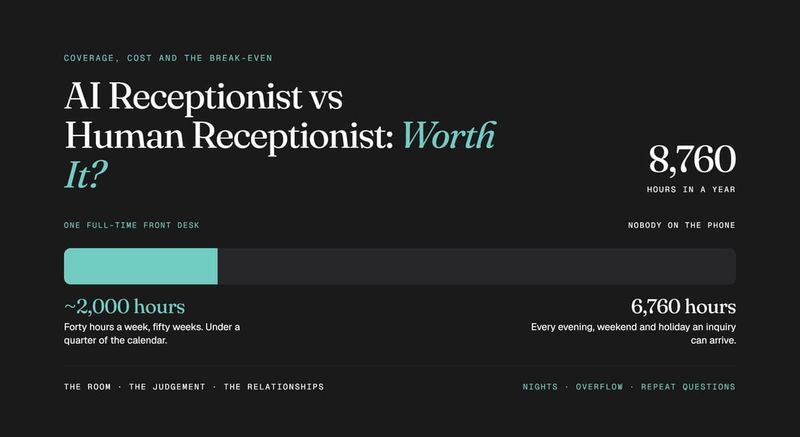
50 minutes disappears fast, and coverage costs climb steeply with volume. For the full cost comparison, see AI receptionist vs human receptionist.
What Separates a Realistic AI Receptionist Voice From a Robotic One
Raw voice quality has largely converged. Nearly every serious platform now sounds convincingly human in a clean demo. What still separates good from bad is everything around the voice:
- Time to first word. A near-instant reply sounds like a person. A two-second pause sounds like a machine thinking, and callers start talking over it.
- Interruption handling. A strong agent stops talking, listens, and adapts. A weak one finishes its sentence, the most obvious tell that the caller is not speaking to a human.
- Off-script recovery. "Sorry, what was that?" or "actually, different question" is where many agents fall apart, and it never shows up in a scripted demo.
- Disclosure behaviour. An agent that discloses honestly when asked, then keeps being useful, outperforms one that tries to pass as human and gets caught.
Common AI Receptionist Software Complaints From Business Owners
Owners are often far less impressed than vendor pages suggest. The recurring complaints cluster into four:
- Invoices do not match the advertised rate. Usage-based platforms list a headline per-minute rate, then bill the language model, voice, telephony, phone numbers and add-ons as separate lines. Retell's and Vapi's own pricing pages show this structure.
- Per-call and per-caller models punish success. A marketing campaign that drives call volume also drives your receptionist bill straight up, which is a perverse outcome for the businesses working hardest to grow.
- The agent handles the happy path only. Fine on "what are your hours." Lost on "I called yesterday about my daughter's appointment and someone said they'd call back."
- Nobody tuned it after launch. A self-serve tool configured once in an afternoon and never revisited degrades as the business changes. This is the strongest argument for a managed platform over a cheaper self-serve one.
Still, for most businesses the real comparison is not AI versus a perfect human front desk. It is AI versus voicemail.
Compliance Checks for Healthcare, Legal and Canadian Businesses
If your calls carry health, legal or financial details, compliance narrows the list before features do. Canadian businesses handling personal information in commercial activity fall under PIPEDA, which is built on principles such as consent, limiting collection and safeguards. US healthcare providers need a vendor willing to sign a HIPAA business associate agreement.
Ask every provider on your shortlist, in writing:
- Does the agent disclose that it is AI when asked?
- Is data encrypted in transit and at rest, and where is it stored?
- Can intake be limited to the minimum information needed to book?
- Is compliance included in the plan, or sold as an add-on?
Treat any provider that cannot answer specifically as a no.
How to Test AI Receptionist Software Before You Sign
Every provider will give you a polished demo. Run your own instead. Call the demo line and do these six things:
- Interrupt it mid-sentence with a different question and see whether it adapts or finishes its script.
- Ask something specific to your business, like a service you offer that a generic script would not know.
- Ask for a time you know is unavailable and see whether it checks real availability or invents a slot.
- Change your mind halfway through a booking. Weak agents cannot back out of a flow.
- Ask it directly whether it is a human. Note exactly what it says.
- Call after hours, on a weekend, when a real prospect actually would.
Then ask: what happens in month three when your services change? If the answer is "you update it yourself in the dashboard," you have bought a tool. If a person reviews real call data and tunes the agent, you have bought a service.
Run all six tests on Patrick right now, and try switching languages mid-call.
Matching AI Receptionist Software to Your Call Volume
The best AI receptionist software in 2026 is the one matched to the right tier. A solo operator taking twenty simple calls a week does not need a managed platform. A four-location clinic with insurance questions, multi-practitioner scheduling and compliance obligations will not be served by a $29 app, no matter how good the demo sounded.
Work backwards from what a missed call costs you. If that number is small, buy cheap and self-serve. If it is large, buy the tier where someone is accountable for the outcome.
Answering the phone is only half the equation. If inbound volume itself is the problem, local SEO and AI search visibility are the other half.
ell us your call volume and we will map a managed front desk against it before you spend anything.
FAQ
Frequently asked questions
Which AI receptionist software is best overall in 2026?
For businesses that want one managed system across voice, chat, WhatsApp and SMS with real booking depth and industry-specific compliance, Patrick is our pick, and we build it, so weigh that accordingly. For firms needing human agents on select calls, Smith.ai is the strongest established option. For a solo operator with simple phone-only needs, a budget self-serve tool like Rosie or Goodcall is enough.
What is the difference between AI receptionist software and an AI voice platform?
AI receptionist software is a finished product configured for your business. An AI voice platform like Retell AI or Vapi is infrastructure you build a receptionist on top of. The platforms advertise lower per-minute rates because you supply everything else, including the engineering time.
What is the cheapest AI receptionist software on this list?
Dialzara starts at $29/month for 60 minutes and Rosie at $49/month for 250 minutes. Smith.ai has a free tier for 25 calls a month. The cheapest plan is only cheap while your volume stays inside its allowance.
How many AI receptionist companies are worth comparing?
Shortlist three, and make sure all three are in the same tier. Comparing a managed platform against a per-minute developer tool produces a meaningless spreadsheet.
Can I switch AI receptionist providers later?
Usually, if you avoid long contracts. What does not transfer is the knowledge base, escalation logic and tuning, so expect to rebuild that. This is the main reason to avoid annual commitments on your first deployment.
Discussion