
AI Receptionist vs Human Receptionist: Is It Worth It in 2026?
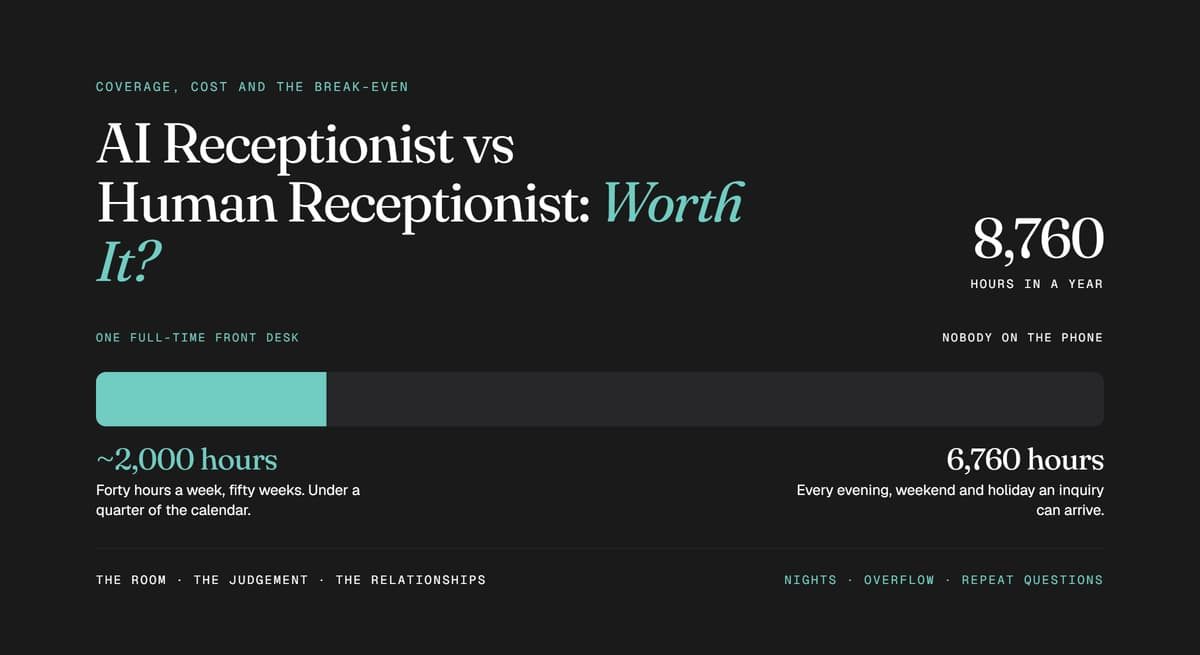
An AI receptionist costs a flat monthly fee, answers every call in under two seconds, covers all 8,760 hours in a year, and handles unlimited calls at once. A human receptionist costs $48,000 to $58,000 fully loaded in Toronto, covers roughly 2,000 of those hours, and takes one call at a time. On coverage and cost, this is not a close comparison. On judgement, empathy and in-person work, the human still wins outright.
Which means the real question is not which one is better. It is which parts of a front desk you are actually buying. This guide compares all three options on the table, AI receptionist, in-house human, and virtual receptionist, and gives you the break-even math to decide whether the switch is worth it for your specific business.
The Three Options, Defined
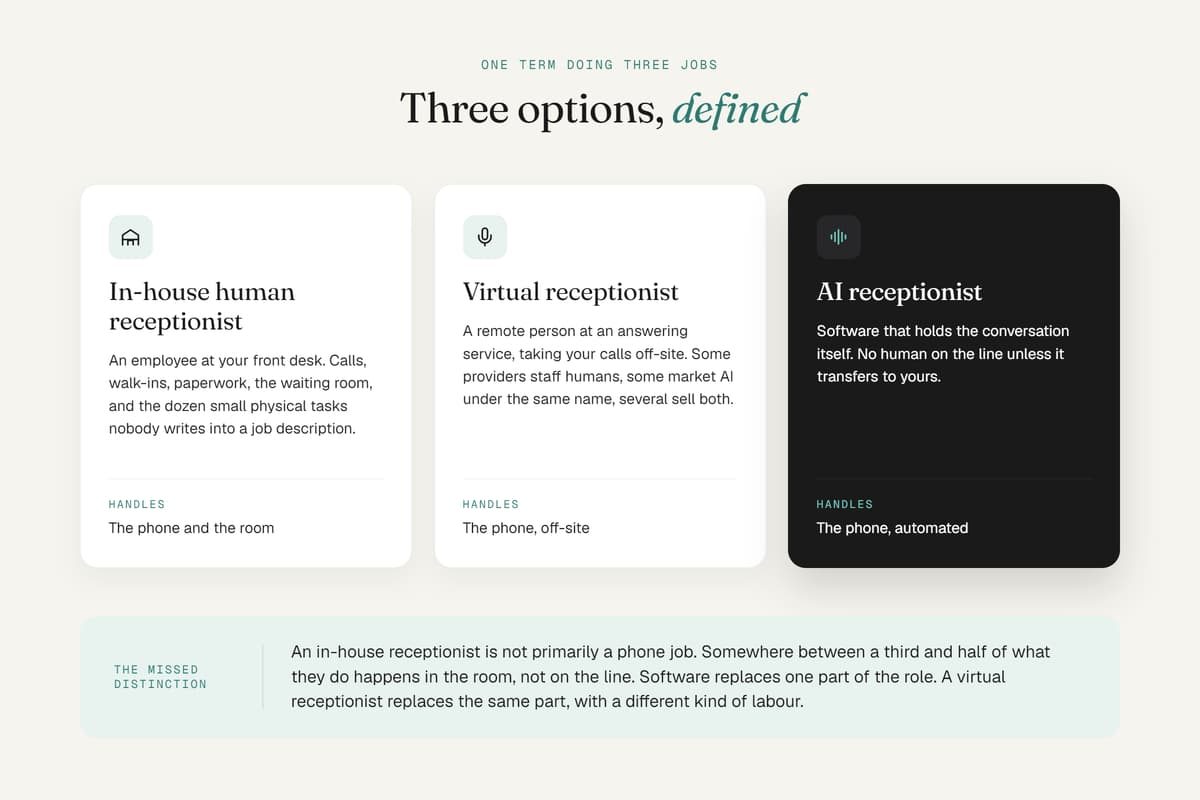
Most confusion in this decision comes from one term doing three jobs.
In-house human receptionist. An employee at your front desk. Answers calls, greets walk-ins, handles paperwork, manages the waiting room, and does the dozen small physical tasks nobody writes into a job description.
Virtual receptionist. A remote person, usually employed by an answering service, who takes your calls off-site. This is where the term gets slippery, and it matters: some virtual receptionist providers staff real humans, some now market AI as a virtual receptionist, and several sell both from the same website. If you are comparing quotes, establish which one you are being sold before anything else.
AI receptionist. Software that holds the conversation itself. No human on the line unless it transfers to yours.
The distinction people miss is that an in-house receptionist is not primarily a phone job. Somewhere between a third and half of what they do happens in the room, not on the line. Replacing that person with software replaces one part of the role. Replacing them with a virtual receptionist replaces the same part, just with a different kind of labour.
AI Receptionist vs Human Receptionist: Head to Head
| AI receptionist | In-house human | Virtual receptionist (human) | |
|---|---|---|---|
| Hours covered | 8,760 per year | ~2,000 per year | Varies, often extended but rarely 24/7 |
| Simultaneous calls | Unlimited | One | Limited by staffing |
| Answer speed | Under 2 seconds | Varies, worse when busy | Usually fast, queues at peak |
| Cost structure | Flat monthly | Salary plus 20% loading | Per minute or per call |
| Cost predictability | High | High | Low, scales with volume |
| Books into live calendar | Yes | Yes | Sometimes, depends on provider |
| Handles walk-ins | No | Yes | No |
| Emotional judgement | Limited | Strong | Moderate |
| Knows your business deeply | As configured | Deeply, over time | Shallow, reads a script |
| Sick days, vacation, turnover | None | Yes | Absorbed by provider |
| Languages | Many, simultaneously | One or two | Depends on staffing |
| Consistency across calls | Identical every time | Varies by day | Varies by agent |
Two rows carry most of the weight.
Hours. A full-time employee working 40 hours a week for 50 weeks covers about 2,000 hours. A year contains 8,760. That is under 23% coverage, and the missing 77% includes every evening, weekend and holiday, which is exactly when a meaningful share of inquiries arrive.
Simultaneous calls. One person handles one conversation. When three people call during a busy Tuesday morning, two of them hear ringing or voicemail. This is not a performance problem. It is arithmetic, and no amount of good hiring fixes it.
The Real Cost Comparison
Salary is not the cost of an employee. Here is what a full-time front desk actually costs in Toronto in 2026.
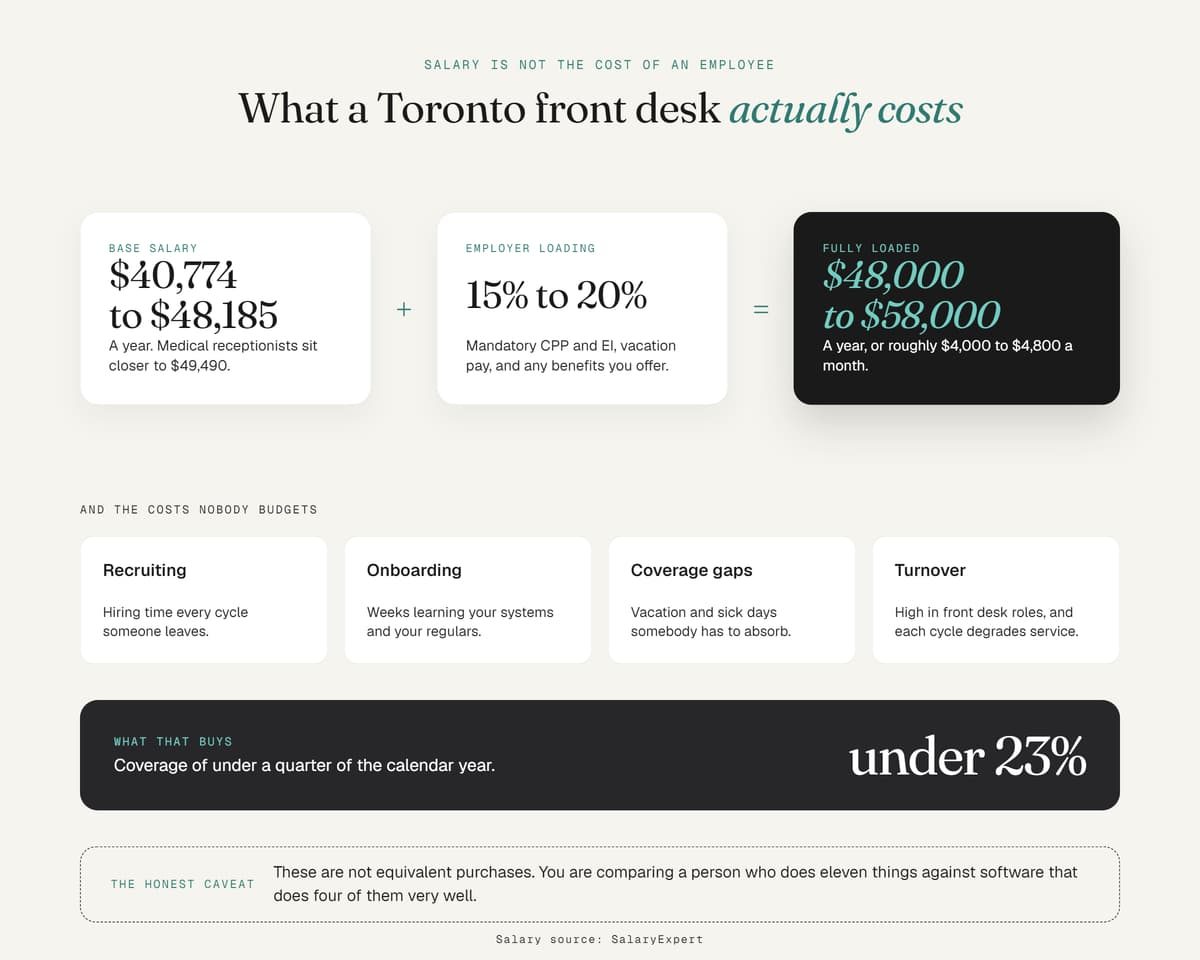
Base salary. Independent salary data puts a Toronto receptionist between roughly $40,774 and $48,185 a year, with medical receptionists closer to $49,490. SalaryExpert + 2
Employer loading. Add mandatory CPP and EI contributions, vacation pay, and any benefits. Depending on what you offer, this typically adds 15% to 20%.
Fully loaded, that lands between roughly $48,000 and $58,000 a year, or $4,000 to $4,800 a month, for coverage of under a quarter of the calendar.
The costs nobody budgets. Recruiting and onboarding time when someone leaves. Coverage during vacation and sick days. Training a replacement on your systems and your regulars. Turnover in front desk roles is high, and each cycle costs weeks of degraded service.
Against that: an AI receptionist on a flat monthly plan typically runs a fraction of the monthly cost of an employee, with no loading, no turnover, and full-calendar coverage. For exact figures across providers, see our AI receptionist pricing breakdown.
The honest caveat. These are not equivalent purchases. You are comparing a person who does eleven things against software that does four of them very well. The comparison only holds if those four are the ones costing you money.
AI Receptionist vs Virtual Receptionist
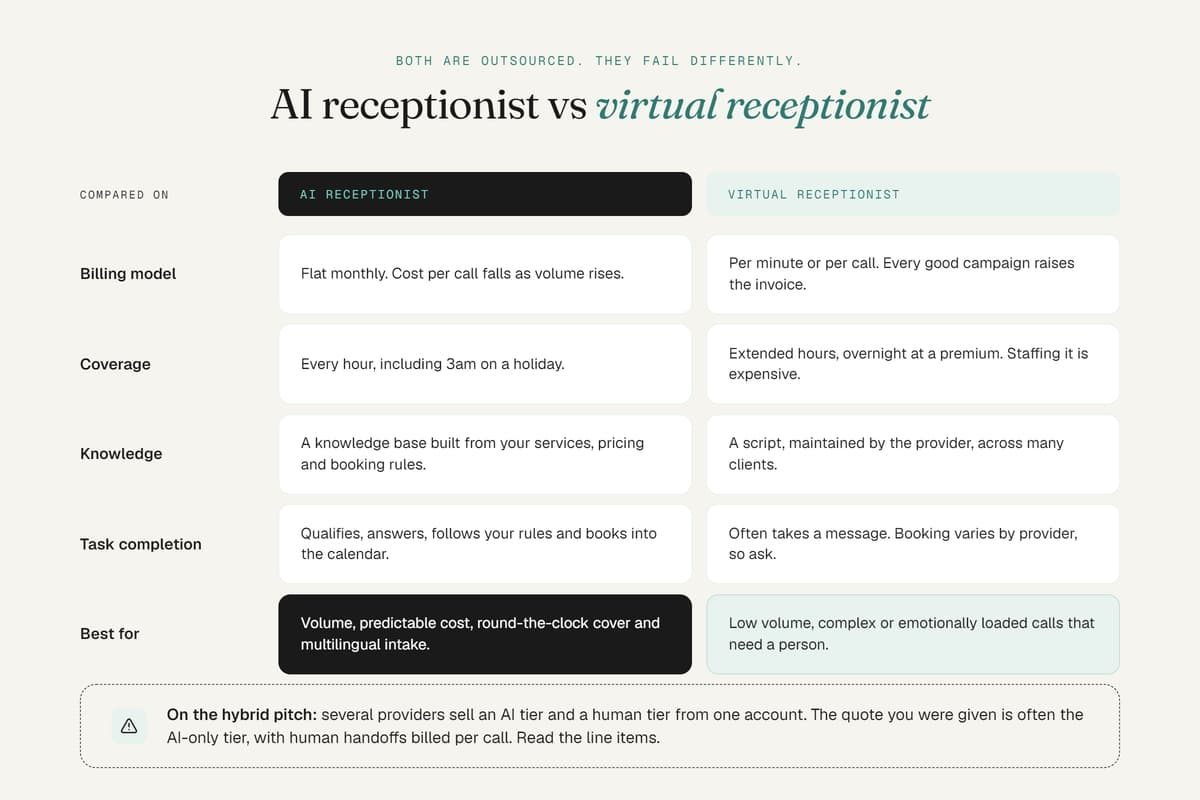
This is the comparison most buyers actually face, because both are outsourced and both promise to stop missed calls. They fail differently.
Billing model is the biggest divide. Virtual receptionist services bill per minute or per call. That sounds fair until you succeed at marketing. Every campaign that drives call volume also drives your receptionist invoice, and a busy month produces a bill you did not forecast. An AI receptionist on flat monthly pricing does the opposite: your cost per call falls as volume rises.
Coverage. Human virtual receptionist services offer extended hours, and some offer overnight coverage at a premium. Almost none offer genuinely equivalent service at 3am on a holiday, because staffing that is expensive. AI has no such constraint.
Depth of knowledge. A virtual receptionist reads from a script your provider maintains. They are handling several clients and cannot know your business the way your own team does. An AI receptionist runs on a knowledge base built specifically from your services, pricing and booking rules. Neither has a human's intuition. The AI at least has your complete information in front of it on every call.
Task completion. Many virtual receptionist services take a message and pass it to you. Some book. Ask directly, because "we answer your calls" and "we book your appointments" are very different products at similar prices.
Where the virtual receptionist wins. A live human voice, real-time judgement on an unusual call, and callers who react badly to AI. If your inquiry volume is low and each one is high-value and emotionally loaded, a person on the line is worth paying for.
Where the AI receptionist wins. Volume, cost predictability, coverage, simultaneous handling, multilingual intake, and consistency. If your calls are mostly booking requests and repeat questions, you are paying human rates for work that does not require a human.
A note on the hybrid marketing. Several providers now sell an AI tier and a human tier from one account, with human handoffs priced as a per-call add-on. That flexibility is genuinely useful. It also means the price you were quoted is often the AI-only tier, and the human backup you assumed was included is billed separately. Read the line items.
Where a Human Receptionist Still Wins
Any comparison that skips this section is selling something.
The room. Walk-ins, waiting patients, deliveries, signing for packages, handing someone a form and explaining it. Software cannot do a single one of these. If you have a physical front desk with people standing at it, you are not replacing that person.
Emotional weight. A distressed patient. A bereaved family calling a funeral home. A client three complaints deep who needs to be heard before anything gets fixed. AI should recognise these and escalate immediately, not attempt them.
Genuine judgement. The call that does not fit any category you anticipated. A human improvises. AI follows its fallback path, which is the right behaviour but not the same as solving the problem.
Relationship memory. A receptionist who has been with you five years knows which patients need extra time, which client is difficult on the phone but loyal, and which supplier to chase. That knowledge is real and it is not in any knowledge base.
Callers who want a person. Some do, particularly in older demographics and in high-stakes purchases. Honest disclosure plus a fast transfer path handles this better than pretending, but it does not eliminate the preference.
Where the AI Receptionist Wins Outright
Every call outside business hours. No contest. The alternative is voicemail.
The third simultaneous caller. A human physically cannot take that call. The AI takes it and the two after it.
Repetitive questions. Hours, location, parking, pricing ranges, what to bring, insurance accepted. Answered identically the thousandth time as the first.
Multilingual intake. In a market like the GTA, a caller more comfortable in another language often will not call twice. An agent that switches mid-sentence captures inquiries a single-language front desk loses silently.
Cost predictability at volume. Flat monthly, regardless of how good a month you have.
Data. Every call transcribed, categorised, scored and reported. Most businesses running a human front desk genuinely do not know how many calls they receive or how many convert.
Is an AI Receptionist Worth It? The Break-Even Math
Skip the feature comparison and run three numbers.
Number one: how many calls do you actually miss? Pull your phone records for the last 90 days. Count unanswered inbound calls, including after-hours. Most owners are surprised, and the number is usually worst on the days they were busiest, which is to say the days it mattered most.
Number two: what is one new customer worth? Not the first transaction. Lifetime value. A new dental patient, a signed legal retainer, an HVAC system replacement, a listing. Use a conservative figure.
Number three: what conversion rate would you assume on recovered calls? Be pessimistic. Not every missed call was a buyer. Ten to twenty percent is a defensible assumption for most service businesses.
Then:
Monthly AI receptionist cost ÷ (customer lifetime value × conversion rate) = bookings needed per month to break even
A worked example. A clinic paying $500 a month, with a patient lifetime value of $2,000 and a conservative 15% conversion on recovered calls. Each recovered call is worth $300 in expected value. The clinic needs to recover fewer than two calls a month to break even. If they are missing thirty calls a month, the return is not marginal.
Run the same math with a pessimistic lifetime value and a 5% conversion rate. If it still clears, the decision is made. If it does not, your call volume is genuinely too low and you should not buy one. That is a legitimate outcome and any provider telling you otherwise is not doing the arithmetic with you.
Is It Worth It? By Situation
Solo operator, on-site or on the road. Usually yes, and often the strongest case on this page. You are the person most likely to miss calls entirely, because there is nobody else to answer while you are with a client or under a sink. A monthly cost well below a part-time hire covers every hour you cannot.
Small team with one front desk person. Yes, as overflow and after-hours rather than replacement. Your receptionist stops being interrupted mid-task and stays on the in-person work you are actually paying them for.
Multi-location. Yes, and the case strengthens with each location. Routing, consistency and reporting across sites are exactly what breaks down when each location answers its own phone differently.
Seasonal or spiky demand. Yes. Staffing for the peak means overpaying in the trough. Software absorbs the peak at no extra cost.
Emergency-driven trades. Yes, and here the after-hours case is the whole case. A burst pipe at 2am goes to whoever picks up.
High-touch, very low volume. Probably not yet. If you take eight calls a week and every one is a lengthy, delicate conversation, hire a person or use a human virtual receptionist. Revisit when volume grows.
Businesses with a broken booking process. Not yet. Fix the process first. An AI receptionist will book into a broken calendar faster than a human would.
The Answer Most Businesses Land On
Framed as a replacement decision, this comparison usually resolves as a split.
Your human handles the room, the complex calls and the relationships. The AI handles nights, weekends, overflow, repeat questions and first-pass qualification, then transfers anything that needs a person with full context attached.
Nobody gets replaced. The front desk stops dropping calls, and the person you employ spends their day on work that actually needs a human. In practice this is what most of our clients run, and it is the configuration we recommend by default unless there is a reason not to.
If you want to see what that looks like against your real call volume, see how the AI receptionist works or get in touch and we will run the break-even numbers with you before you spend anything.
Frequently Asked Questions
Is an AI receptionist better than a human receptionist? Neither is better in general. AI wins decisively on coverage, cost, simultaneous calls and consistency. A human wins on walk-ins, emotional judgement, improvisation and long-term relationships. Most businesses get the best result running both, with AI covering after-hours and overflow.
Is an AI receptionist worth the money? Divide the monthly cost by the expected value of a recovered booking, which is your customer lifetime value multiplied by a conservative conversion rate. If you need to recover only one or two calls a month to break even and you are currently missing many more, it is worth it. If your call volume is genuinely low, it is not.
What is the difference between an AI receptionist and a virtual receptionist? A virtual receptionist is usually a remote human employed by an answering service, billed per minute or per call, working set hours. An AI receptionist is software, billed at a flat monthly rate, running 24/7 with unlimited simultaneous calls. Confusingly, some providers now use "virtual receptionist" to describe their AI product, so confirm which you are being quoted.
Will an AI receptionist replace my front desk staff? Rarely, and usually it should not. A front desk role is mostly in-person work that software cannot do. Most businesses use AI for after-hours, overflow and routine questions, which frees existing staff rather than replacing them.
Is an AI receptionist cheaper than an answering service? Usually yes at any real volume, because answering services bill per minute or per call while AI plans are typically flat monthly. The gap widens the busier you get, which is the opposite of how per-minute billing behaves.
Do customers mind talking to an AI receptionist? Most do not notice in a normal booking conversation. Some react badly once they realise, which is why honest disclosure when asked, plus a fast path to a human, matters more than a convincing voice. Preferences also vary by industry and demographic.
How many calls do I need to be missing for this to pay off? Fewer than most owners expect. With a $2,000 customer lifetime value and a conservative 15% conversion on recovered calls, two recovered bookings a month covers a typical mid-tier plan. Pull your actual missed call count before deciding, since most businesses underestimate it substantially.
Continue reading
Read the latest issues


Discussion