
Best Dental AI Receptionist Platforms in 2026: Compared
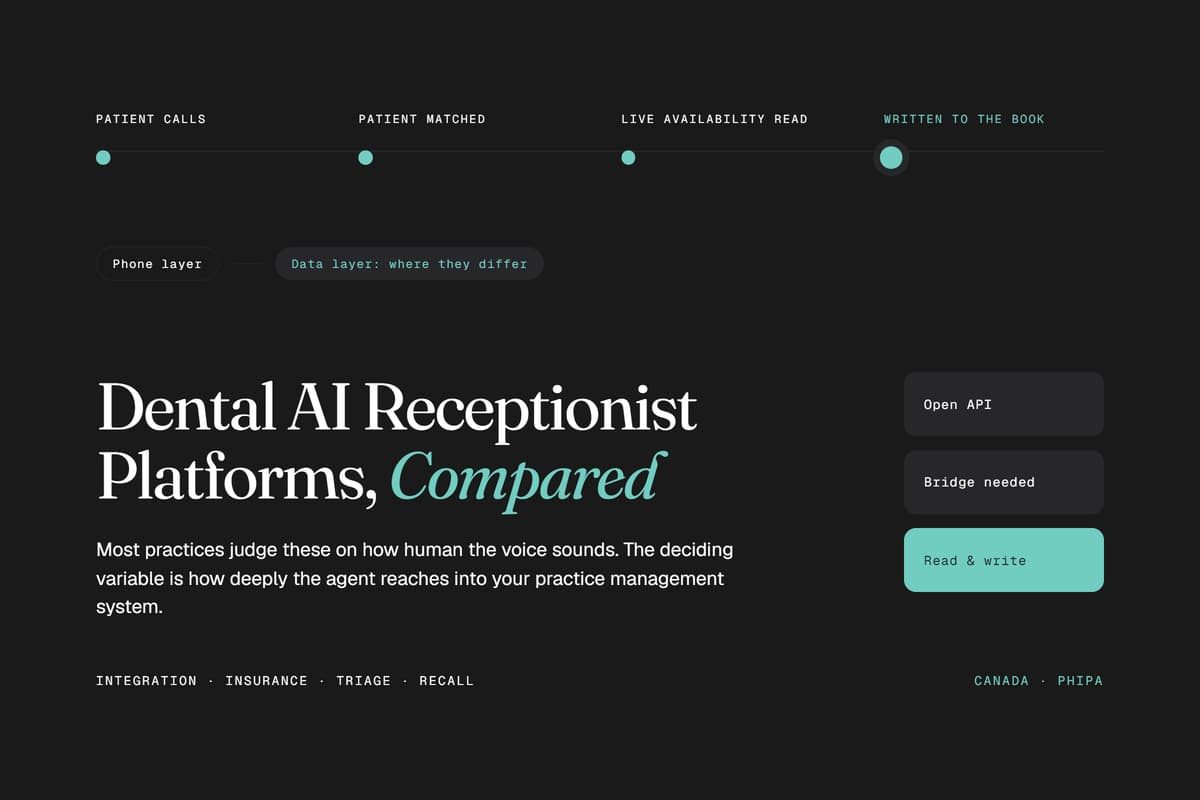
Most practices evaluate a dental AI receptionist on how human the voice sounds. That is the wrong test. Every serious platform in this category now sounds convincing on a demo call. What separates them is whether the system can actually write an appointment into your practice management software, and that answer depends more on which PMS you run than on which vendor you pick.
This guide compares the platforms dental practices are actually shortlisting in 2026, organised around the variable that decides the purchase.
Why Generic AI Receptionists Struggle in Dental
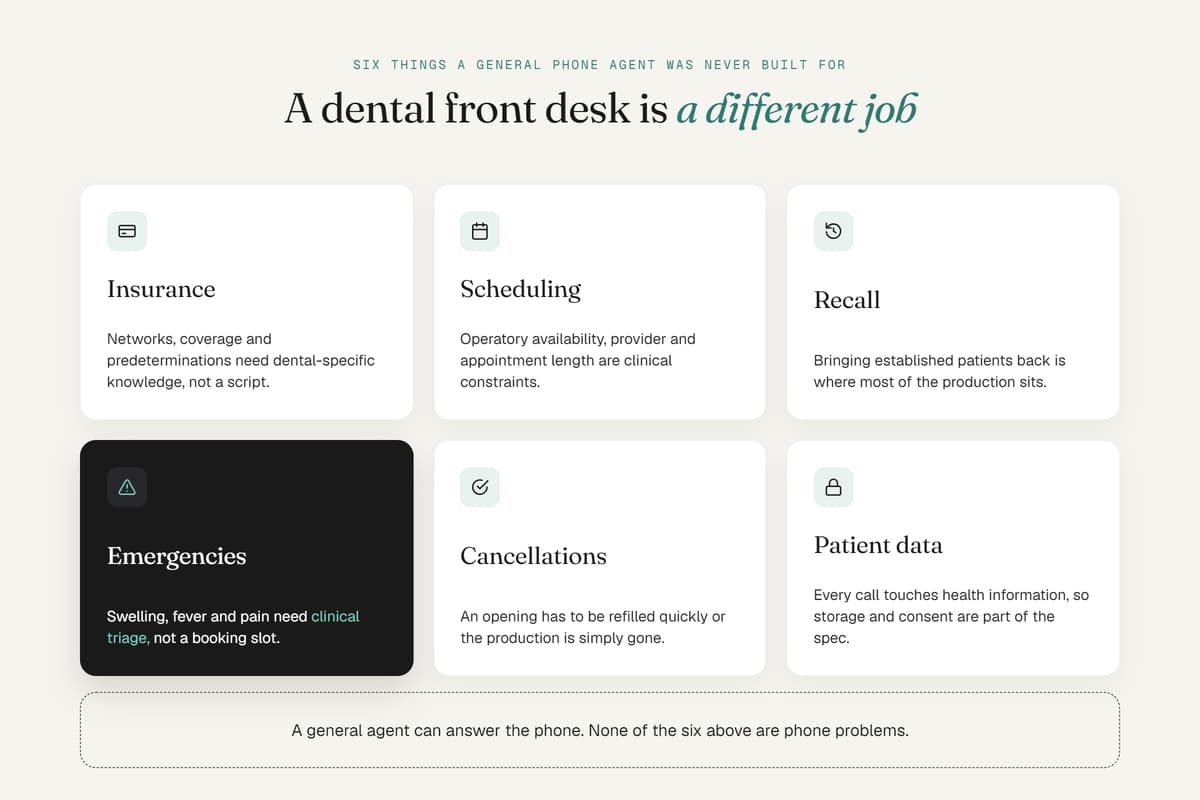
A dental front desk is not a generic front desk, and this is where horizontal AI receptionist tools fall down.
Insurance is the first question on most new patient calls. Do you take my plan, what will this cost me, am I covered for a cleaning. A generic agent reads a policy list. A dental-aware agent understands the difference between being in network, accepting assignment, and submitting a predetermination.
Scheduling has structure. Hygiene columns, operatories, provider assignments, appointment lengths that vary by procedure code, and block scheduling rules that exist for production reasons. Booking a 60-minute crown prep into a 30-minute hygiene slot creates a worse problem than the missed call did.
Recall is where the money is. A large share of production comes from patients who are already yours and are overdue. An inbound-only receptionist ignores this entirely.
Emergencies need triage, not booking. A patient describing swelling and fever is a different call from a chipped veneer. The agent has to tell them apart and escalate correctly.
Cancellations need backfilling. A 9am cancellation on Tuesday is lost production unless something fills it within hours.
And it is all protected health information. A caller describing symptoms is disclosing health data on a recorded line.
If you are new to the category generally, start with what an AI receptionist is and how it works. This guide assumes you already know and are choosing a vendor.
The Variable That Actually Decides It: PMS Integration Depth
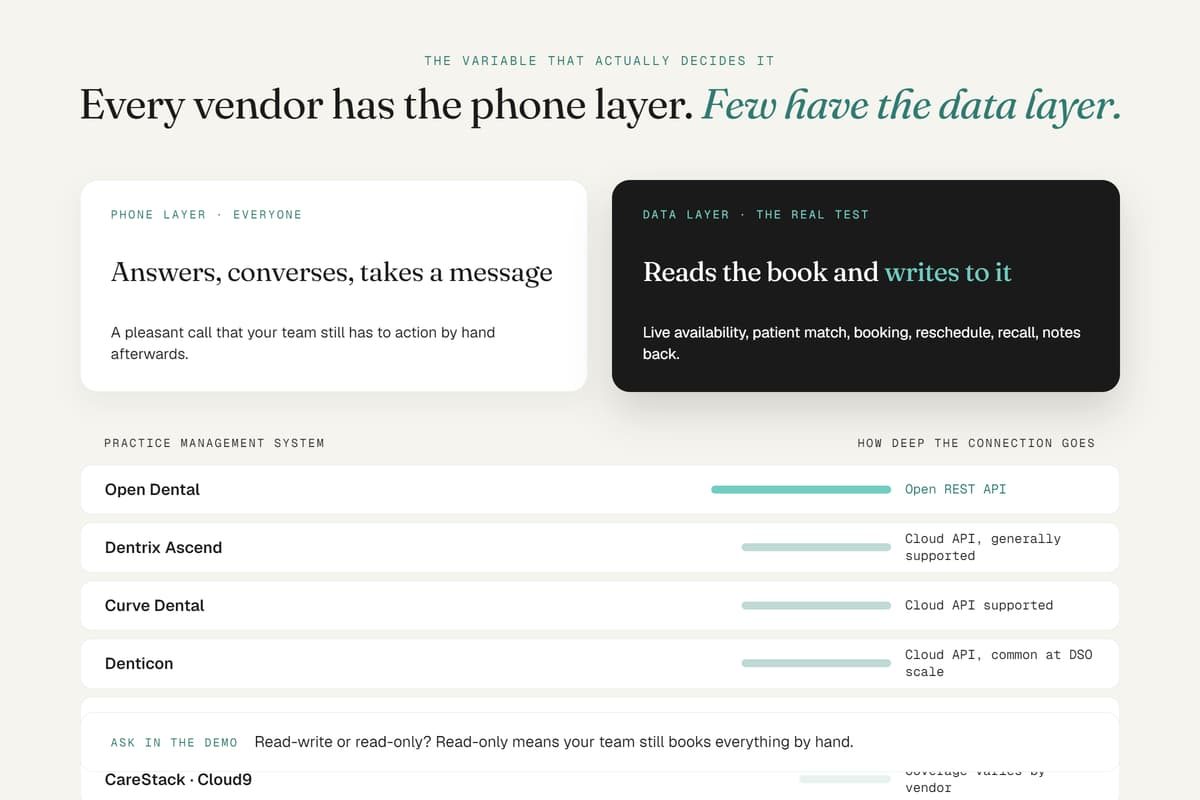
Every vendor claims integration. The word covers two very different things.
The phone layer is the AI answering your calls, holding a conversation and capturing information. This works with any practice management software, because it does not touch your database. Every vendor has this.
The data layer is the AI reading your live schedule, matching the caller to an existing patient record, and writing the appointment back. This is the part that determines whether you wake up to a booked schedule or a list of tasks for your front desk to key in manually.
Industry guidance on this is blunt: the depth of the connection depends on whether your practice management software offers an open API. Open Dental connects cleanly. Dentrix and Eaglesoft require a workaround.
That single fact should reorder your shortlist. If you run Open Dental, most of the market can serve you properly. If you run Dentrix or Eaglesoft, you need to ask harder questions, because closed platforms restrict third-party connections and require middleware or a database bridge rather than direct API access.
The question to ask every vendor: "When your AI books an appointment for a patient on my system, what exactly happens, and can you show me on a live call?" Watch for the word "sync." Sync can mean real-time write-back, or it can mean a batch job every fifteen minutes, or it can mean a member of your team gets an email.
PMS Compatibility at a Glance
| Practice management software | Integration route | What to expect |
|---|---|---|
| Open Dental | Open REST API | Cleanest path. Real-time two-way booking is standard across most vendors |
| Dentrix | Closed, needs bridge | Possible with major dental-specific vendors, verify it is write-back not read-only |
| Dentrix Ascend | Cloud API | Generally supported by dental-first platforms |
| Eaglesoft | Closed, needs bridge | Same caution as Dentrix |
| Curve Dental | Cloud API | Supported by dental-first vendors, plus Curve's own native AI |
| Denticon | Cloud API | Common at DSO scale |
| CareStack / Cloud9 | Cloud API | Ask specifically, coverage varies by vendor |
Confirm your exact version and hosting setup, not just the product name. A vendor that supports cloud Dentrix Ascend may not support your server-hosted Dentrix install.
Open Dental AI Receptionist Integration
Open Dental deserves its own section because it is the one system where integration is genuinely straightforward, and because it serves over 15,000 practices.
The reason is architectural. Open Dental exposes a RESTful API and a MySQL backend that allow direct real-time communication with outside systems, without middleware or screen scraping. In practice that means a properly built integration can:
- Read live availability across providers and operatories
- Look up an existing patient by phone number and personalise the conversation
- Write a new appointment straight into the appointment book
- Update or cancel an existing appointment
- Pull recall lists for outbound reactivation
- Write call notes back to the patient record
Setup is usually straightforward. You generate an API key in Open Dental's eServices setup, the vendor maps your providers, operatories, appointment types and scheduling rules, and the integration is tested before going live.
The questions that still matter on Open Dental:
Is the connection read-write or read-only? Read-only means your team still books everything by hand.
How does it handle a patient it cannot match to an existing record? A silent duplicate patient file is a mess that surfaces months later at billing.
What happens if the API connection drops mid-call? The agent should degrade gracefully and flag the booking, not confirm an appointment that never got written.
Does it respect your block scheduling rules, or will it fill a prime crown slot with a hygiene check?
The Three Categories of Dental AI Receptionist
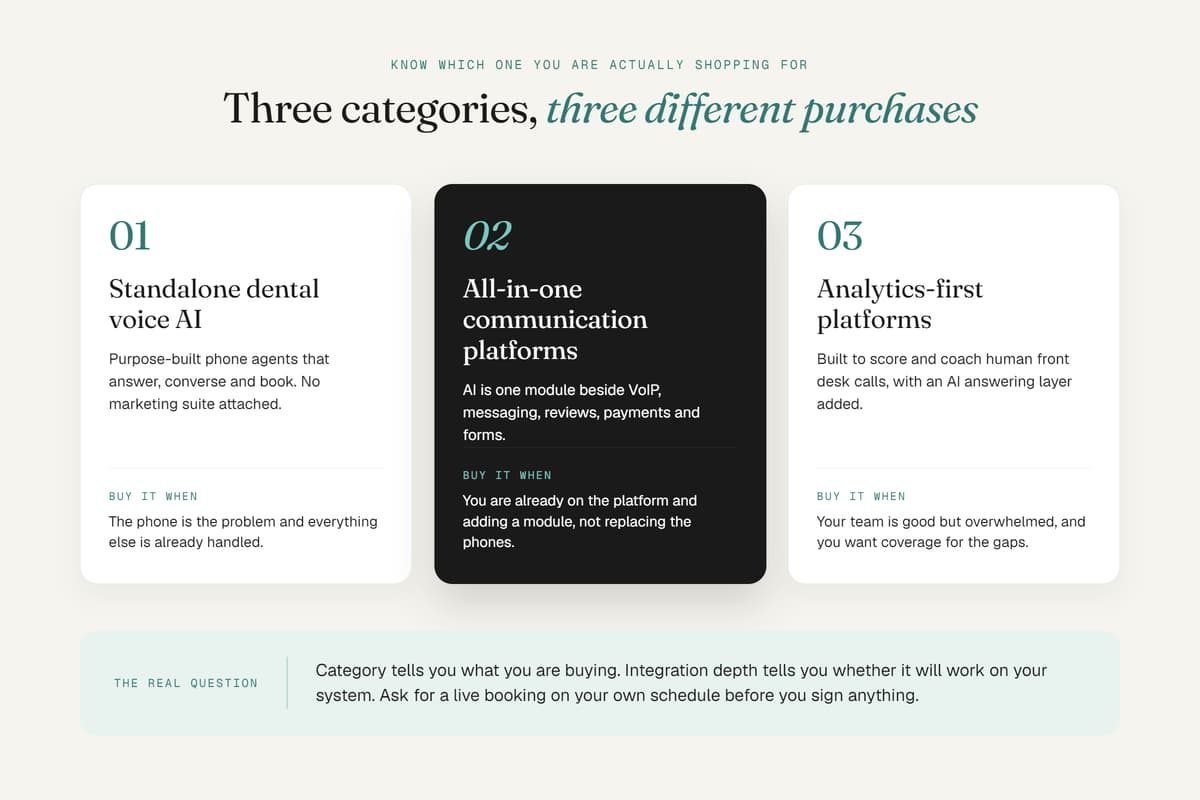
The market has fractured into three groups that get compared as though they are one.
Standalone dental voice AI. Purpose-built phone agents that answer, converse and book. No marketing services, no analytics suite. Pricing typically runs from under $100 to around $500 a month flat. Arini and Dentina sit here.
All-in-one practice communication platforms with AI added. Broader platforms where the AI is one module alongside VoIP, messaging, reviews, payments and forms. Pricing runs $300 to $800 and up for the full suite. Weave, Adit and RevenueWell sit here.
Analytics-first platforms. Built originally to score and coach human front desk calls, now with an AI answering layer added. Peerlogic is the clearest example.
Across the category as a whole, standalone platforms run roughly $200 to $800 a month for single-location practices, with custom quotes at DSO scale based on call volume and integration complexity.
Category matters more than it looks. If you are already paying for a communication platform, adding its AI module is cheaper than a second vendor. If you are not, buying a whole suite to get the AI is an expensive way to answer the phone.
Platform by Platform
Patrick by Mehrana
Patrick is our own AI receptionist, and we will be direct about where it fits in a dental comparison rather than pretending it is something it is not.
Where Patrick is genuinely different from everything above: it is not voice only. Patrick answers phone calls, website chat, WhatsApp and SMS from one system, with every conversation for a patient landing in one thread. Nearly every dental-specific platform on this page is a phone product, which leaves the patient who messages your Instagram or fills in your website form unanswered. It also handles multilingual intake natively, switching language mid-conversation, which in a market like the GTA is not a nice-to-have.
Where Patrick is a Canadian product rather than an American one. Every platform above is built for the US market and speaks in terms of HIPAA. An Ontario practice is regulated under PHIPA, with different consent, retention and breach notification obligations, and Canadian data residency questions that a US vendor may not be able to answer. We build for that requirement because our clients are here.
[FILL THIS IN BEFORE PUBLISHING] State exactly which dental practice management systems Patrick writes back to today. If the answer is none yet, say so plainly and describe what happens instead, for example structured booking requests delivered to the front desk with full patient context. Do not claim PMS write-back we do not have. A dental buyer will test this on the first call.
Where Patrick is not the right pick: if your entire requirement is deep Dentrix or Open Dental write-back and nothing else, a dental-only vendor built around that single integration will serve you better. We will say so on the call.
See the AI receptionist for dental practices →
Arini
Arini is the most widely recognised dental AI receptionist on the market, backed by Y Combinator's W24 batch. It is the default name on most shortlists, and the reason is integration coverage: native connections to Dentrix, Open Dental, Eaglesoft and Curve, with real-time booking, multilingual support and cancellation backfill. Pricing starts around $249 a month.
Strongest for: practices that want a dental-specific voice agent and have their marketing and analytics handled elsewhere.
Consider carefully if: you need more than inbound voice. It is a focused product, which is a strength and a limit. Specialty practices should also check fit, since it is built around general dental PMS platforms rather than orthodontic workflows.
Weave AI Receptionist (formerly TrueLark)
The most important thing to know here is a corporate one that reshapes the comparison. Weave acquired TrueLark in May 2025 and now sells the product as the Weave AI Receptionist, which means anyone evaluating TrueLark in 2026 is buying into Weave's roadmap rather than the standalone product of 2024.
Weave AI receptionist features sit inside a much larger platform: VoIP phones, two-way texting, payments, reviews and the AI receptionist bundled into one system. TrueLark brought the AI voice and multi-channel scheduling layer into that bundle.
Strongest for: single-location and small-group practices already running Weave. The AI becomes an add-on to infrastructure you already pay for, and consolidation has real value.
Consider carefully if: you are not on Weave already. You are then evaluating a full phone system replacement to get an AI receptionist, which is a much larger project than it first appears. Note also that the AI voice feature has been described as still rolling out, so ask specifically what is shipped today versus on the roadmap for your configuration.
Peerlogic
Peerlogic is the oldest company in this comparison at eight years, focused on conversational AI for dental and veterinary practices. Its origin is different from everyone else's: it was built to analyse calls handled by your human team, scoring conversations and surfacing missed opportunities. It later added Aimee, an AI receptionist that answers, texts back missed calls and books.
That history explains where it fits. Its analytics product is the most specialised in the niche.
Strongest for: practices keeping a human front desk and wanting to make it measurably better, with AI covering after-hours and overflow rather than replacing anyone.
Consider carefully if: your problem is purely coverage. You may be paying for an analytics layer you will not use.
Dentina
Positioned as a reactivation specialist rather than a general receptionist. Its pitch is deep PMS sync and scheduling intelligence for mid-size practices.
Strongest for: practices whose real problem is lapsed patients rather than missed inbound calls. If your schedule has holes and your recall list has hundreds of overdue patients, this is a different and often better purchase than inbound coverage.
The All-in-One Platforms
Adit, RevenueWell and similar suites have added AI front desk modules, with Adit launching its AI Front Desk Agent in February 2026.
The buying logic is the same as Weave. If you already run the platform, evaluate the module. If you do not, do not buy a suite to get one feature.
How to Evaluate a Dental AI Receptionist Properly
Vendor demos are scripted around calls the agent handles well. Run these instead.
1. Make them book a real appointment live. During the demo, have the vendor book a test appointment on a live connection to your system, then look at your own appointment book while still on the call. If they cannot do this, the integration is not what they described.
2. Call as a patient with an insurance question. Ask something specific to a plan you accept. Note whether it answers, deflects, or invents.
3. Describe an emergency. Swelling, fever, pain that woke you up. It should triage and escalate rather than offering next Thursday at two.
4. Ask to reschedule an existing appointment. Booking is the easy half. Modifying an existing record is where read-only integrations get exposed.
5. Call after hours on a weekend. That is when the calls you are losing actually arrive.
6. Ask what happens to the recording and the transcript. How long is it kept, where is it stored, who can access it, and will they sign a data agreement.
7. Ask what happens in month three. Your fee schedule changes, you add an associate, you drop a plan. Is there a person who updates the agent, or is that now your office manager's job?
The Compliance Question Canadian Practices Should Ask
Almost every platform in this comparison markets HIPAA compliance. If your practice is in Ontario, HIPAA is not your regulation. PHIPA is, and the obligations differ on consent, retention, patient access rights and breach reporting.
Three things to establish with any US vendor:
Where is patient data stored and processed? Cross-border storage is permitted but carries obligations you should understand before signing.
Will they sign an agreement referencing PHIPA, not just a standard US business associate agreement?
What is the disclosure behaviour? A patient disclosing symptoms should know they are speaking to an automated system.
This is not a reason to rule out US vendors. It is a reason to get the answers in writing rather than assuming a HIPAA badge covers you. For the broader picture of how to compare platforms outside dental specifically, see our comparison of the best AI receptionist software in 2026.
Choosing for Your Practice
Single location on Open Dental, want calls answered. The widest field. A focused standalone like Arini works well, and integration will not be the obstacle.
Single location already on Weave. Evaluate the Weave AI receptionist first. Adding a module beats adding a vendor.
Dentrix or Eaglesoft, server hosted. Narrow your list to dental-first vendors and make write-back a live demonstration requirement, not a claim on a feature page.
Your schedule has holes and your recall list is long. Your problem is reactivation, not inbound. Look at Dentina or an outbound-capable platform rather than an inbound receptionist.
You have a good front desk that is overwhelmed at peak. Peerlogic's analytics-plus-coverage model fits better than replacement.
Multi-location or DSO. Centralised routing and cross-location reporting matter more than voice quality. Get pricing based on your real call volume, not list price.
Patients contact you across channels, or in more than one language. This is where a voice-only dental tool leaves gaps, and where a multi-channel platform is worth evaluating alongside the dental specialists.
If you want help mapping this against your practice management software and call volume before you talk to any vendor, get in touch. We will tell you honestly if a dental-only platform is the better fit.
Frequently Asked Questions
Which is the best dental AI receptionist in 2026? There is no single answer, and any guide claiming one is selling something. Arini is the most recognised standalone dental voice AI. Weave suits practices already on its platform. Peerlogic fits practices keeping a human front desk. The right pick depends on your practice management software, your call volume, and whether your real problem is inbound coverage or patient reactivation.
Does an AI receptionist integrate with Open Dental? Yes, and Open Dental is the easiest of the major systems to integrate with because it publishes an open API allowing direct real-time reading and writing of appointments. Confirm the connection is read-write rather than read-only before signing.
Can an AI receptionist book into Dentrix or Eaglesoft? It depends on the vendor and your setup. Both are closed systems requiring a bridge or middleware rather than direct API access, so integration is possible with dental-specific platforms but should be demonstrated live rather than accepted as a claim.
What happened to TrueLark? Weave acquired it in May 2025 and the product is now sold as the Weave AI Receptionist. Practices evaluating TrueLark today are evaluating Weave.
What does a dental AI receptionist cost? Standalone dental voice platforms generally run from under $100 to around $500 a month flat for a single location, while all-in-one communication suites that include AI run higher because you are buying phones, messaging and payments alongside it. DSO pricing is quoted on call volume and integration complexity.
Will it handle insurance questions correctly? Only to the depth you configure. A well-built agent answers which plans you accept and general coverage questions, then books the appointment where specifics get confirmed. Any system quoting exact patient out-of-pocket amounts on a first call is a risk, not a feature.
Can it fill cancellations? The better platforms can, using a waitlist and outbound contact. Ask whether this is shipped today or on the roadmap, and ask to see it demonstrated.
Is a dental-specific platform always better than a general one? Not always. Dental-specific vendors win on practice management integration and clinical vocabulary. General platforms often win on channel coverage, multilingual handling and pricing. If your patients only ever phone you and you need deep write-back, go dental-specific. If they message you across channels, weigh both.


Discussion