
Is My Business Visible In ChatGPT
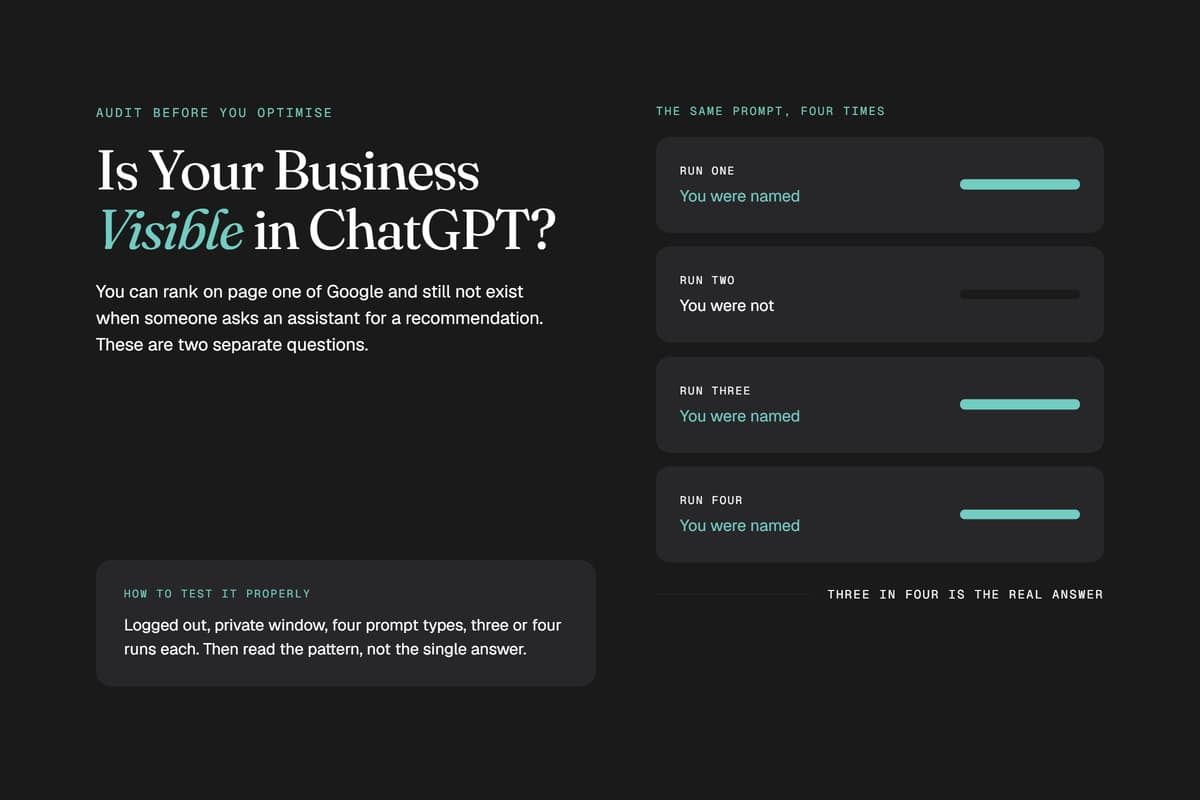
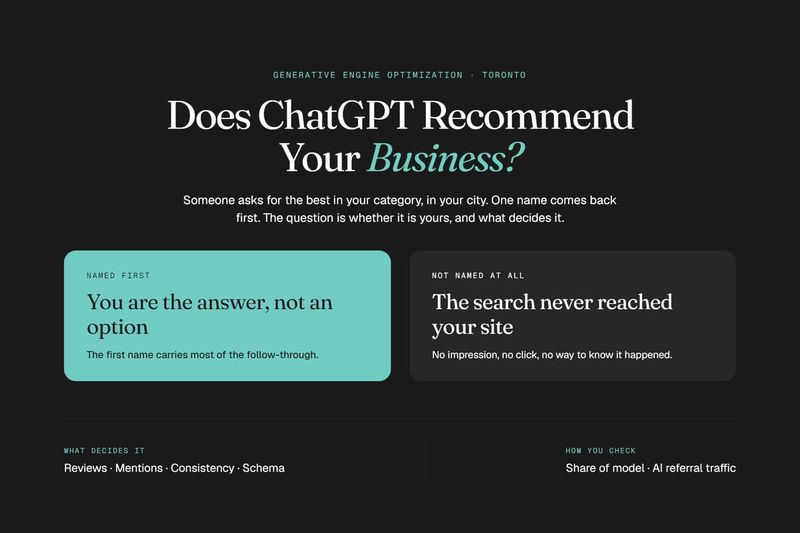
More of your customers are skipping Google and asking ChatGPT directly: "who is the best [service] near me?" If your business is not visible in ChatGPT when that question gets asked, a competitor gets the lead and you never see it happen in any report you run. The unsettling part is that this is invisible: you can rank on page one of Google and still be completely absent from the answer ChatGPT gives a buyer in your city, because AI answers run on a different set of signals that AI search SEO is built to earn. Here is how to check where you stand in about five minutes, why AI leaves some businesses out, and exactly what to fix.
To find out, open ChatGPT in a logged-out window and ask the questions your customers ask, such as "best [service] in [your city]." If your name appears, you are visible. If it does not, your business likely lacks the structured data, consistent listings, and third-party citations that AI engines use to decide which companies to name.
How to Check If Your Business Is Visible in ChatGPT
You do not need a paid account or a special tool to run a first check, and it works whether or not you have invested in professional SEO services before. Open a logged-out or private window (AI tools personalize, and your own history skews what you see), then run the same prompts a few different ways. Responses are probabilistic, so the pattern across three or four runs matters far more than any single answer. Note not just whether you appear, but how you appear: named as a top recommendation, mentioned in passing, or described with the wrong hours and a dead phone number.
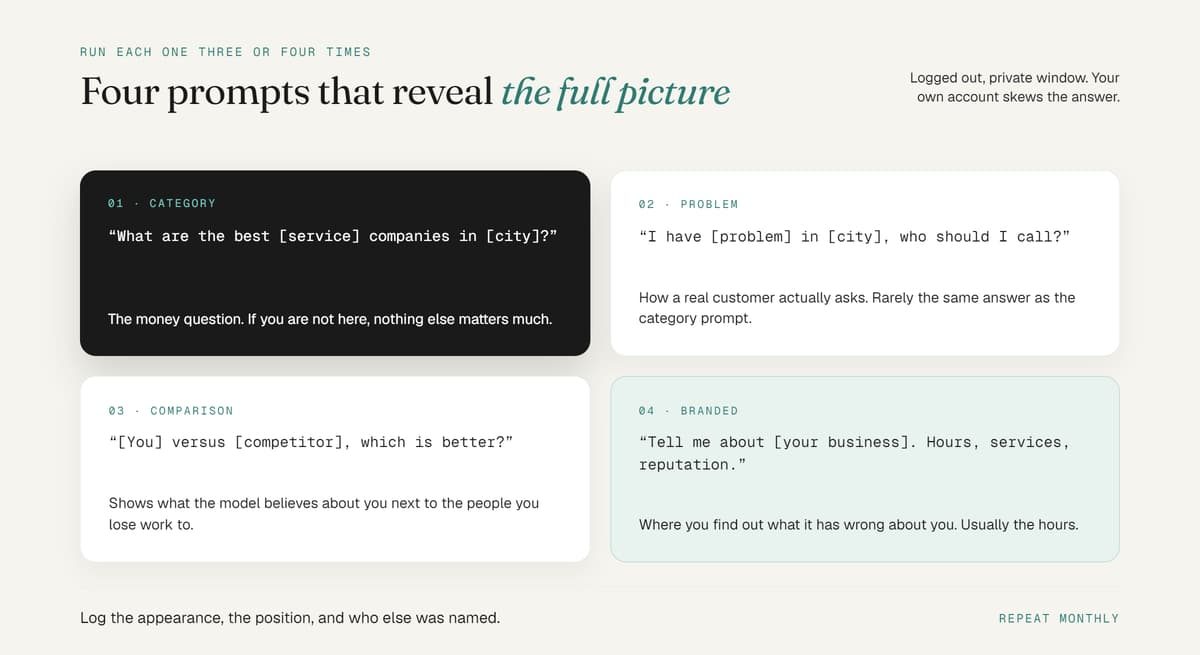
The four prompt types that reveal the full picture
Run each of these, swapping the brackets for your real service, city, and business name:
- Category prompt: "What are the best [service] companies in [city]?"
- Problem prompt: "I have [the exact problem you solve] in [city], who should I call?"
- Comparison prompt: "Is [your business] a good choice for [service]?" or "[Your business] vs [competitor], who is better?"
- Branded prompt: "What do you know about [your business]? What are their hours, services, and reputation?"
Category and problem prompts carry the most revenue weight, because they catch buyers before they have chosen anyone. Branded prompts tell you what the model already believes about you, including any wrong facts you need to correct at the source.
How to read your results
Score each prompt with a simple rubric: Absent (not mentioned), Mentioned (named but not recommended), or Recommended + Accurate (named as a top choice with correct details). Most businesses land in the middle, visible for a few prompts and invisible for the ones that matter most. The gaps are the map: the prompts where competitors appear and you do not show you exactly which topics and signals to strengthen first.
How ChatGPT Actually Decides Which Businesses to Name
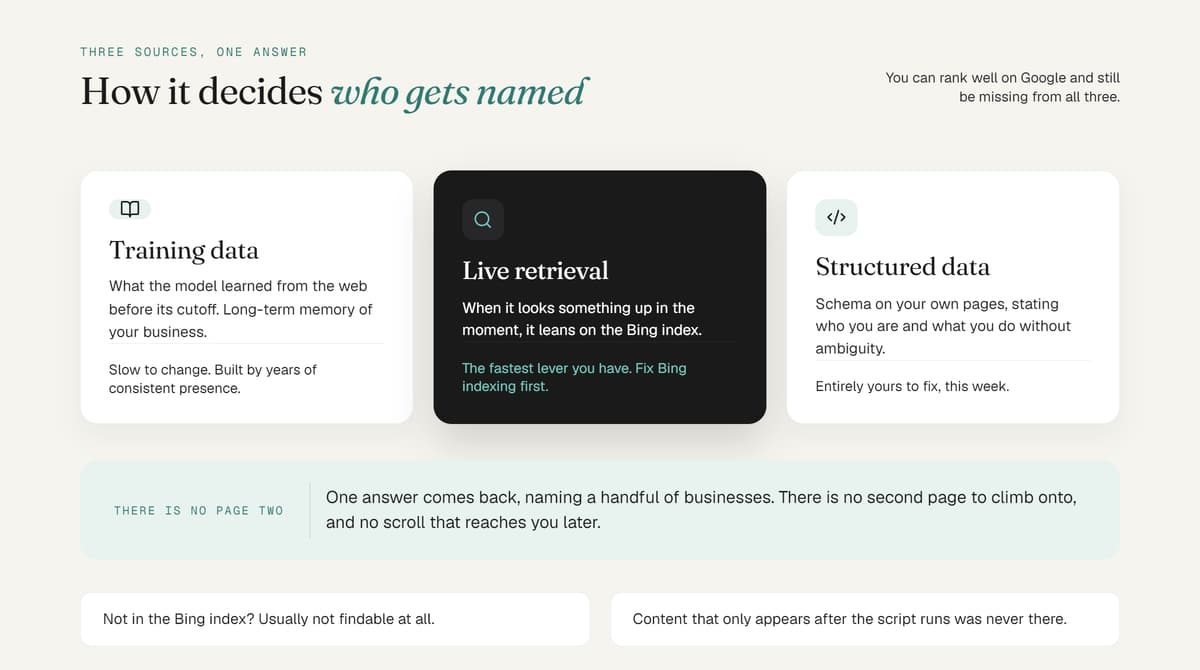
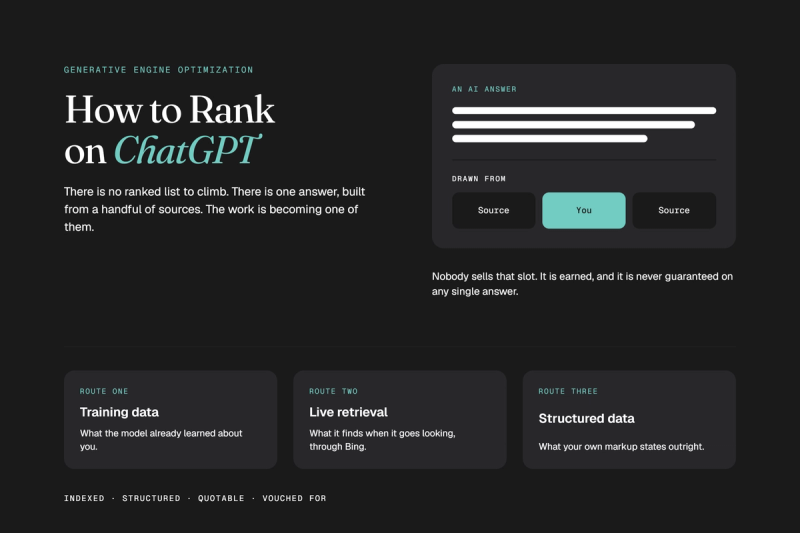
ChatGPT is not a search engine that lists ten links. It generates one answer that names two to four businesses, and there is no page two. It assembles that answer from three sources, and understanding them explains why you appear or do not:
- Training data (long-term memory): The model learned from a huge slice of the public web indexed before its training cutoff, including Wikipedia, review platforms, directories, and news. Businesses with more consistent mentions across the web are simply "known" to the model.
- Live retrieval and search: When ChatGPT browses or runs its search feature, it fetches current pages, historically leaning on the Bing index. This is how newer or lesser-known businesses can appear even without deep training-data presence, if their site and citations are clean.
- Structured data on your site: Schema markup (JSON-LD) tells the model in machine-readable terms who you are, what you do, and where you operate. Without it, AI has to guess, and it tends to guess in favour of the competitor who made themselves easy to understand.
The through-line is trust. AI engines reward many of the same signals that strong SEO has always rewarded: accurate business information, authoritative third-party mentions, structured content, and a credible reputation. If that foundation is thin, you are invisible to the model no matter how much you spend elsewhere.
Why Your Business Isn't Showing Up in ChatGPT
If you came out of the test mostly "Absent," one or more of these is almost always the cause:
- No schema markup. Without Organization, LocalBusiness, Service, and FAQ schema, the model cannot cleanly extract who you are and defaults to competitors who have it.
- Thin or vague content. Service pages with a few sentences give the model nothing to quote. Pages that never state plainly what you do, where, and for whom produce a weak "entity" the AI cannot confidently name.
- Inconsistent NAP. Different names, addresses, or phone numbers across your site, Google Business Profile, and directories make AI lose confidence in your data and deprioritize you.
- Missing third-party citations. AI leans on sources it trusts: directories, review platforms, "top X" round-ups, and local press. If your competitors are cited there and you are not, the model has fewer reasons to mention you.
- Content hidden behind a framework. AI crawlers like GPTBot often do not run JavaScript. If your content only appears after the page hydrates, the crawler sees an empty shell and you effectively do not exist for ChatGPT.
How to Make Your Business Visible in ChatGPT
The path in is earned, not bought, which makes it slower than an ad but far more durable, because an earned position in the data layer carries across every AI tool that reads it. Prioritize in this order:
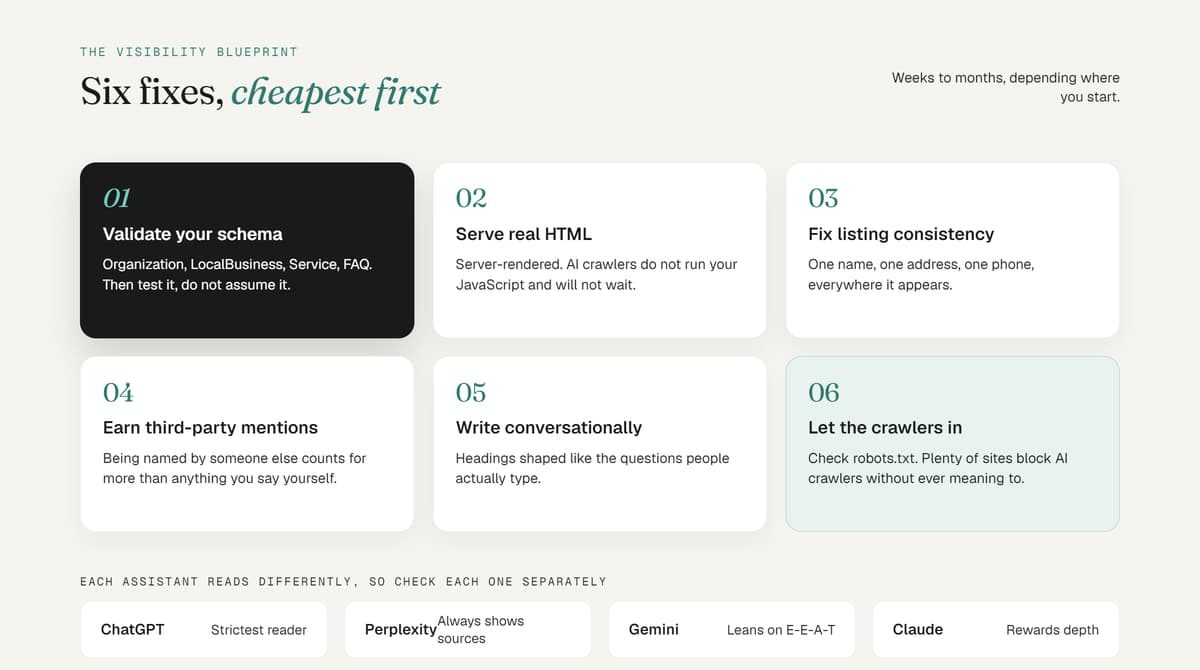
1. Add and validate schema. Implement Organization, LocalBusiness, Service, and FAQ schema in JSON-LD, then confirm it passes Google's Rich Results Test. This is often the single fastest lever, moving a business from "invisible" to "occasionally cited" within weeks. This structured-data work is the core of dedicated AI search SEO services built specifically for ChatGPT, Perplexity, and Gemini.
2. Ship server-rendered, readable HTML. Make sure the words a crawler needs are in the first response, not lazy-loaded behind JavaScript. A fast, custom-built website that serves clean HTML is what makes GPTBot able to read and cite you at all.
3. Fix your listings and reviews. Lock down consistent NAP everywhere and keep your Google Business Profile complete and current. Strong, recent, plentiful reviews weigh heavily in who AI recommends for local queries. Tightening these signals is exactly what local SEO is built to do.
4. Earn third-party mentions. Get listed accurately on the directories and review platforms your industry is cited on, and contribute genuine expertise where your customers already read. The goal is quality and consistency of mentions, not raw volume.
5. Write the way buyers ask. Publish content that answers real, conversational questions in plain language ("how," "what," "who is best for"). Well-structured FAQ and how-to content lifts cleanly into AI answers. You can automate the review requests and lead follow-up around this with AI automation so the signals keep compounding without manual effort.
6. Allow the AI crawlers. Check that your robots.txt does not block GPTBot, ClaudeBot, PerplexityBot, or Google-Extended, and consider an llms.txt that points them to your priority pages.
ChatGPT vs Perplexity vs Gemini: Visibility Isn't One Score
Being recommended on one engine does not mean you are recommended on the others. Each pulls from different sources and weights signals its own way, so test every prompt on every platform:
- ChatGPT is the strictest reader: content must be in the initial HTML, and it favours FAQ and how-to schema plus author and article signals.
- Perplexity always shows its sources, so a brand mention is real reach; it retrieves live web content and rewards clean URLs and breadcrumbs.
- Gemini inherits Google's crawl but ranks separately, leaning hard on E-E-A-T, and it powers the AI Overview box at the top of Google.
- Claude rewards depth and cited sources, picking up nuance and expertise in longer content.
How Often Should You Check?
Treat a manual check as a snapshot, not the movie. Model updates, new indexed content, and competitor activity shift citation patterns constantly, and the businesses most blindsided by a drop are the ones who checked once and assumed the result was permanent. A practical rhythm is a manual re-test every 30 days, ideally paired with systematic tracking across all four engines so you catch a decline before it costs you leads.
Getting Found in AI Search: Where Toronto Businesses Start
AI search is still an open field, and few businesses in the GTA have optimized for it, so schema quality and content depth can beat a bigger competitor's budget right now. The businesses that appear in AI answers in 2027 are the ones starting the work today. If you want to know exactly where you stand, a free AI visibility audit runs your name and your competitors through the major AI engines and shows you the specific gaps to close. You can also see how this played out for real businesses in our case studies.
Frequently Asked Questions
How do I check if my business appears in ChatGPT? Open ChatGPT in a logged-out window and ask the questions your customers ask, like "best [service] in [city]" or "who should I call for [problem]." Run each prompt a few times, since answers vary, and note whether you are named, mentioned in passing, or absent, and whether the details are correct.
Why isn't my business showing up in ChatGPT? Usually because AI cannot confidently identify or trust you. The common causes are missing schema markup, thin or vague website content, inconsistent name, address, and phone details across the web, few third-party citations, and content hidden behind JavaScript that AI crawlers cannot read. Fixing these is what brings you into AI answers.
Can I pay to appear in ChatGPT? Not today. AI answers in ChatGPT, Perplexity, and Google AI Overviews are assembled from organic signals rather than sold as placements. Ad formats around AI results are beginning to emerge, but the reliable path in is still earned: accurate data, structured content, strong reviews, and credible third-party mentions.
Is ChatGPT visibility the same as my Google ranking? No, they are two different things. A business can rank on page one of Google and still be invisible when someone asks ChatGPT for a recommendation, because AI weighs source authority, citation frequency, and content structure differently. You need to check and optimize both separately.
How long does it take to show up in ChatGPT? It varies by starting point. Adding validated schema can move you from invisible to occasionally cited within weeks. Building the third-party citations and reputation that earn consistent recommendations takes longer, often several months, which is why starting now matters.
Which should I optimize for: ChatGPT, Perplexity, or Gemini? All of them, because they pull from different sources and cite different businesses for the same query. A single foundation of clean schema, server-rendered content, consistent listings, and strong reviews improves your odds across every engine, then platform-specific tuning closes the remaining gaps.
Continue reading
Read the latest issues
Discussion