
Do You Need an llms.txt File in 2026?
For almost every commercial website, no. Five independent 2026 studies covering hundreds of thousands of domains found no measurable connection between publishing an llms.txt file and getting cited by AI systems. Google has stated on the record that you do not need it. If GEO is the goal, your effort is better spent elsewhere. The one narrow exception is developer documentation, where AI coding agents genuinely do read these files.
That is the conclusion. The rest of this article is the evidence, because this topic has generated more confident advice with less data behind it than almost anything else in SEO right now.
What llms.txt actually is
llms.txt is a single Markdown file placed at the root of a site, at /llms.txt. It contains a short description of what the site is and a curated list of links to its most important pages, each with a one-line description. The idea is that an AI system could read this one file and orient itself instead of crawling everything.
It was proposed by Jeremy Howard, co-founder of Answer.AI and fast.ai, in September 2024. The original proposal was aimed at helping language models parse documentation efficiently. The "AI visibility" framing came later, added by the SEO industry on the assumption that AI platforms would eventually reward it.
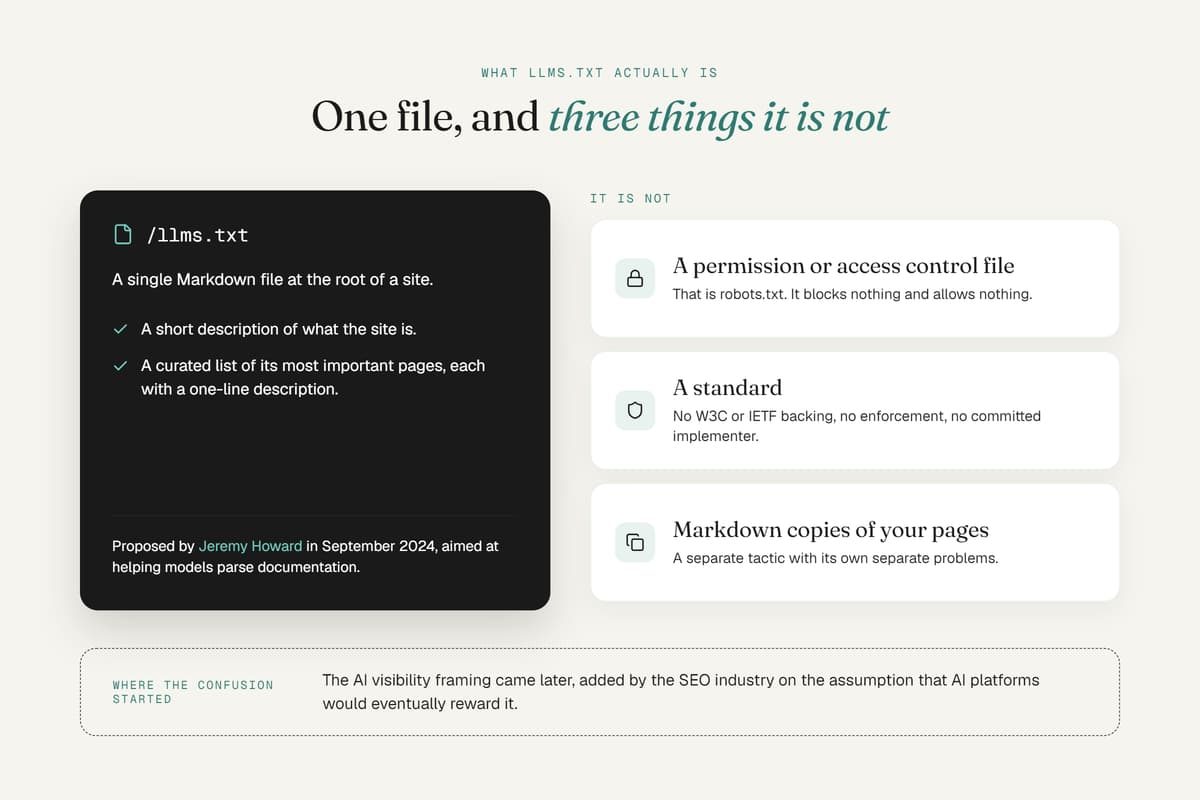
Three things it is not, and all three get confused constantly:
It is not a permission or access control file. That is robots.txt. llms.txt blocks nothing, allows nothing and controls nothing, despite the filename resemblance.
It is not a standard. There is no W3C or IETF backing, no enforcement mechanism, and no committed implementer among the major AI platforms.
It is not the same as publishing Markdown copies of your pages. That is a separate tactic with its own separate problems.
If you want to control which AI systems can reach your content, that work happens in robots.txt, and we covered which crawler families matter in our guide to GEO vs AEO vs LLM SEO.
What five independent studies found
This is the part that settles the question. Every large-scale study published so far points the same direction.
| Study | Scope | Finding |
|---|---|---|
| Ahrefs, June 15 2026 | 137,210 domains, server logs and bot analytics | 28% publish an llms.txt. 97% of those files received zero requests in May 2026. Not from bots, not from humans. |
| SE Ranking, November 2025 | ~300,000 domains, XGBoost model | No statistically significant correlation between llms.txt and AI citation frequency. Removing llms.txt from the model improved its accuracy. |
| ALLMO.ai, January 2026 | 94,614 cited URLs from 11,867 responses across five models | Exactly one citation traced to an llms.txt file. |
| Trakkr, March 2026 | 37,894 domains with two or more AI citations, Mann-Whitney U test | No citation advantage for adopters. Among the 50 most-cited domains, only 6% had the file. |
| OtterlyAI, 90-day experiment | 62,100 AI bot visits | 0.1% of AI crawler traffic targeted llms.txt. The file performed roughly three times worse than an average content page. |
Two details from the SE Ranking data deserve their own line. Adoption sat at 10.13% overall, but 0% among the top 1,000 domains by traffic. And among the 50 most AI-cited domains in the dataset, exactly one had an llms.txt file.
The Trakkr study found the same pattern and named the mechanism: adoption increases as you move down the citation rankings. The sites that dominate AI answers are not the ones publishing llms.txt. They are cited because of brand authority and content quality. If anything, the correlation runs backwards.
Who is actually reading llms.txt files
The Ahrefs study is the most useful piece of research here because it looked at server logs rather than outcomes. For the 3% of files that did receive any traffic at all, it classified every single user agent.
The result is not what the industry assumed.
| Requester type | Share of requests |
|---|---|
| SEO audit tools | 21.7% |
| Other and unidentified bots | 14.9% |
| General web crawlers (Googlebot, Amazonbot) | 13.1% |
| Tech profiling tools (BuiltWith and similar) | 11.6% |
| AI agents and agentic infrastructure | 10.5% |
| GEO and AEO scoring tools | 5.8% |
| AI training crawlers (GPTBot, ClaudeBot) | 5.3% |
| llms.txt validators and scanners | 3.6% |
| Link-preview bots (Slackbot and similar) | 2.9% |
| Research bots | 2.7% |
| AI assistants (ChatGPT-User, Claude-User) | 2.5% |
| AI retrieval bots (OAI-SearchBot, PerplexityBot) | 1.1% |
Read that bottom row again. The bots that actually decide whether you get cited in an AI answer account for 1.1% of requests to these files.
Slackbot, a link-preview bot, fetched llms.txt files more often than PerplexityBot did.
Roughly 12% of all traffic to llms.txt files comes from tools auditing, validating and studying llms.txt. The industry is measuring itself and calling it demand.
And the single cleanest finding in the whole dataset: zero AI bots requested llms.txt on domains where the file did not exist. They never go looking. The people probing for missing files are humans typing the URL into a browser, presumably competitors checking on each other. Publishing the file does not put you on anyone's radar, because nobody is knocking.
One nuance worth extracting, because it is the strongest argument the file has. Where AI bots do fetch llms.txt, the pattern points upstream and sideways rather than at retrieval. Training crawlers fetch it roughly five times more than retrieval bots. Anthropic's Claude-Code, a coding agent, out-fetched every AI retrieval bot, every AI assistant and every training crawler except GPTBot. So if llms.txt has any effect on visibility at all, the mechanism is training data or agent workflows, not the live citation pipeline that most people are buying it for.
What Google actually said, and the contradiction
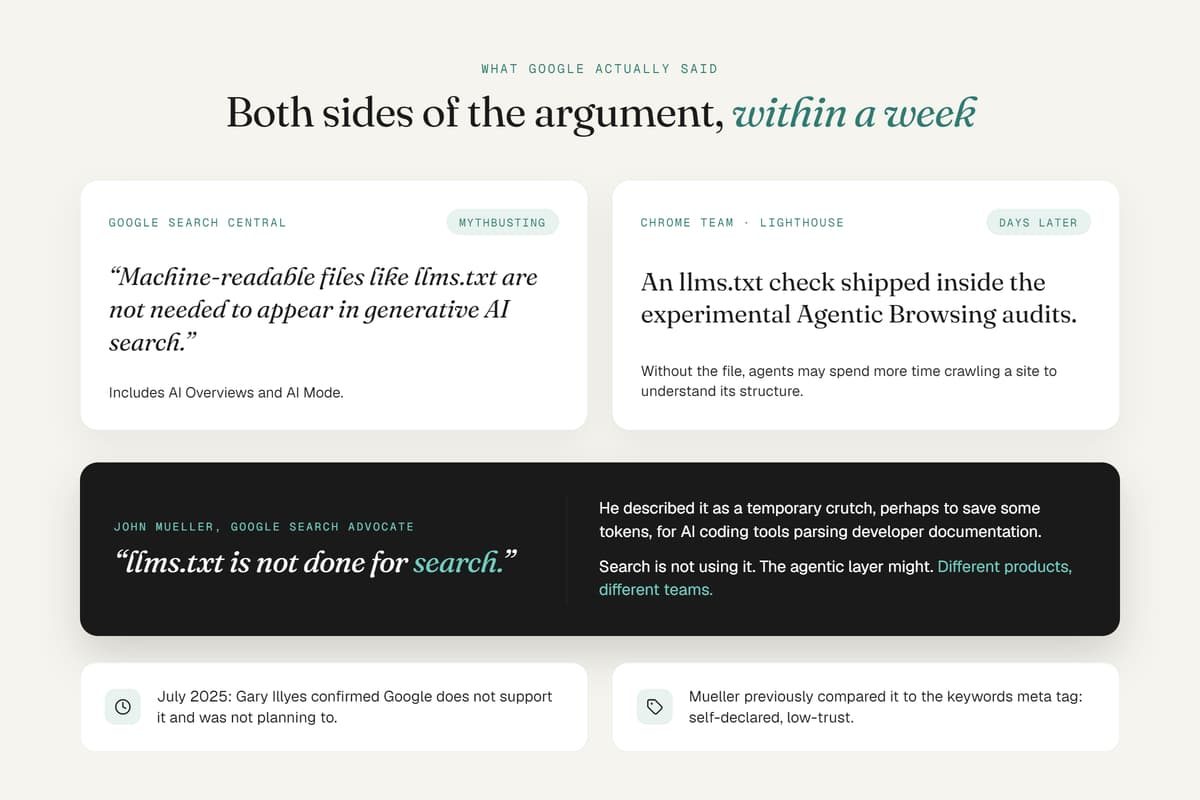
In late May 2026, Google managed to take both sides of this argument within a week.
Google's official guide on optimizing for generative AI features includes a section titled "mythbusting" which tells site owners plainly that machine-readable files like llms.txt are not needed to appear in generative AI search, including AI Overviews and AI Mode.
Days later, the Chrome team shipped an llms.txt check inside Lighthouse's experimental Agentic Browsing audits, with documentation explaining that without the file, agents may spend more time crawling a site to understand its structure.
When Lily Ray put the contradiction to John Mueller, his answer resolved it: llms.txt is "not done for search." He described it as a temporary crutch, perhaps to save some tokens, for AI coding tools parsing developer documentation. He also noted that site owners who check their logs will find very little AI agent traffic at the moment.
That reading is consistent with everything else. Search is not using it. The agentic layer might. Those are different products with different teams.
For context, Gary Illyes had already confirmed in July 2025 that Google does not support llms.txt and was not planning to, and Mueller had previously compared it to the keywords meta tag, a self-declared description of what a site claims to be about, which is exactly the class of signal search engines stopped trusting fifteen years ago.
Meanwhile, none of OpenAI, Anthropic, Perplexity, Meta or Mistral has publicly stated that their production systems read or act on llms.txt. Their published guidance for site owners is about crawler access, user agents and robots.txt.
The one case where the evidence supports it
If you publish developer documentation, APIs or SDKs, publish an llms.txt.
This is the use case with real supporting data. AI coding agents such as Claude Code, Cursor and GitHub Copilot retrieve external documentation in real time when a developer asks a product-specific question. The Ahrefs data shows exactly that: agentic tools are the largest single AI category fetching these files, and Claude-Code specifically was near the top of the list.
This is also the use case the file was originally designed for. Jeremy Howard's proposal was about helping models parse documentation efficiently, not about winning citations in ChatGPT.
Everything else is speculation dressed up as best practice.
The security angle almost nobody mentions
Buried in the Ahrefs bot classification is a detail worth stopping on. The largest single research crawler in their dataset identified itself as prompt-injection-survey/1.0.
Someone is systematically studying llms.txt as a prompt injection surface, precisely because agents are designed to fetch and trust this file.
Think about the shape of the risk. llms.txt is a plain-text file that an autonomous agent reads and treats as authoritative guidance about your site. If it is auto-generated by a plugin nobody reviews, or sits unversioned in a web root where anyone with CMS access can edit it, or goes stale after a site restructure, it becomes a channel for misleading every agent that reads it.
This is not a reason to panic. It is a reason not to let a plugin generate one on your behalf and then forget about it, which is what a large share of existing implementations are. One analysis of the 2025 HTTP Archive data found that a substantial proportion of live llms.txt files are plugin-generated stubs with no curation at all.
Should you publish llms.txt? A decision table
| Your situation | Verdict |
|---|---|
| Developer docs, API reference, SDK, technical product | Yes. This is the documented use case. Publish llms.txt and llms-full.txt. |
| SaaS product where customers use coding agents | Yes, probably. Your buyers' tools will read it. |
| Your CMS or site builder generates it automatically | Fine, leave it, but review what it produced and version-control it. |
| Local service business, clinic, restaurant, trades | No. Zero evidence of benefit. Your AI visibility is decided elsewhere entirely. |
| E-commerce | No. Structured product data and merchant feeds are the lever. |
| Content publisher or media site | No. Your citation rate is driven by authority and freshness. |
| Anyone whose logs already show AI bots requesting /llms.txt and getting a 404 | Yes. Something is asking. Answer it. That is real signal about your specific site. |
The 10-minute test that settles it for your site
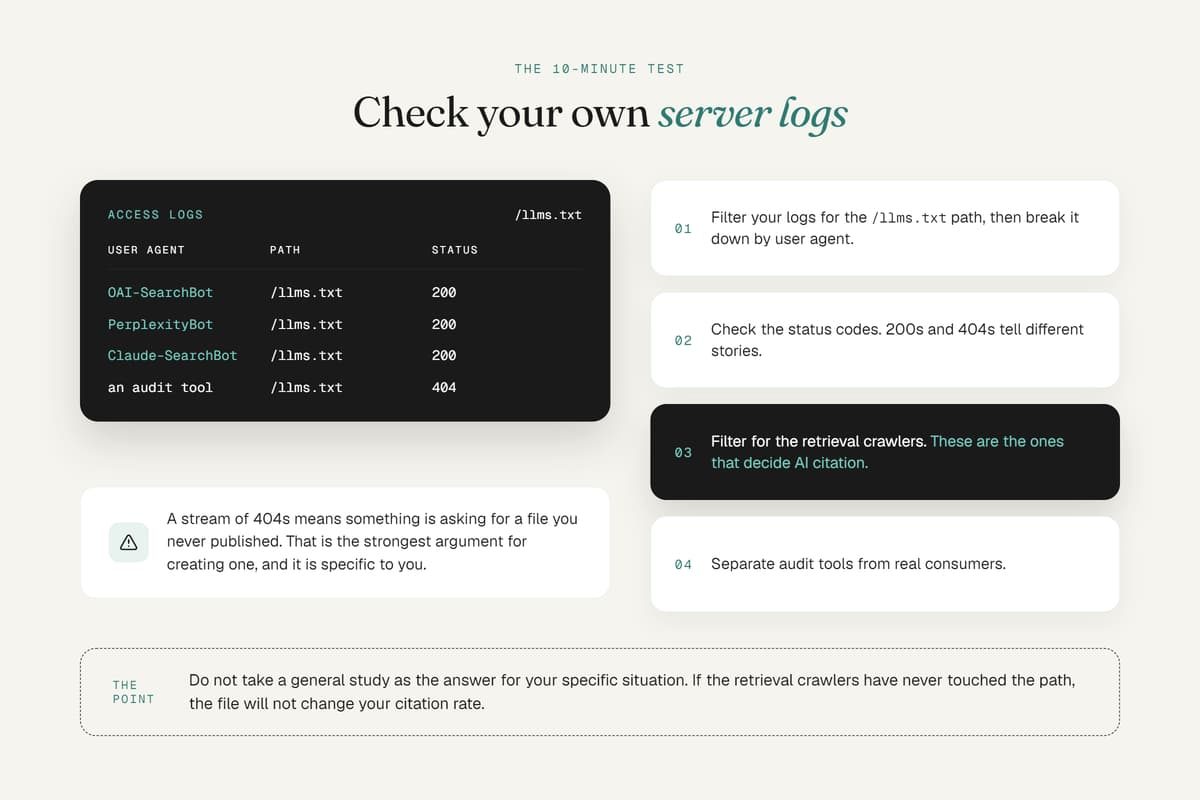
Do not take a general study as the answer for your specific situation. Check your own logs.
1. Look for requests to /llms.txt in your server access logs or CDN analytics. Filter for the path, then break the results down by user agent.
2. Check the status codes. A stream of 404s on /llms.txt means something is asking for a file you never published. That is the strongest possible argument for creating one, and it is specific to you.
3. Filter for the retrieval crawlers specifically: OAI-SearchBot, PerplexityBot, Claude-SearchBot. These are the ones that decide AI citation. If they have never touched the path, the file will not change your citation rate.
4. Separate audit tools from real consumers. If everything hitting the path is an SEO scanner or a validator, you are watching the industry study itself, not demand.
If you have never checked your server logs for AI bot activity at all, that is a bigger gap than llms.txt. It is the first thing we look at in any AI Search SEO audit, and we find blocked retrieval crawlers far more often than we find a missing llms.txt.
If you publish one anyway, do it properly
The file costs almost nothing to make, and reasonable people are hedging. If you are one of them, four rules:
Get the basics right. It must resolve at /llms.txt with a 200 response and be served as text/markdown or text/plain. Serving text/html with Markdown-looking content inside is the single most common failure mode in plugin-generated files.
Curate it, do not dump it. An H1 with your site name, a one-line summary, then H2 sections with links, each carrying a one-sentence description of what the linked page contains. A bare list of URLs with no abstracts is useless to an agent.
Route agents to it. Agents fetch llms.txt when a link, an index or a user instruction tells them it exists. They do not go hunting. Link it from your HTML head or footer, reference it in your docs, and mention it wherever agents receive instructions about your site. An unlinked file is a file nobody will find.
Treat it like code, not content. Version-control it, restrict who can edit it, alert on unauthorized changes, keep it to plain links and descriptions with nothing instruction-shaped in it, link only to resources you control, and review anything a platform generates on your behalf.
What to do instead
Every hour spent on llms.txt is an hour not spent on something with evidence behind it. In rough order of return:
Fix crawler access first. Confirm your robots.txt and CDN rules are not blocking OAI-SearchBot, Claude-SearchBot or PerplexityBot. Blocking a retrieval crawler makes you ineligible for citation on that platform outright. This is a real, documented, binary lever, and plenty of sites are still failing it from the 2023 "block everything" wave.
Make your pages fast and clean. Retrieval crawlers have low tolerance for slow pages and redirect chains. A fast, well-structured site is the actual machine-readability improvement people think they are buying with llms.txt.
Structure your content for extraction. Question-shaped headings, direct answers underneath them, real FAQ blocks, proper schema. The SE Ranking dataset that found nothing for llms.txt did find measurable citation lift associated with FAQPage markup. Structure the pages, not a file about the pages. This is the core of answer engine optimization.
Then do conventional SEO well. The peer-reviewed benchmarking on this is unambiguous: retrieval ranking dominates what an AI answer ends up citing. Competent technical and on-page SEO remains the highest-leverage AI visibility work available.
What would change this verdict
Being honest about evidence means being specific about what would overturn it. Four things:
A major platform commits publicly. If OpenAI, Anthropic, Perplexity or Google states that their production retrieval reads llms.txt, the calculation flips immediately.
Retrieval bot fetch rates climb. Right now they are at 1.1% of a very small pool. If OAI-SearchBot and PerplexityBot start systematically requesting the path, including on sites where it does not exist, that is the signal to watch.
Top-tier adoption moves. Adoption is currently 0% among the top 1,000 domains by traffic. AI engines are unlikely to treat the absence of a file as meaningful while the most-cited sites on the web do not publish it.
The agentic web arrives properly. This is the most plausible path. If autonomous agents end up mediating a meaningful share of commercial discovery rather than retrieval bots fetching pages directly, llms.txt could start mattering through the agent layer. Google has been clear that it sees search becoming agentic. That is a real bet, just not a 2026 one.
We will revisit this article when any of the four happens.
llms.txt is a technically coherent proposal that solved a real problem for AI coding tools and then got marketed as an AI visibility shortcut it was never designed to be. The proposal is fine. The claims built on top of it are not supported by any evidence that currently exists.
Publish one if you run developer documentation, if your platform generates it for free, or if your own logs show agents asking for it. Otherwise, check your robots.txt, speed up your site, structure your content properly, and build the off-site signals that actually determine whether an AI system knows who you are.
If you want to know what is genuinely limiting your AI visibility rather than what is fashionable, start with a free audit. We will check your crawler access, your log data and your citation footprint, and tell you where the real gap is.
Frequently asked questions
Do I need an llms.txt file in 2026? For most commercial websites, no. Five independent studies covering hundreds of thousands of domains found no measurable relationship between publishing llms.txt and being cited by AI systems, and Google's official guidance states you do not need it for AI Overviews or AI Mode.
Does Google use llms.txt? No. Google's guide on optimizing for generative AI features explicitly lists machine-readable files like llms.txt among the things you do not need. John Mueller has described it as not done for search.
Does ChatGPT or Perplexity read llms.txt? Neither OpenAI nor Perplexity documents llms.txt as a signal. In Ahrefs' log analysis, AI retrieval bots accounted for just 1.1% of requests to these files.
Is llms.txt the same as robots.txt? No. robots.txt controls crawler access and is supported by every major AI crawler. llms.txt controls nothing. If you want to manage AI access to your site, that work happens in robots.txt.
Who should publish an llms.txt file? Sites with developer documentation, APIs or SDKs. AI coding agents genuinely retrieve these files, and that is the use case the format was designed for.
Is there any risk to publishing one? Minor but real. Agents are built to trust the file, and security researchers are already probing llms.txt as a prompt injection surface. A stale, auto-generated or compromised file misleads every agent that reads it. Version-control it and review anything a plugin creates for you.
Will this change? Possibly. If the agentic web develops as Google expects, or a major platform commits to reading the file, the answer changes. Adding a file later takes twenty minutes, which is a good reason not to rush it now.
Continue reading
Read the latest issues
Discussion