
GEO, AEO, and LLM SEO
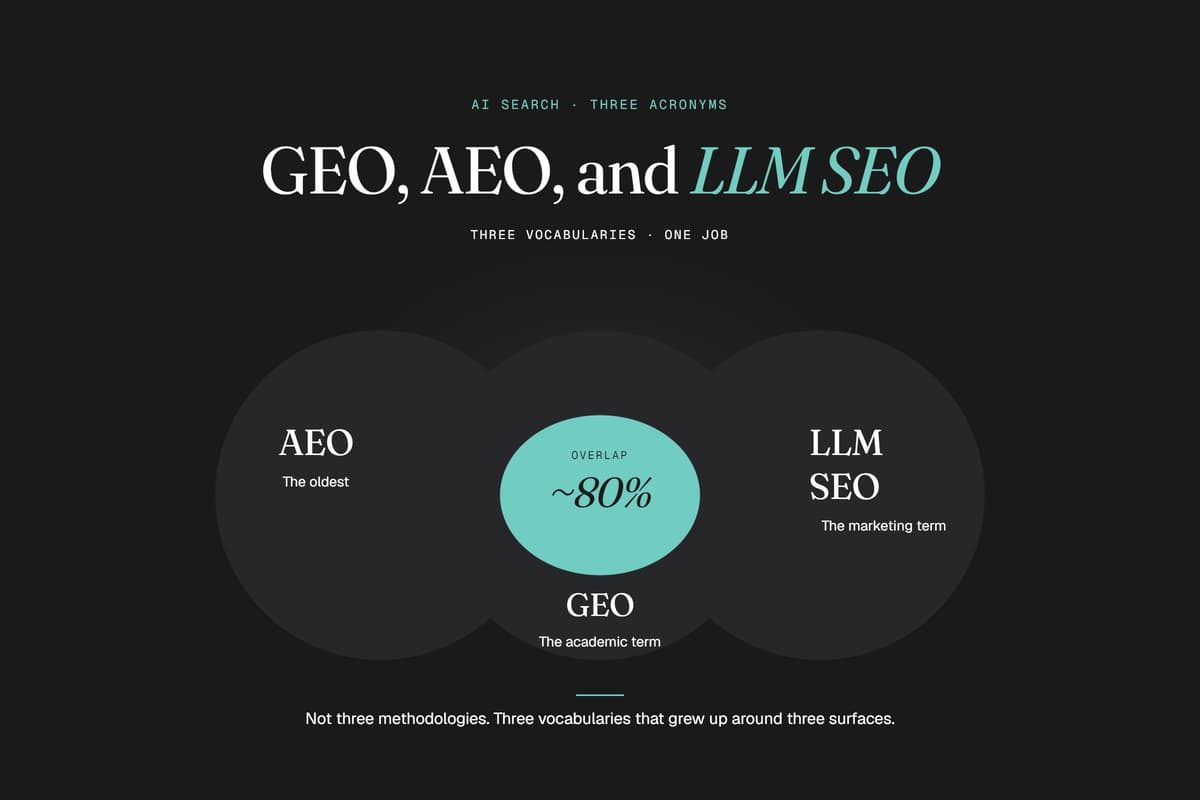
AEO is optimizing to be extracted as the direct answer. GEO is optimizing to be one of the sources an AI-generated answer is synthesized from. LLM SEO is optimizing to be recognized as a trustworthy brand inside an AI assistant's knowledge, whether or not it searches the web. They overlap heavily, they run on the same foundation, and the strongest published evidence says the foundation matters more than any of the three labels.
Most articles on this topic stop at those definitions. This one covers what actually differs underneath them: how each surface retrieves your content, which crawlers control that, what the peer-reviewed research says (including the study that contradicts the popular one), and how to decide where to spend.
Our LLM SEO and Perplexity SEO programs address both halves separately, because they run on completely different timelines.
GEO, AEO, and LLM SEO: Why Three Acronyms for One Job
Each acronym was coined for a different surface, at a different time, by different people.
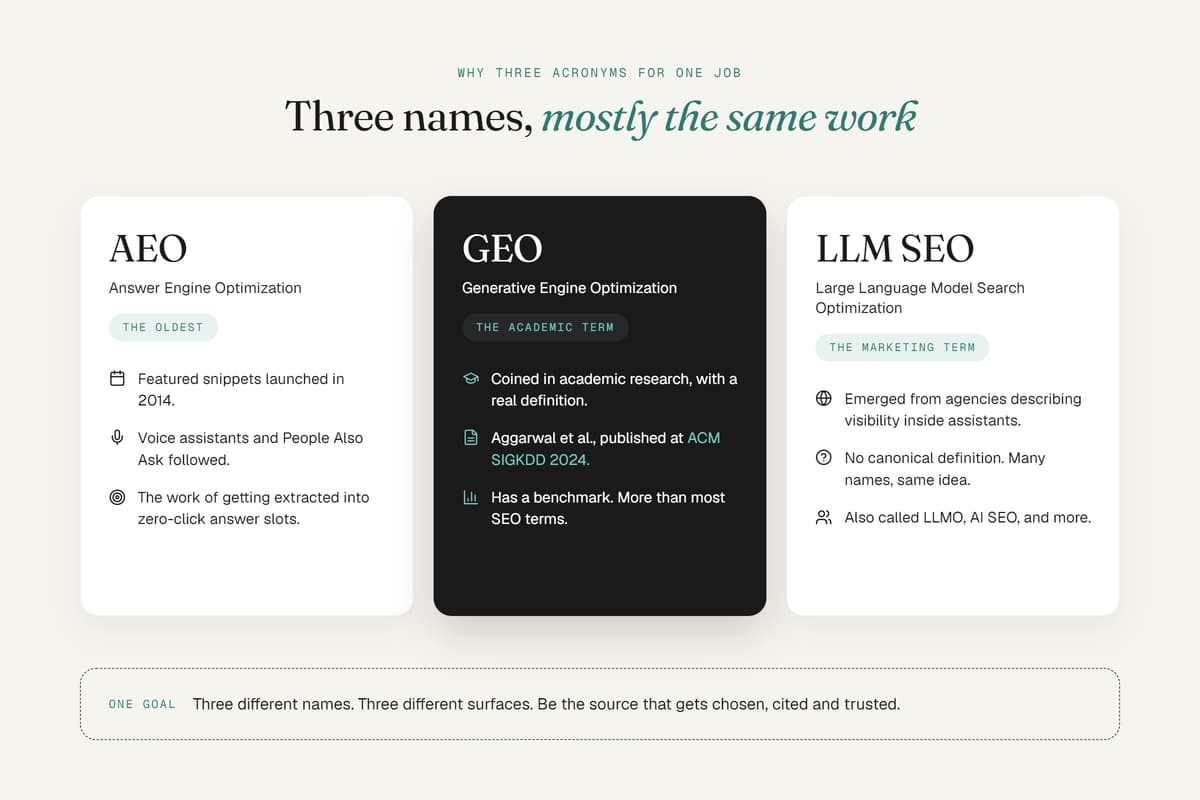
AEO is the oldest. Featured snippets launched in 2014. Voice assistants and People Also Ask followed. Answer engine optimization named the work of getting extracted into those zero-click answer slots, and it predates the current AI wave by roughly a decade.
GEO was coined academically. The term comes from "GEO: Generative Engine Optimization" by Aggarwal, Murahari, Rajpurohit, Kalyan, Narasimhan and Deshpande, published at ACM SIGKDD 2024 by researchers affiliated with Princeton, Georgia Tech, IIT Delhi and the Allen Institute for AI. It has an actual definition and an actual benchmark behind it, which is more than can be said for most SEO acronyms.
LLM SEO is the marketing term. It emerged from agencies describing visibility inside ChatGPT, Claude, Gemini and Perplexity. There is no canonical definition, which is exactly why the industry also calls it LLMO, AI SEO, and half a dozen other things.
So the terms are not three competing methodologies. They are three vocabularies that grew up around three surfaces and now overlap by roughly 80 percent.
What GEO (Generative Engine Optimization) actually is
GEO is optimizing content so that a generative engine selects it as one of the sources it synthesizes an answer from, and ideally cites it.
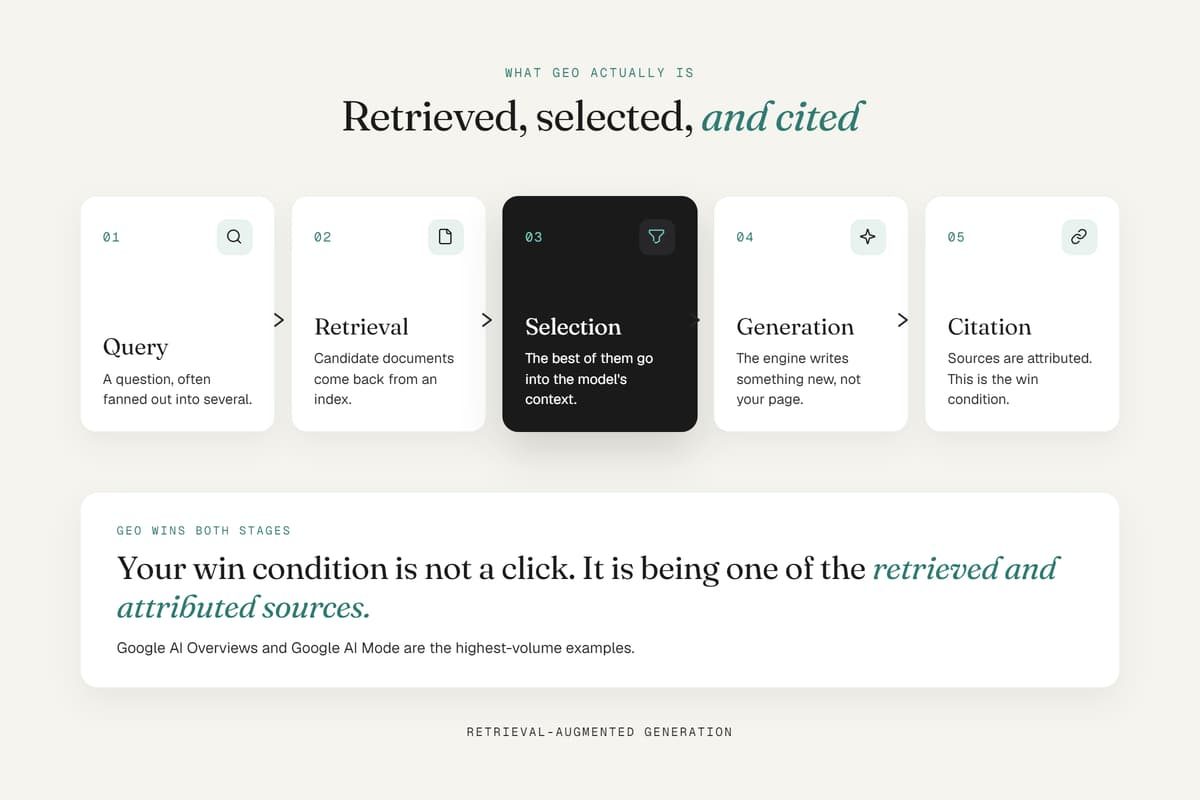
The defining characteristic of a generative engine is that it does not return your page. It reads your page alongside several others and writes something new. Your win condition is not a click, it is being one of the retrieved and attributed sources. Google AI Overviews and Google AI Mode are the highest-volume examples.
The mechanism underneath is retrieval-augmented generation: the system runs a query (often several, fanned out from the original question), retrieves a set of candidate documents from an index, and passes the best of them into the model's context to generate an answer. GEO is about winning both stages, retrieval and selection.
We run this as generative engine optimization for clients who care primarily about AI Overview presence.
What AEO (Answer Engine Optimization) actually is
AEO is structuring content so an answer engine can lift a specific passage out and display it as the response.
The distinction from GEO is extraction versus synthesis. A featured snippet is your words, verbatim, in a box. An AI Overview is a paraphrase of several sources. The tactics that win extraction are formatting-led: a question as the heading, a direct 40 to 60 word answer immediately under it, clean lists and tables, and schema markup that tells the parser what kind of content it is looking at.
AEO also covers voice results, knowledge panel eligibility and People Also Ask. It is the most mature and most measurable of the three, because answer-box win rate has been trackable for years. Our answer engine optimization work sits here.
What LLM SEO actually is
LLM SEO is building the entity signals that make an AI assistant recognize, trust and recommend your brand, in the assistant's own environment rather than in a search results page.
This is the one people get wrong most often, because it splits into two very different problems:
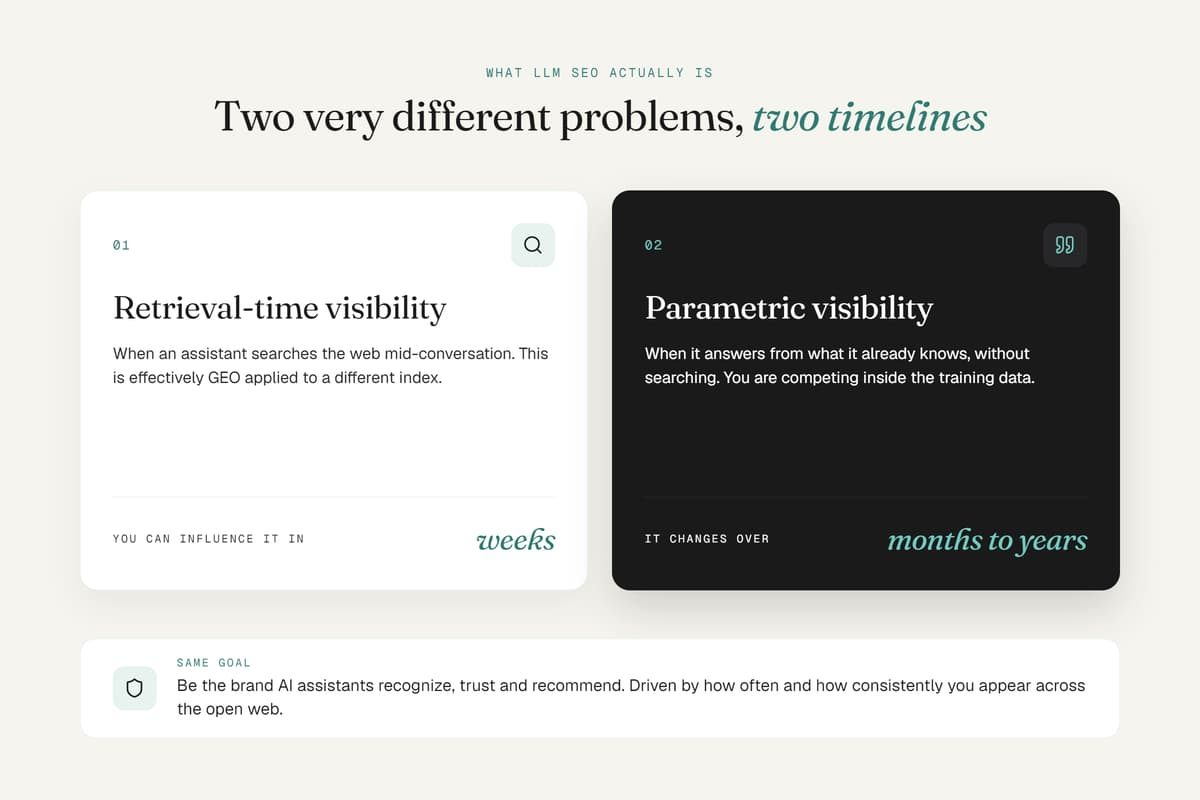
Retrieval-time visibility. When ChatGPT, Claude or Perplexity searches the web mid-conversation, you can influence the outcome in weeks. This is effectively GEO applied to a different index.
Parametric visibility. When someone asks an assistant a question and it answers from what it already knows, without searching, you are competing inside the model's training data. You cannot influence that this quarter. It changes at the next training cycle, which is a horizon of many months to years, and it is driven overwhelmingly by how often and how consistently your brand appears across the open web.
That second half is why LLM SEO leans so heavily on off-site work: brand mentions, third-party coverage, consistent entity data, presence on the directories and lists the models ingested.
The comparison, in one table
| AEO | GEO | LLM SEO | |
|---|---|---|---|
| Win condition | Your passage is extracted verbatim | Your page is retrieved and cited as a source | Your brand is recommended by name |
| Primary surfaces | Featured snippets, PAA, voice, knowledge panels | Google AI Overviews, AI Mode, Bing Copilot | ChatGPT, Claude, Perplexity, Gemini app |
| Mechanism | Passage extraction | Retrieval-augmented synthesis | Retrieval plus parametric memory |
| Tactic emphasis | Formatting, schema, question structure | Authority, extractable evidence, citation-worthiness | Off-site mentions, entity consistency, topical depth |
| Where the work happens | On-site | Mostly on-site | Mostly off-site |
| Primary metric | Answer-box win rate | Citation share in AI answers | Brand mention and recommendation rate |
| Realistic timeline | Weeks | 4 to 8 weeks for retrieval-based surfaces | Weeks for retrieval, many months for parametric |
| Age of discipline | Since roughly 2014 | Named academically in 2024 | Industry term, no canonical definition |
Read across the rows and the pattern is clear: the further right you go, the more the work moves off your website and the longer the feedback loop gets.
How AI Search Surfaces Actually Find Your Content
This is where the practical difference lives, and it is the reason two businesses with identical content can have completely different AI visibility.
Three distinct families of bots touch your site, and they do different jobs:
| Family | What it does | Examples | If you block it |
|---|---|---|---|
| Training crawlers | Collect content for future model training | GPTBot, ClaudeBot, Google-Extended, Applebot-Extended, CCBot | You lose long-term parametric visibility. No effect on live AI answers. |
| Search and retrieval crawlers | Build the live index the assistant queries mid-answer | OAI-SearchBot, Claude-SearchBot, PerplexityBot | You become ineligible for citation in that platform's AI answers. This is the expensive mistake. |
| User-triggered agents | Fetch a specific URL because a user asked | ChatGPT-User, Claude-User, Perplexity-User | Users cannot get your page summarized on request. |
Two consequences follow, and they are the whole reason this section exists.
First, "blocking AI" is not one decision, it is three. OpenAI's own publisher documentation states that sites blocking OAI-SearchBot will not appear in ChatGPT search answers. You can block training while staying fully eligible for AI search citation. Plenty of sites did the opposite by accident during the 2023 and 2024 "block everything" wave and are still paying for it.
Second, your CMS or CDN may have made this decision for you. Many hosting platforms and security plugins ship with AI crawler blocking on by default. Before spending a dollar on GEO, check your live robots.txt and your CDN bot rules. We check this on every AI Search SEO audit and find a blocked retrieval crawler more often than anyone expects.
A reasonable starting posture for a business that wants AI visibility:
# Retrieval crawlers: allow, these decide AI citation eligibility User-agent: OAI-SearchBot Allow: / User-agent: Claude-SearchBot Allow: / User-agent: PerplexityBot Allow: / # User-triggered agents: allow User-agent: ChatGPT-User Allow: / User-agent: Claude-User Allow: / # Training crawlers: a genuine business decision, not a default User-agent: GPTBot Allow: / User-agent: ClaudeBot Allow: / User-agent: Google-Extended Allow: / # Never block this one User-agent: Googlebot Allow: /
Two caveats worth stating plainly. Compliance is voluntary, so a directive only works for bots that honour it, and a spoofed user agent can claim to be anything. And user-triggered fetches are treated by most providers as user-directed access rather than crawling, so robots.txt may not govern them the way you expect. Server-level rules are the enforcement layer if you actually need one.
GEO Research: What the Studies Show and Where They Conflict
Every GEO article cites the same paper. Almost none cite the one that tested it properly.
The Princeton GEO study (Aggarwal et al., KDD 2024). The researchers built GEO-bench, a benchmark of roughly 10,000 queries across multiple domains, and tested nine content modification strategies against a generative engine, validating the strongest on Perplexity. The headline: visibility improvements of up to around 40 percent. The winning tactics were adding statistics, adding credible quotations, and citing sources, with reported relative gains in the 30 to 40 percent range on their position-adjusted word count metric. A frequently quoted secondary finding is an equalizer effect: lower-ranked pages, around position 5, benefited far more than pages already at position 1.
Two things about that number that the industry consistently drops. It is an upper bound, not an average. And it was measured in a single-actor setting, where one document adopts the tactic and nobody else does.
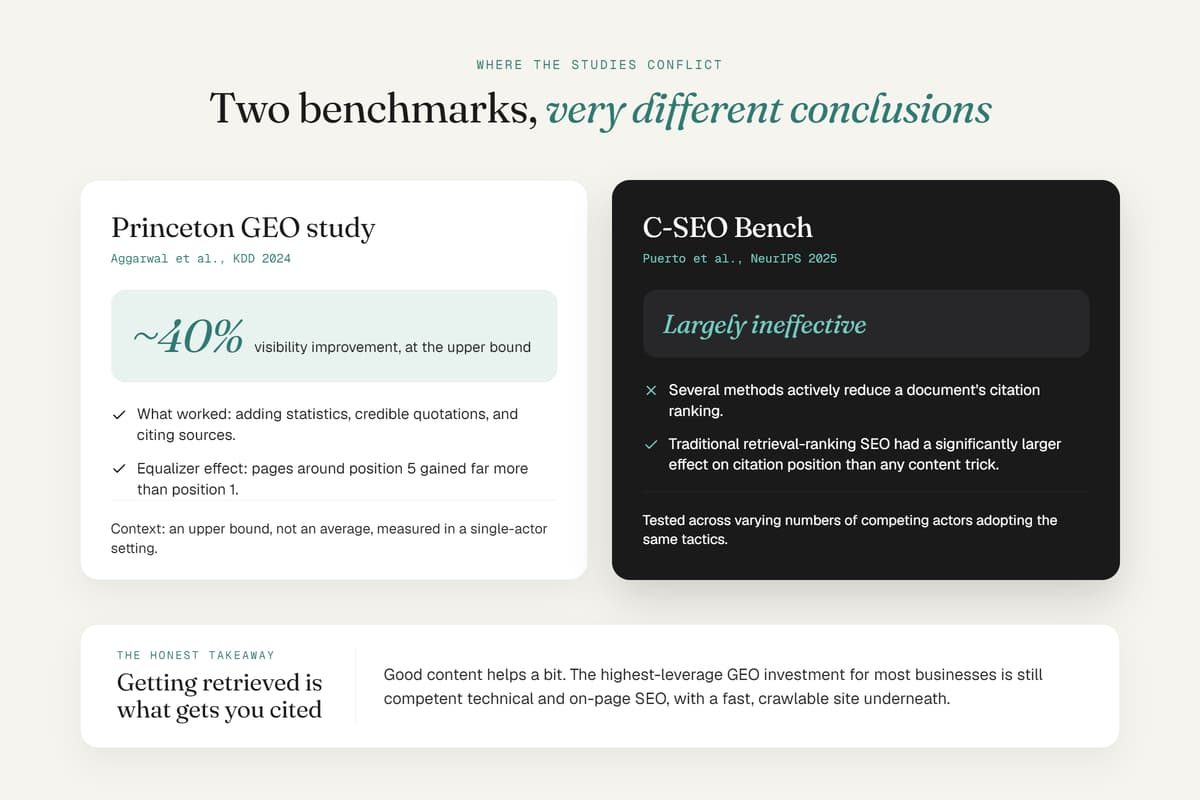
C-SEO Bench (Puerto, Gubri, Green, Oh and Yun, NeurIPS 2025 Datasets and Benchmarks Track). This is the corrective, and it is blunt. The authors built the first benchmark to test conversational SEO methods across multiple tasks, multiple domains and, critically, varying numbers of competing actors adopting the same tactics. Their finding: most C-SEO methods are largely ineffective, and several actively reduce a document's citation ranking. Traditional retrieval-ranking SEO had a significantly larger effect on citation position than any of the content tricks. In their framing, the initial retrieval ranking of a document dominates what the model ends up treating as important, and C-SEO is a congested, close to zero-sum game where marginal gains shrink as adoption rises.
How to read both honestly. Adding real statistics, real quotes and real citations to your content is good practice and probably helps a bit. It is not a lever that reliably produces 40 percent gains once your competitors are doing it too. What consistently determines whether you get cited is whether you get retrieved in the first place, and retrieval is decided by conventional signals: relevance, authority, crawlability, entity clarity.
Which leads to the least fashionable conclusion in this entire topic: the highest-leverage GEO investment for most businesses is still competent technical and on-page SEO, with a fast, crawlable site underneath it.
Do you need all three? A decision framework
You need one content infrastructure with three measurement layers, not three campaigns. But the starting weight genuinely differs by business type.
Local service business (trades, clinics, restaurants, contractors). Priority order: local SEO, then AEO, then LLM SEO, then GEO. Your customers are still overwhelmingly finding you through Maps and local results, and your AI visibility is driven far more by directory and review presence than by page formatting.
Professional services and regulated verticals (law, immigration, healthcare, finance). Priority order: AEO, then LLM SEO, then GEO. Your buyers ask long, comparative, question-shaped queries, which is exactly the extraction sweet spot, and assistants are cautious about recommending regulated providers without strong third-party corroboration.
E-commerce. Priority order: technical and product-schema SEO, then GEO, then LLM SEO. Product recommendation is one of the domains where the C-SEO Bench results were most sobering, so structured product data and merchant feed accuracy beat content tricks.
B2B and SaaS. Priority order: LLM SEO, then GEO, then AEO. Comparison and shortlist queries have moved to assistants faster in B2B than anywhere else, and those answers lean hard on third-party review sites, round-ups and editorial mentions rather than your own site.
What this means for a local business in Toronto and the GTA
If you run a local business, here is the honest translation of all three acronyms into your situation.
Your AI visibility problem is mostly not a content problem. When an assistant is asked for the best plumber in Scarborough or a family dentist in North York, it is not reading your service page and grading your prose. It is assembling an answer from directories, review platforms, editorial round-ups and local listings. That means the highest-return AI work for a GTA business overlaps almost entirely with local citation building and review presence, not with rewriting your homepage.
Ranking in the Map Pack does not carry over automatically. Independent 2026 analyses of AI local recommendations found that less than half the businesses leading Google local results also appear in AI-generated local recommendations. Strong Map Pack ranking is necessary and not sufficient.
AEO is the cheapest win available to you. Adding a proper FAQ block with direct, honest answers to your service pages improves featured snippet eligibility, AI Overview eligibility and assistant citation at the same time, for one piece of work.
How to measure each layer
Different acronyms, different KPIs. If you are measuring all three with organic sessions, you are measuring none of them.
AEO: answer-box and PAA win rate for your target question set, tracked in a rank tracker that reports SERP features. Impressions with flat clicks in Search Console is often a healthy AEO signal, not a failure.
GEO: AI Overview presence and citation share for your priority queries. Track which of your URLs get cited and which competitor gets cited instead.
LLM SEO: a fixed prompt set. Write 20 to 40 prompts a real buyer would type, run them monthly across ChatGPT, Gemini, Perplexity and Claude, and log three things: whether you are mentioned, whether you are cited with a link, and what the assistant says about you. Sentiment matters as much as presence.
Underneath all three: AI referral traffic segmented in GA4, and AI bot hits in your server logs. If OAI-SearchBot has never touched your site, no amount of content work will fix your ChatGPT visibility.
Common mistakes we see
Treating the acronyms as products. Any agency selling GEO, AEO and LLM SEO as three separate retainers with three separate content plans is selling you the same work three times.
Skipping the foundation. Both academic studies point the same direction: retrieval ranking dominates. A site that cannot be crawled quickly and understood clearly will not be cited no matter how many statistics you sprinkle into it.
Optimizing for the model instead of the reader. The C-SEO Bench results found several content manipulation tactics actively hurt citation ranking. Prompt-injection-style tricks and hidden instructions belong in the same bin as keyword stuffing.
Ignoring off-site entirely. The one thing you cannot fix on your own website is what the rest of the web says about you, and that is the single strongest input to assistant recommendations.
Expecting parametric change on a quarterly timeline. If a model has never heard of your brand, publishing twelve blog posts will not change that this year. Getting mentioned on sites the models actually ingest will, eventually.
A realistic 60-day starting plan
Days 1 to 10. Audit access. Check robots.txt, CDN bot rules and server logs for every AI user agent. Fix anything blocking retrieval crawlers. Confirm crawlability and page speed.
Days 11 to 25. Build the prompt set and take a baseline across all four assistants. Baseline AI Overview presence for your priority queries. You cannot report progress without a starting line.
Days 26 to 45. AEO pass on your top 10 pages: question-shaped H2s, direct 40 to 60 word answers under each, FAQ blocks, FAQPage and appropriate entity schema, real data and real sources added where you have them.
Days 46 to 60. Off-site: fix entity consistency everywhere your business is listed, and start earning the third-party mentions and round-up placements that feed assistant recommendations.
Re-run the prompt set at day 60. Then monthly.
GEO, AEO and LLM SEO are three vocabularies describing one shift: search stopped being a list and started being an answer. The distinctions between them are real but narrow, and the evidence points somewhere unglamorous. Be crawlable by the right bots. Be genuinely authoritative. Answer questions directly. Be mentioned consistently across the web. Then measure each surface on its own terms.
If you want to know which of the three is actually costing you visibility right now, start with a free audit and we will show you where you appear, where you do not, and which layer to fix first.
Frequently asked questions
What is the difference between GEO and AEO? AEO optimizes for your content to be extracted verbatim as a direct answer, such as a featured snippet. GEO optimizes for your content to be retrieved and synthesized into an AI-generated answer, such as a Google AI Overview, where you appear as a cited source rather than as the answer itself.
Is LLM SEO the same as GEO? They overlap but are not identical. GEO usually refers to AI answers inside search engines. LLM SEO refers to visibility inside AI assistants users go to directly, which includes both live retrieval and the model's own training knowledge. The training-knowledge half has no GEO equivalent.
Is traditional SEO dead? No. C-SEO Bench (NeurIPS 2025) found that traditional retrieval-ranking SEO had a significantly larger impact on citation rankings inside AI answers than dedicated conversational SEO tactics did, and that most of those tactics were largely ineffective. SEO is the foundation the other three stand on.
Does GEO really increase visibility by 40 percent? The Princeton GEO study (KDD 2024) reported gains of up to roughly 40 percent for tactics like adding statistics, quotations and citations. That figure is an upper bound measured in a single-actor setting. Later multi-actor benchmarking found much smaller and sometimes negative effects once many sites adopt the same tactics.
Should I block AI crawlers? Only deliberately, and only the training ones if that is your policy. Blocking search and retrieval crawlers such as OAI-SearchBot, Claude-SearchBot or PerplexityBot removes you from eligibility for citation in those platforms' AI answers.
How long does AI visibility work take? Roughly 4 to 8 weeks to see citation changes on retrieval-based surfaces after publishing or updating content. Influencing what a model knows about you without web search takes far longer, because it depends on the next training cycle.
Do I need a different agency for each? No. The signals overlap heavily. What changes between them is measurement and the balance of on-site versus off-site work, not the team.
Continue reading
Read the latest issues
Discussion