
Does ChatGPT Recommend My Business?
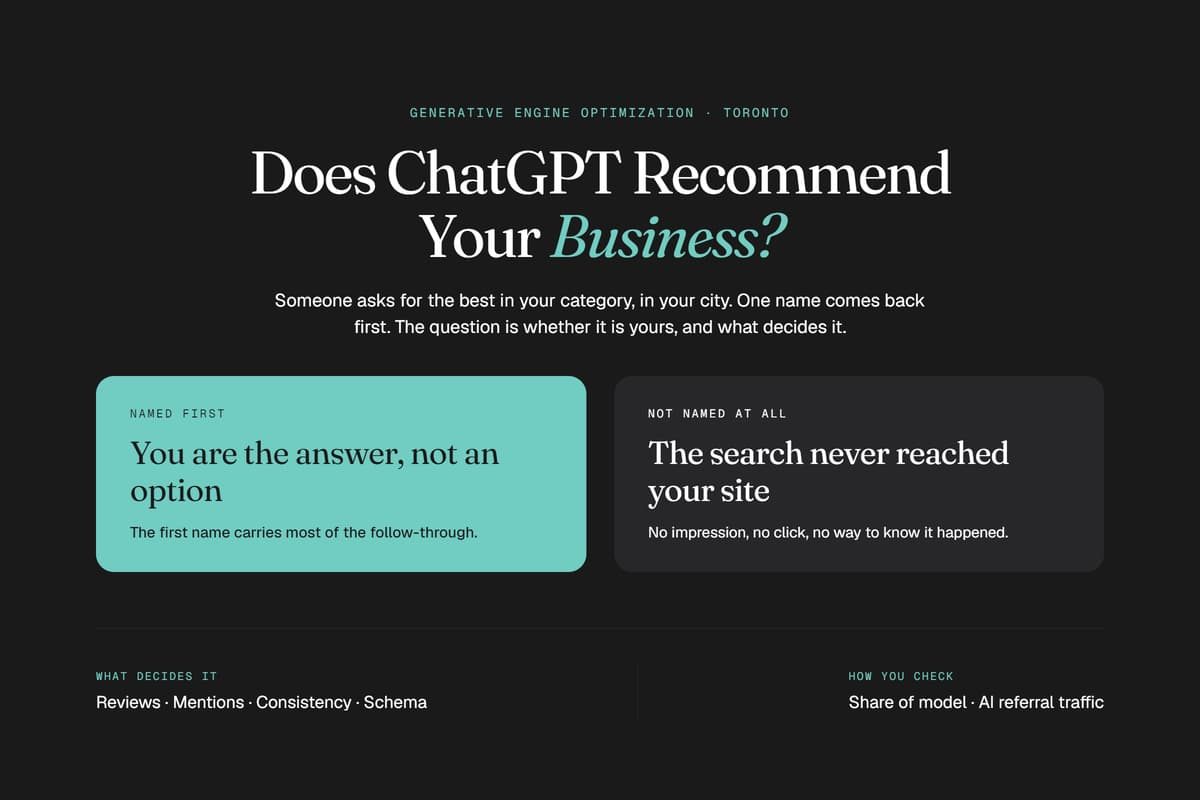
Does ChatGPT Recommend My Business?
When a buyer asks ChatGPT "who is the best [service] in Toronto?", it does not hand back ten links. It names a short list of businesses, and the ones it names get the lead while everyone else stays invisible. So the question that matters is not only whether you appear, it is whether ChatGPT recommends your business by name at the moment a buyer is deciding. That outcome is earned through the trust signals that dedicated AI search SEO is built around, and it works differently from your Google ranking. Here is how AI chooses who to recommend, why it may be picking your competitor, how to become the name it names, and how to actually measure it.
Maybe, and maybe not consistently. ChatGPT recommends the businesses it trusts most for a query, based on reviews, third-party mentions, consistent listings, and clear structured data. Because its answers are probabilistic, you may be named in one response and skipped in the next. The goal is to raise your odds of being the recommended name.
Mentioned vs Recommended: They Are Not the Same Thing
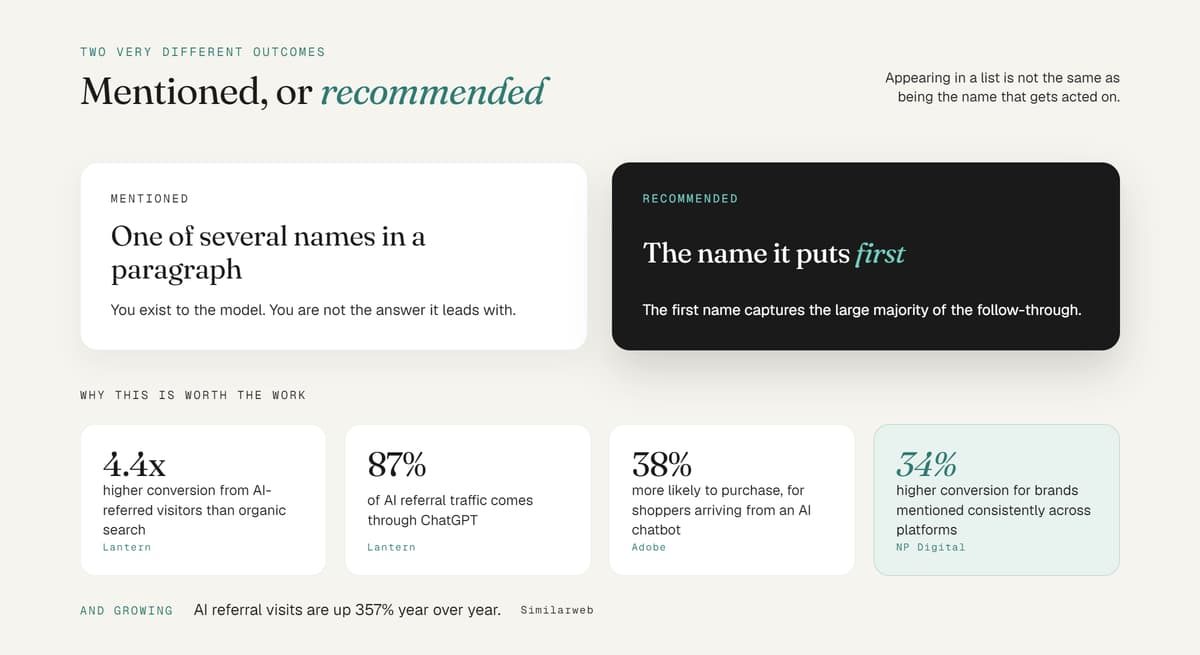
There is a real difference between being mentioned and being recommended, and it decides whether you win the customer. A mention names you in passing. A recommendation presents you as the answer, the business someone should actually call. To a buyer, that reads as neutral, third-party validation, and validation reduces hesitation. Because AI recommendations arrive pre-qualified, the click that follows tends to be a high-intent buyer rather than a casual browser, which is why this is worth getting right even while overall AI traffic is still small.
| Mentioned | Recommended | |
|---|---|---|
| What ChatGPT does | Names you among several others | Presents you as the answer to call |
| How buyers read it | One option in a list | Trusted, neutral endorsement |
| Effect on leads | Little follow-through | Captures most of the follow-through |
| Typical position | Middle or bottom | First or near-first |
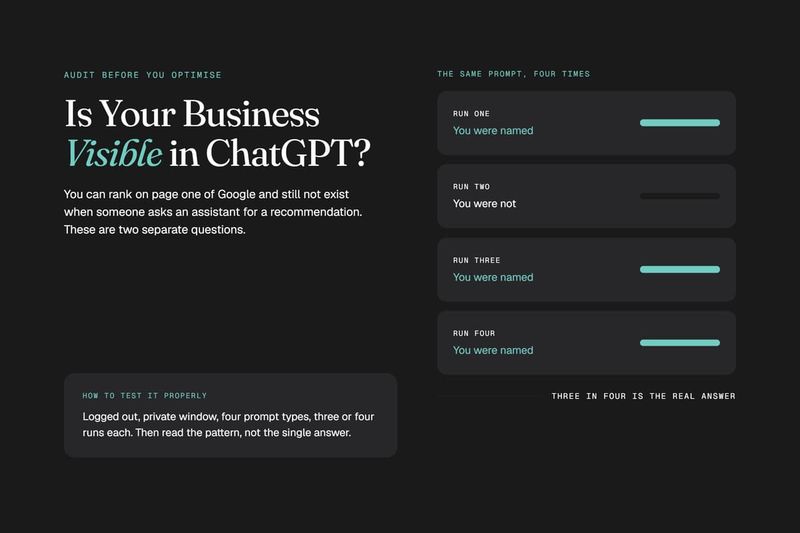
Position matters as much as presence. ChatGPT usually surfaces two to four names, and the first one captures the large majority of follow-through, with each later slot getting far less. Moving from third mention to first is not vanity, it changes how many buyers investigate you. If your first goal is simply confirming you show up at all, our companion guide on whether your business is visible in ChatGPT walks through the full diagnostic test.
How ChatGPT Decides Which Business to Recommend
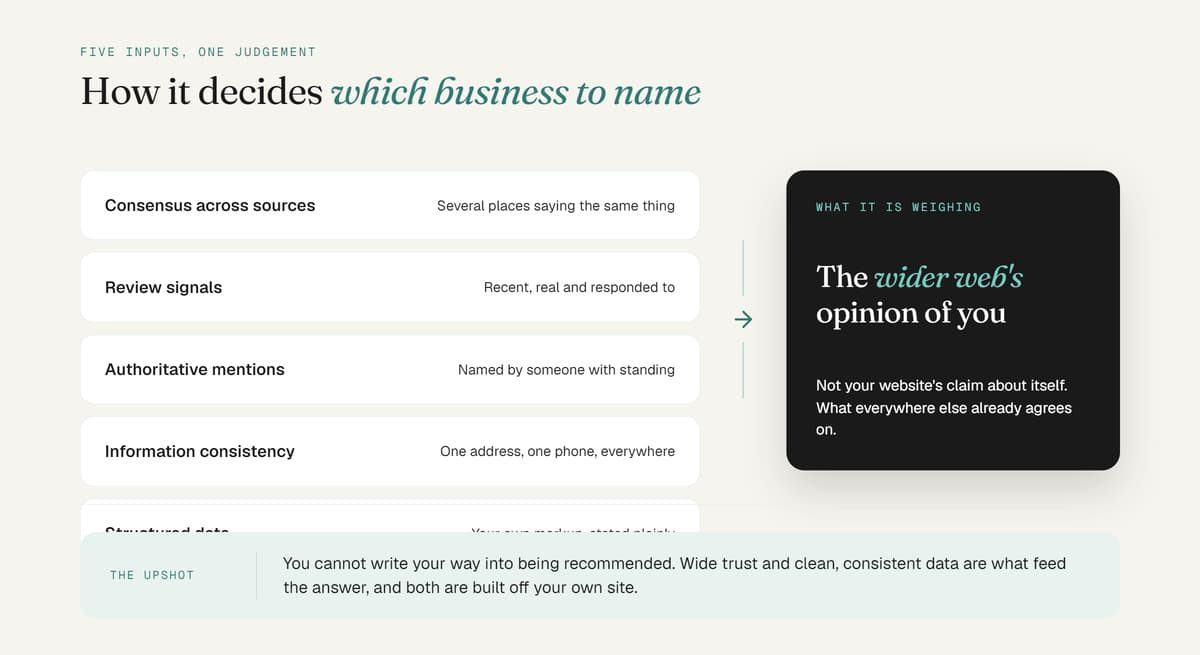
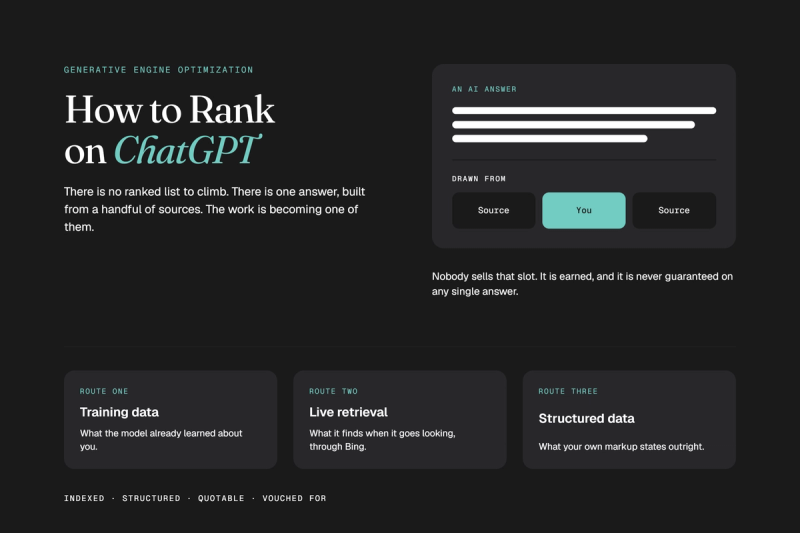
ChatGPT does not run a fresh Google search each time. It draws on what it learned in training, on live retrieval when it browses (leaning on the Bing index and, for local, on sources like Google Business Profile), and on structured signals about you. Its picks also echo what already ranks and is widely trusted, so a strong foundation of SEO services feeds directly into who gets recommended. These are the trust factors that move you into the recommendation:
| Signal | Why it drives a recommendation | How to strengthen it |
|---|---|---|
| Consensus across sources | AI recommends the business the wider web already agrees is good | Get named positively across reviews, directories, and round-ups |
| Review signals | Strong, recent reviews make you the safer local pick | Generate and respond to reviews consistently |
| Authoritative mentions | A credible feature outweighs a generic listing | Earn press, local media, and industry-list placements |
| Information consistency | Conflicting details lower the model's confidence | Keep NAP and service info identical everywhere |
| Structured data / entity clarity | Clean schema lets AI recommend you with confidence | Add and validate Organization, LocalBusiness, Service, and FAQ schema |
Why ChatGPT Recommends Your Competitor Instead of You
If AI names a competitor and skips you, it is rarely random. Usually one of these gaps is the cause:
- Their review profile is stronger. More recent, higher-quality reviews on the platforms AI trusts make them the safer recommendation.
- They are cited where you are not. If competitors appear in the directories, review sites, and "best of" round-ups AI leans on, the model has more reasons to name them.
- Your data is inconsistent. Mismatched details across your site, Google Business Profile, and directories quietly erode the confidence AI needs to recommend you.
- Your entity is fuzzy. A site that never states plainly what you do and who you serve produces a weak entity the model will not stake a recommendation on.
- ChatGPT is not confident enough to recommend anyone. In sensitive or thin-data cases it gives a generic answer with no names. The fix is to supply so much clear, validated information that recommending you becomes the confident, factual answer.
How to Get ChatGPT to Recommend Your Business
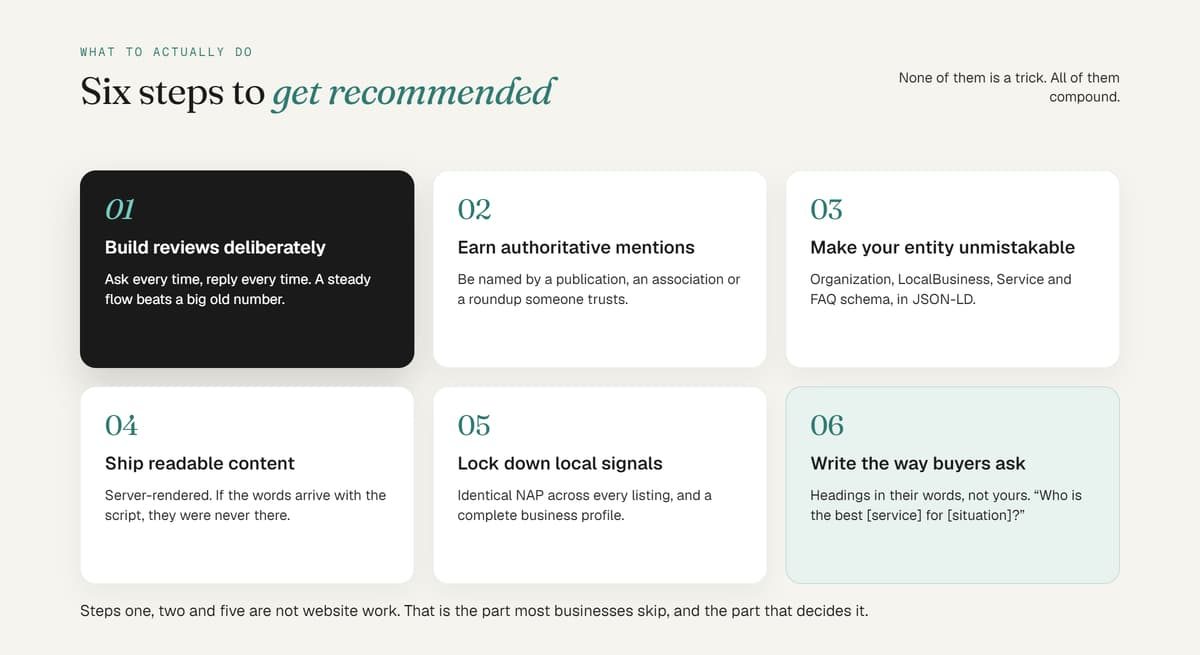
You cannot pay OpenAI for a recommendation, and one blog post will not do it. Recommendations are earned by making your business the option the web already trusts. Work these levers in order of impact:
1. Build reviews and reputation deliberately. Ask happy customers for reviews across Google and the platforms your industry is judged on, and respond to every one. Run these requests at scale with review-and-referral email marketing so the signal keeps growing without manual chasing.
2. Earn authoritative mentions. Get featured, quoted, or listed in credible publications, local media, and respected industry round-ups. A few strong third-party mentions move you from "known" to "recommended" faster than anything on your own site.
3. Make your entity unmistakable with schema. Implement and validate Organization, LocalBusiness, Service, and FAQ schema in JSON-LD. This structured-data work is the core of getting recommended across ChatGPT, Perplexity, and Gemini, not just being listed.
4. Ship server-rendered, readable content. AI crawlers often do not run JavaScript, so the words they need must be in the initial HTML. A fast, custom-built website that serves clean HTML is what lets the model read, trust, and cite you.
5. Lock down local signals. Keep NAP identical everywhere and your Google Business Profile complete and current. For local recommendations this is decisive, and it is exactly what local SEO exists to tighten.
6. Write the way buyers ask. Publish clear content that answers real questions like "best [service] for [situation]" and format it conversationally with FAQ blocks, since that is the language AI matches against recommendation prompts. Pair it with AI automation for instant lead follow-up so the buyers AI sends you actually convert.
Is It Even Worth It? What the Data Says
AI referrals are still a small share of total traffic, but two things make them matter now: they convert unusually well, and they are compounding fast. The businesses building a baseline today will have a head start their competitors will not.
| Finding | Source | Why it matters |
|---|---|---|
| ChatGPT drives roughly 87% of AI referral traffic | Lantern, 2026 | Missing from ChatGPT is the single biggest AI gap |
| AI-referred visitors convert about 4.4x higher than organic search | Lantern, 2026 | A recommendation pre-qualifies the buyer before the click |
| Shoppers from AI chatbots were 38% more likely to purchase | Adobe, Black Friday 2025 | AI traffic is high-intent, not casual browsing |
| Brands consistently mentioned across platforms saw up to 34% higher conversion | NP Digital | Consistent mentions compound into revenue |
| AI referral visits reached about 1.1 billion in June 2025, up 357% year over year | Similarweb | Small today, compounding quickly |
How to Measure Whether ChatGPT Is Recommending You
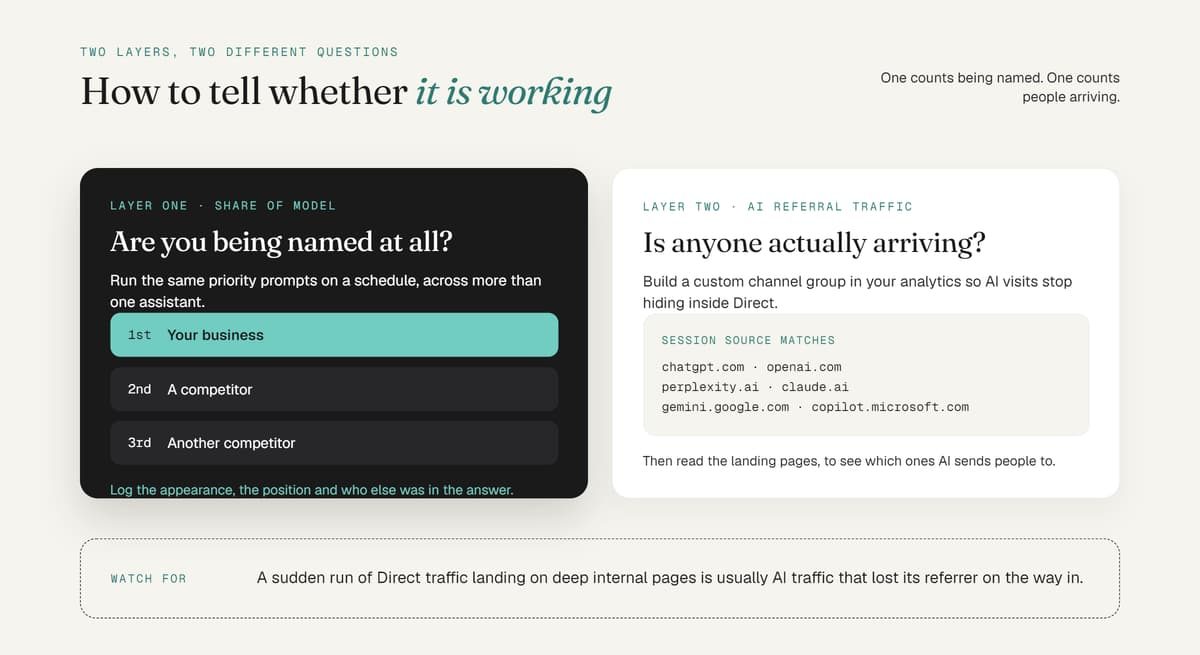
Most guides stop at "get recommended" and never tell you how to know if it is working. There are two layers to track.
Track the mentions (share of model). Run your priority category and problem prompts across ChatGPT, Perplexity, and Gemini on a schedule, and record whether you appear, in what position, and how you stack up against competitors. That competitor-relative view is your share of model, and a free AI visibility audit can establish that baseline for you.
Track the clicks (GA4). By default, GA4 buries ChatGPT visits inside the generic Referral bucket, and clicks from the free app often arrive with no referrer at all, showing up as Direct. To surface what you can:
- In GA4, go to Admin, then Data Display, then Channel Groups, and create a new group.
- Add a channel named "AI Traffic" with a Session source condition set to matches regex, using a pattern that covers
chatgpt.com,openai.com,perplexity.ai,claude.ai,gemini.google.com, andcopilot.microsoft.com. - Drag the new channel above Referral (GA4 reads top down), then save.
- Review Acquisition, then Traffic acquisition, and add Landing page to see which pages AI sends people to.
Treat the GA4 number as a floor, not a ceiling, since copy-paste and no-referrer visits will always leak into Direct. A useful tell is a rise in Direct traffic landing on deep service or blog pages rather than your homepage, which usually signals hidden AI referrals.
How Long Until ChatGPT Starts Recommending You
Set realistic expectations, because this is earned and probabilistic. Cleaning up schema and listings can lift you from invisible to occasionally mentioned within weeks. Consistent recommendations for competitive category prompts build over months as reviews and citations accumulate.
| Timeframe | What to expect | What to focus on |
|---|---|---|
| Month 1 | Minimal change, groundwork only | Fix schema, listings, and NAP consistency |
| Month 2 | Occasional mentions appear | Build reviews and first third-party citations |
| Months 3 to 4 | Regular appearances for category prompts | Earn authoritative mentions, expand FAQ content |
| Months 6 to 12 | Consistent recommendations, higher positions | Sustain reviews, citations, and content depth |
Even a strong business will not be named in every single response, so the target is a higher probability of inclusion, not guaranteed placement.
Getting Recommended in AI Search: A Toronto Advantage
AI search is still an open field, and few GTA businesses have optimized for recommendation rather than mere presence, so review depth, schema quality, and earned mentions can outperform a bigger competitor's budget right now. To see exactly where ChatGPT places you against your competitors today, a free AI visibility audit maps the specific gaps to close. You can also see how this has worked for real businesses in our case studies.
Frequently Asked Questions
Does ChatGPT recommend my business right now? It depends on how much the web already trusts you. With strong reviews, consistent listings, third-party mentions, and clear structured data, ChatGPT is more likely to name you for relevant prompts. Test it by asking category questions in a logged-out window and noting whether you appear, and in what position.
How does ChatGPT decide which business to recommend? It leans on consensus across trusted sources: reviews, directories, credible publications, and consistent business data, reinforced by structured data on your site. It tends to echo businesses that already rank well and are widely validated, so recommendations reward earned authority rather than ads or keywords alone.
Can I pay to get ChatGPT to recommend my business? No. Unlike Google Ads, OpenAI does not sell placement in organic business recommendations. Ad formats around AI are starting to appear, but the reliable path is earned: strong reviews, authoritative mentions, consistent listings, and well-structured content that gives the model confidence in you.
Why does ChatGPT recommend my competitor and not me? Usually because they have stronger review signals, more third-party citations, more consistent data, or a clearer entity definition. AI recommends the option it is most confident about, so if a competitor is easier to verify and more widely validated, the model defaults to them until you close those gaps.
How can I tell if ChatGPT is sending me customers? Set up a custom AI channel in GA4 to separate AI referrals from generic Referral traffic, and watch for Direct-traffic spikes on deep pages, which often signal no-referrer AI clicks. Pair that with regular prompt testing to track your share of recommendations against competitors over time.
Is being recommended by ChatGPT different from ranking on Google? Yes. A business can rank on page one of Google and never be recommended by ChatGPT, because AI weighs reviews, citation consensus, and content structure differently. You need to earn and monitor both, since they draw on overlapping but distinct signals.
Continue reading
Read the latest issues
Discussion