
How to Appear in Perplexity AI Search Results

Perplexity does not hand back ten blue links. It writes one answer and puts a short, numbered list of sources underneath it, usually five to eight. Appearing in Perplexity AI search results means being one of those sources, or being named inside the answer text itself. That is a much narrower target than page one of Google, and it is won in a slightly different way.
The good news is that most of the work sits inside things you already control: crawler access, page structure, and what other websites say about you. The rest of this guide walks through the full process we use on Perplexity SEO projects, in the order we actually run it.
What Appearing in Perplexity Search Results Actually Means
There are three separate outcomes people lump together, and they are not won the same way:
- Citation. Your URL appears in the numbered source list under the answer. This is the one that sends referral traffic.
- Brand mention. Perplexity names your company in the body of the answer, often while citing someone else's page, such as a review site or a best-of list.
- Follow-up visibility. Your brand appears in the suggested related questions, which keeps you in the conversation after the first answer.
Citations come from on-page work. Brand mentions come almost entirely from off-page work. Any plan that only covers one of the two will underperform, which is the single most common mistake we see when auditing an AI SEO account. If the terminology is still fuzzy, our breakdown of GEO vs AEO vs LLM SEO sorts out which label covers what.
How Perplexity Builds an Answer and Chooses Its Sources
Perplexity is not reselling someone else's results. It runs its own continuously refreshed index, and an answer is assembled in roughly four moves.
Query Understanding and Decomposition
A question gets interpreted and, for anything complex, split into sub-questions. A query like "best AI receptionist for a dental clinic in Toronto" quietly becomes several smaller searches about AI receptionists, dental software, and local providers. Each sub-question pulls its own candidate sources, which is why one answer can cite pages that have nothing in common with each other.
Live Retrieval
The engine pulls a large candidate set from its index in real time. Freshness carries real weight here, especially on topics where the correct answer changes month to month: pricing, software comparisons, regulations, anything with a year attached.
Reranking
Far more pages are retrieved than ever get cited. The filter favours semantic match over raw popularity, which is the reason a small site with one genuinely precise page can beat a large domain with a vague one. Perplexity has never published its ranking formula, but the observable pattern across accounts is consistent: relevance, freshness, source reputation, and how cleanly the page can be parsed.
Synthesis
A language model writes the answer and attaches citations to the claims it used. If your page states a fact in one clean sentence, that sentence is easy to lift and attribute. If the same fact is spread across three paragraphs and a table, it usually is not.
One practical consequence runs through everything below: you are not optimizing a page to rank, you are optimizing passages to be quoted.
Step 1: Confirm PerplexityBot Can Reach Your Website
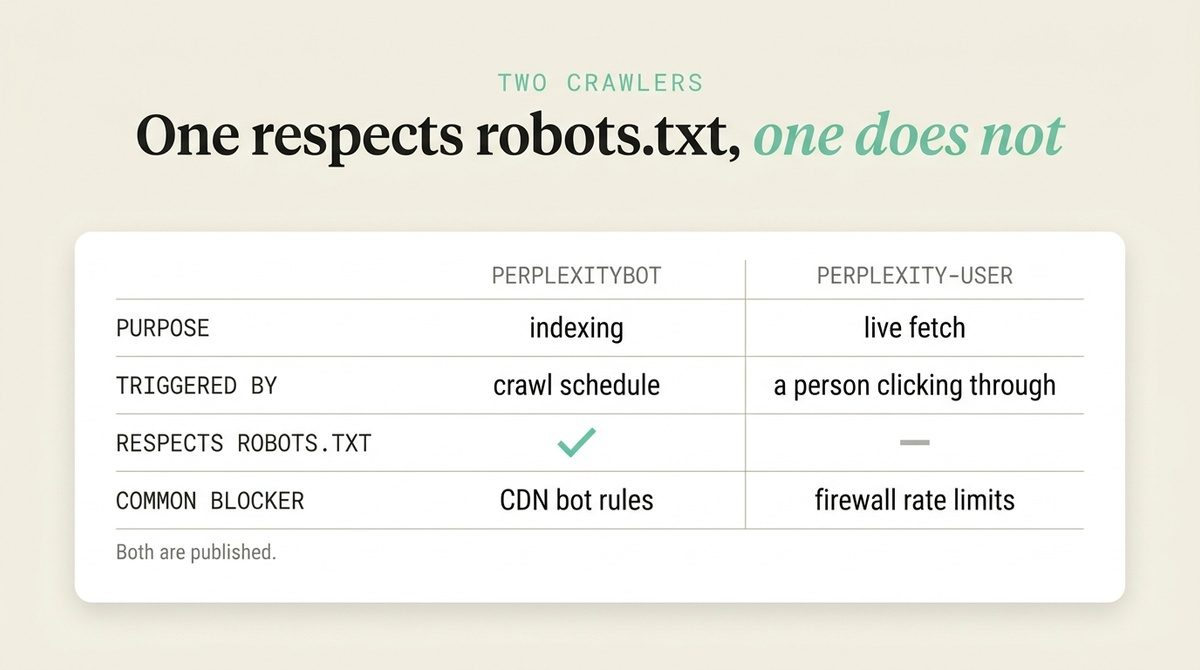
Nothing else matters if the crawler never arrives. Perplexity uses two separate user agents and they behave differently:
- PerplexityBot crawls and indexes pages so they can be surfaced and linked in answers. It respects robots.txt. Perplexity states this bot is not used to train foundation models.
- Perplexity-User fetches a page when a human in the product clicks through to it or asks for it directly. Because a person initiated the request, it generally is not governed by robots.txt.
Check three places, in this order:
- robots.txt. Look for a blanket disallow aimed at AI crawlers. Plenty of sites added one during the 2024 scraping panic and never revisited it.
- Your CDN or WAF. Cloudflare, Sucuri and similar services ship bot-management presets that block AI agents by default. This is the quietest failure of the three, because robots.txt looks perfectly fine while the firewall returns a 403.
- Server logs. Filter for PerplexityBot and Perplexity-User. If neither has visited in the last 30 days, you have your answer. Perplexity publishes verified IP ranges for both agents, so you can whitelist by user agent and confirm by IP rather than trusting the string alone.
Everything in this step belongs to technical SEO, and it is worth running before writing a single new word. We have audited sites that spent six months producing AI-focused content while one firewall rule kept every engine out.
Step 2: Make the Right Pages Indexable
Once the crawler can reach you, make sure the pages you care about are actually eligible. Crawl the site with Screaming Frog or a similar tool and check for noindex tags left behind from a staging environment, canonical tags pointing somewhere unexpected, important content that only renders after JavaScript executes, and orphan pages with no internal links.
Perplexity reads HTML. Content that only appears after a click, inside an accordion that loads on demand, or behind a client-side framework with no server-rendered fallback is content it may never see.
Step 3: Answer the Question in the First Two Sentences
This is the highest-leverage on-page change available, and it costs nothing.
Open every page with a direct, self-contained answer to the question that page targets, then expand underneath. Not a scene-setting introduction, not a paragraph about why the topic matters. A definition or a number, stated plainly, in a sentence that still makes sense when it is lifted out of the page and dropped into an answer.
A page about pricing should say what the range is in the first forty words. A page about a process should say how long it takes. If a sentence needs the three sentences before it to be understood, it is not quotable, and quotable is the whole game.
Step 4: Structure Pages the Way the Engine Reads Them
Formatting is not decoration here, it is extraction. The patterns that consistently get pulled into answers:
- Descriptive headings. An H2 that states the thing it covers beats a clever one. Mixing question-form and statement-form headings works better than making every heading a question.
- Short paragraphs. Two to four sentences. Long blocks get skipped in favour of a competitor's tighter version of the same point.
- Lists and tables for comparative data. Anything with prices, specs, steps, or pros and cons belongs in a structured format.
- Specific numbers with dates and sources. Vague claims do not survive reranking. A figure with a year and an attribution does.
- One topic per page. Pages that try to cover four things get cited for none of them.
This is also where an honest FAQ block earns its place: each question becomes its own extractable unit, matched to the conversational phrasing people actually type into Perplexity.
Step 5: Add Schema Markup for AI Search
Structured data will not force a citation, but it removes ambiguity about what a page is and who published it. Prioritize Organization markup on the homepage with consistent name, address and phone details, Article markup with a visible author and modified date, Product markup where relevant, and FAQPage where the questions are genuine.
The payoff is strongest for entity recognition: the engine needs to connect your brand name to a category, a service area and a set of attributes before it can recommend you. Our guide to schema markup for AI search covers which types are carrying weight in 2026 and which have gone decorative.
Step 6: Earn the Off-Site Mentions Perplexity Trusts
This is where most of the result lives, and where most guides stop short.
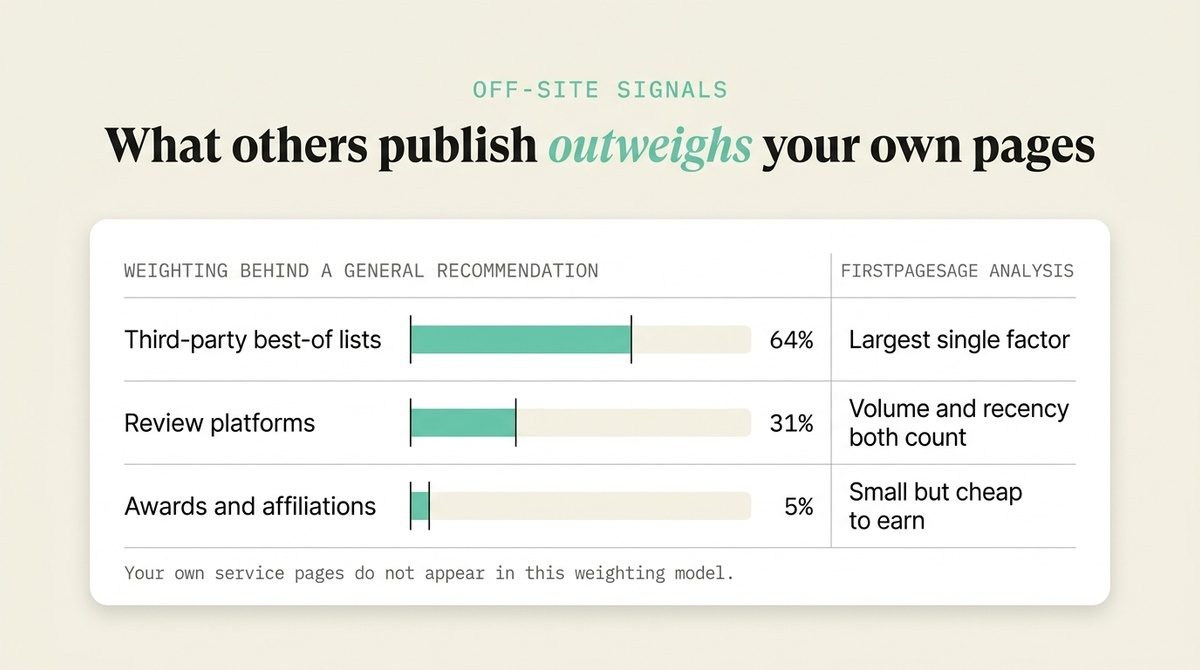
When somebody asks Perplexity for the best provider in a category, the engine rarely cites the providers themselves. It cites the third parties writing about them. FirstPageSage's analysis of recommendation behaviour put best-of listicles at roughly 64 percent of the weighting behind a general recommendation, with review sites around 31 percent and awards or affiliations making up the remainder. The exact split shifts over time, but the hierarchy has stayed stable: what others publish about you outranks what you publish about yourself.
Best-of Lists and Industry Roundups
Identify the listicles already being cited for your money queries, then do the unglamorous work of getting included: pitch the publisher, submit to the directories that feed them, and make sure your own pages give a writer everything needed to describe you accurately.
Reviews and Community Platforms
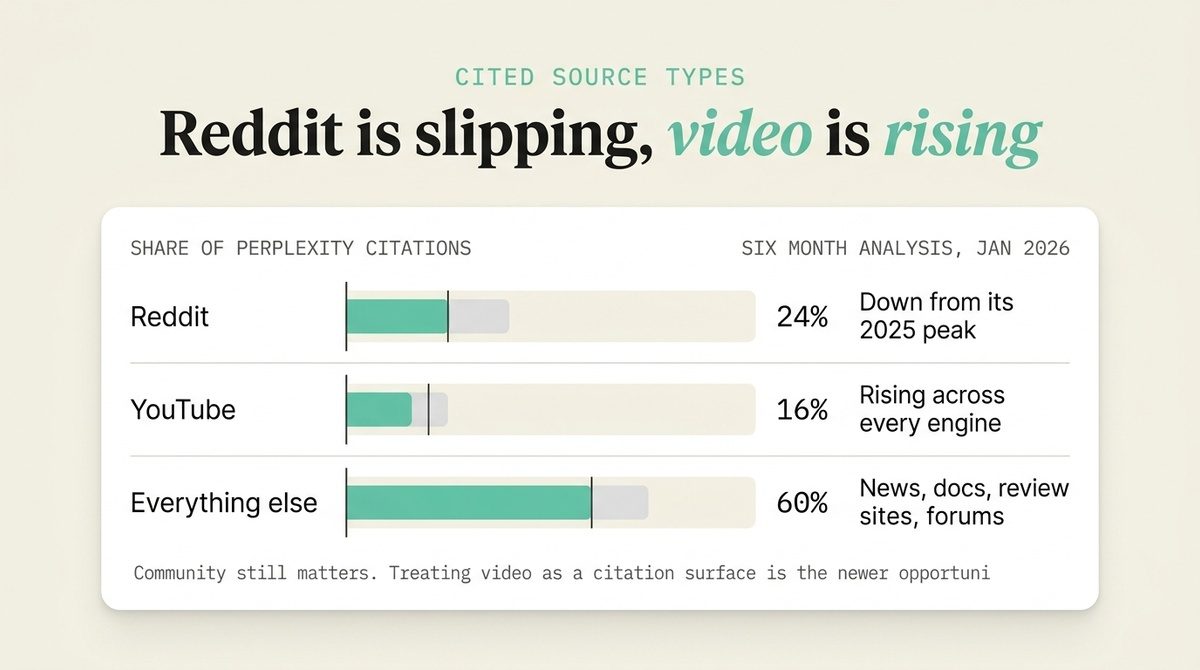
Reddit remains one of the most-cited domains in Perplexity answers, though its share has been falling as video sources rise. Bluefish data reported in January 2026 had Reddit at roughly 24 percent of Perplexity citations, down from the much higher share it held through 2025, with YouTube climbing to around 16 percent. The takeaway is not to game Reddit, which backfires, but to be genuinely present where your category is discussed, and to treat video as a citation surface rather than a social channel. Our write-up on Reddit SEO covers how to do that without getting the account removed.
Links, Citations and Local Signals
Editorial links still matter, because they shape which domains the engine treats as reputable in your category. For service businesses, consistent local citations and a complete Google Business Profile feed the entity data that AI answers lean on for "near me" style questions. A sustained link building program and clean local data do double duty: traditional rankings and AI citations draw from overlapping signals.
Step 7: Keep Pages Current
Perplexity leans on freshness harder than Google does, particularly for anything time-sensitive. Pages updated within the last 30 to 60 days are noticeably more likely to be pulled into answers on fast-moving topics.
Refreshing means changing something real: new data, a corrected figure, a removed section that no longer applies. Changing a date stamp and republishing does not qualify. Make the published and modified dates visible on the page, because an answer engine that cannot date your content will prefer one that can.
Step 8: Track Citations and Perplexity Referral Traffic
You cannot improve what you are not watching. Three layers of measurement, from cheapest to most useful:
- Manual prompt testing. Build a list of 20 to 40 questions a real buyer would ask, run them in Perplexity, and log who gets cited and whether you appear at all. Repeat monthly. This alone tells you which formats and which third-party sources the engine trusts in your category.
- Referral traffic segmentation. Create a segment in GA4 for perplexity.ai referrals. Volume will look small next to organic search, and that is normal. Watch the conversion rate instead, which is typically far higher, because the visitor arrived after reading a recommendation.
- AI visibility tracking tools. Several platforms now monitor citations and brand mentions across engines at scale. Worth the cost once you are tracking more than a handful of queries.
Perplexity Features Most Guides Skip
Three parts of the product create visibility routes that have nothing to do with ranking:
- The Publishers Program. Publishers whose content is cited in ad-supported answers share in the revenue, and partners get API access, analytics and enterprise seats. Applications go through Perplexity directly. Relevant if you run a content property rather than a services site.
- The Merchant Program. Ecommerce brands can feed product listings, including price, availability and reviews, straight into the shopping experience. Free to join, and dramatically faster than waiting for product pages to earn citations organically.
- Comet. Perplexity's browser went free globally in late 2025 and arrived on mobile through 2026. It matters because an agentic browser does not just read your page, it tries to act on it. Forms that only work with a mouse, booking flows buried behind JavaScript, and pricing hidden behind a contact form all fail that test.
What Does Not Move the Needle
Worth saying plainly, because the AI search space has collected a lot of folklore:
- Publishing an llms.txt file. No major engine has publicly committed to reading third-party llms.txt files as a retrieval or ranking signal, and Google has explicitly said it does not use them. It costs nothing to publish, so there is no harm, but treat it as housekeeping rather than strategy. We covered the evidence in detail in our post on whether you need an llms.txt file.
- Keyword density. Retrieval is semantic. Repeating a phrase does not increase the odds of being quoted.
- Mass AI-generated content. Thin pages at volume dilute the topical signal that gets a domain trusted in the first place.
- Chasing one engine in isolation. The work that earns Perplexity citations overlaps heavily with what earns them in ChatGPT and Google AI Mode. Build once, measure across all three.
Perplexity Visibility for Local and Service Businesses
Local queries behave differently. When someone asks for a provider in a city, Perplexity assembles the answer largely from directories, review platforms, local roundups and Google Business Profile data rather than from service pages. For a Toronto business, that means the practical priority list looks like this: a complete and categorized Google Business Profile, consistent NAP data across the directories that rank for your category, a steady review flow with text in the reviews, and presence on the local best-of lists that already get cited.
Service pages still carry weight for the informational half of the journey, so pages that name the city, the service and the specifics tend to get cited for questions like how much something costs or how long it takes. Pairing local SEO with AI search work is what turns a brand mention into a booked call.
A Realistic Timeline
Crawler and indexing fixes show up fastest, sometimes within two to four weeks, because the engine simply needs to re-fetch. On-page restructuring tends to show in six to ten weeks. Off-site authority, which is the part that drives brand mentions in recommendation queries, runs on a three to six month cycle, because it depends on other people publishing.
Anyone promising Perplexity citations in a fortnight is describing the first bucket and quietly ignoring the other two.
FAQ
Frequently asked questions
How Long Does It Take to Appear in Perplexity Search Results?
If the issue was crawler access, a few weeks. If you are building the authority needed to be recommended in competitive queries, plan on three to six months of consistent work.
Does Ranking on Google Help With Perplexity?
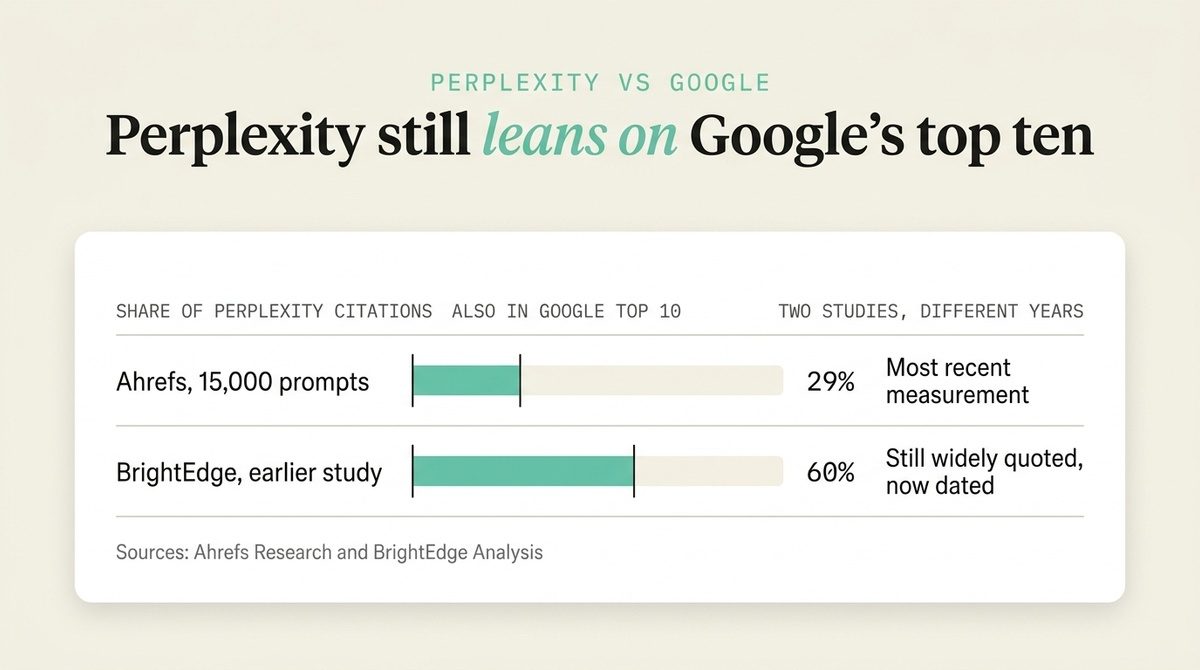
Yes, though less than it used to. Ahrefs' analysis of roughly 15,000 prompts found Perplexity had the highest overlap with Google's top ten of any standalone assistant, at close to 29 percent. Earlier studies put that figure near 60 percent, so the direction of travel is clear: strong organic rankings help, but they are no longer sufficient on their own.
Can a Small Website Get Cited in Perplexity?
Yes, and more easily than on Google. Retrieval rewards precise topical match, so a focused page that answers one question properly can be cited alongside far larger domains. The constraint is category authority, not domain size.
Should I Block Perplexity's Crawlers?
Only if you have a specific reason to, such as a paywalled publication negotiating licensing terms. For most businesses, blocking means removing yourself from an answer engine your buyers are already using.
Is Perplexity Traffic Worth Chasing Given the Volume?
Volume is modest next to Google, but intent is unusually high. Perplexity reported roughly 780 million queries per month as of mid-2025 and has grown since. More importantly, a visitor who arrives from a cited answer has already read a recommendation, which is why conversion rates from this channel typically run well above standard organic.
Getting Started
If you do nothing else this month, do these three things: check that PerplexityBot is not being blocked by your firewall, rewrite the opening two sentences of your ten most important pages so they answer the question directly, and run twenty buyer questions through Perplexity to see who is being cited instead of you. That third exercise usually reshapes the rest of the plan.
Continue reading
Read the latest issues

Discussion