
Google AI Mode SEO: How to Stay Visible in 2026
Google AI Mode SEO is not a new discipline bolted onto your old one. It is the same fundamentals pointed at a different target: instead of earning a position in a list of ten links, you are trying to be the source a language model pulls into a written answer.
That distinction matters more than most teams realize. A page can rank third for a query and never appear in the AI Mode response for the same query. A page can rank eleventh and get cited twice. If your reporting still treats position as the outcome, you are measuring a race that some of your buyers have stopped running.
This is what actually changed, what it does to your numbers, and what to do about it. It is the same ground our AI search SEO team works every week, so the examples below come from live accounts rather than theory.
What Google AI Mode Changes About Search
AI Mode is a conversational tab inside Google Search. You ask a question, Gemini reads across live web sources, and you get a written answer with citation links instead of a results page. Google launched it in Search Labs on March 5, 2025, opened it to all US users on May 20, 2025, and expanded it past 180 countries by August of that year.
Two behavioural shifts sit underneath it.
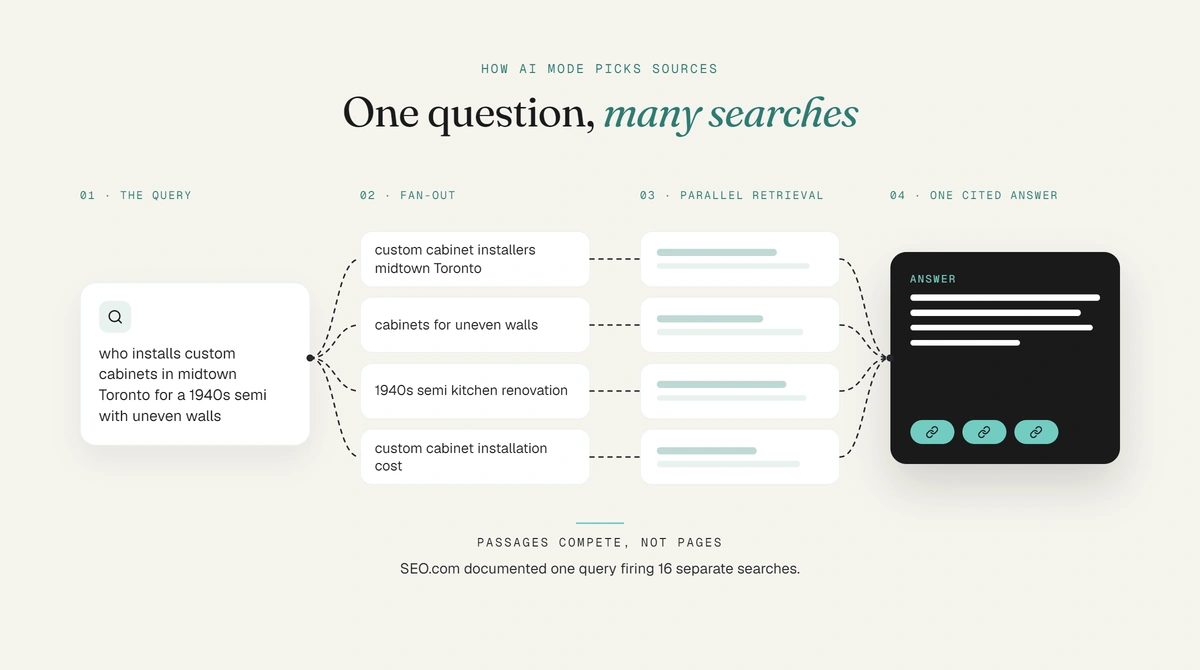
First, the questions got longer. Queries in AI Mode average around 7.2 words against roughly 4.0 in traditional keyword search. People are describing a situation rather than typing a term. "Kitchen cabinet installer Toronto" becomes "who installs custom cabinets in midtown Toronto for a 1940s semi with uneven walls."
Second, the answer arrives before the click. The user reads a synthesis, decides whether they still need a source, and often does not. That is the part your traffic graph is already showing you.
If you have been treating this as the same problem as AI Overviews, it is worth reading our breakdown of GEO vs AEO vs LLM SEO first, because the terminology in this space has gotten sloppy and the tactics genuinely differ by surface.
Google AI Mode vs AI Overviews: Not the Same Problem
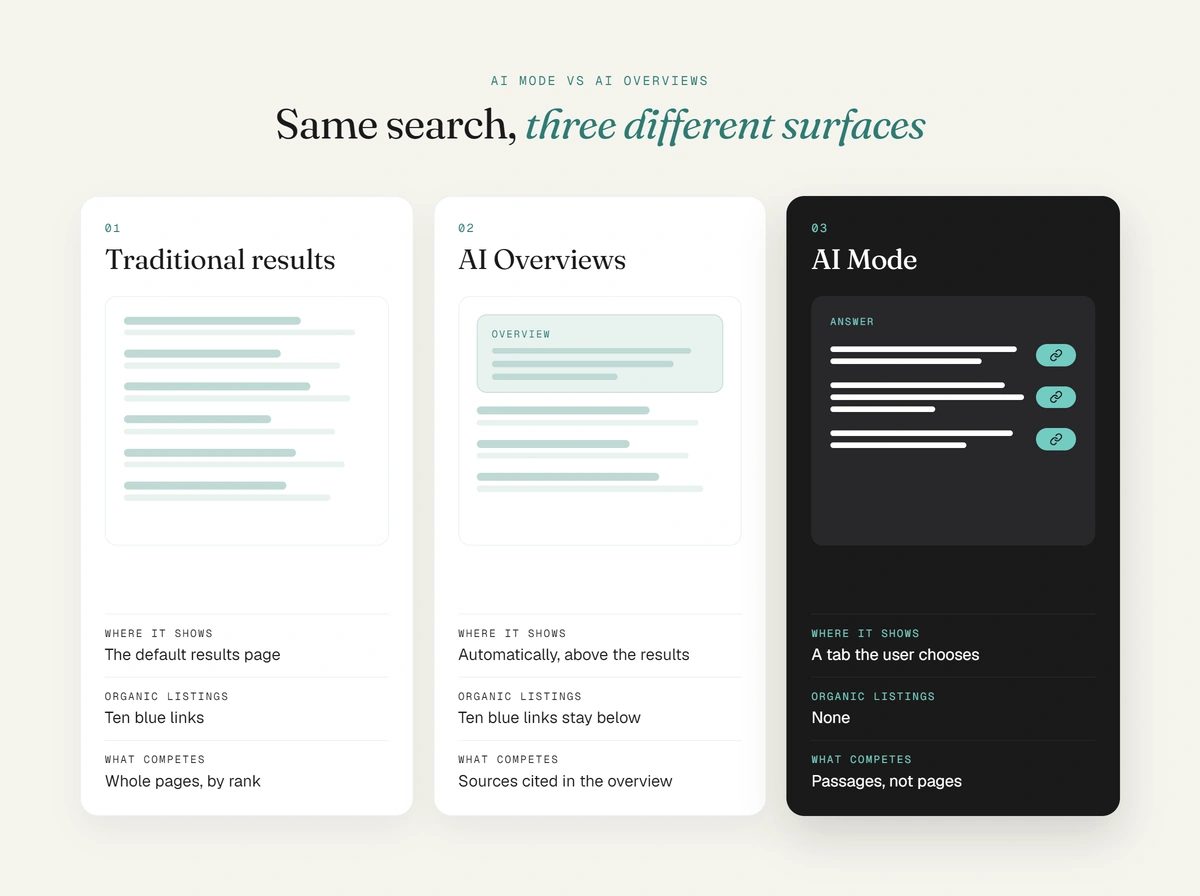
Teams keep collapsing these two into one line item. They behave differently.
AI Overviews sit above the standard results page and Google triggers them automatically. The ten blue links are still there underneath. AI Mode is a tab the user chooses to open, and inside it there is no organic list at all. You either get cited or you do not.
More usefully, they do not draw on the same sources. AI Mode and AI Overviews overlap on only 13.7% of citation sources, and AI Mode responses reference an average of 3.3 entities or brands per answer against 1.3 in AI Overviews.
Read that twice. Winning AI Overviews does not hand you AI Mode. But AI Mode names more brands per answer, which means there is more room in it. For a mid-size business competing against national names, that is the opening.
How Google AI Mode Decides Which Pages to Cite
The mechanism is called query fan-out, and understanding it changes how you brief content.
Instead of running your question as one search, AI Mode breaks it into sub-questions and runs them in parallel. SEO.com documented a single AI Mode query firing sixteen separate searches behind the scenes. Each sub-search retrieves its own set of sources, and Gemini assembles the answer from passages across all of them.
Three consequences follow directly.
Passages compete, not pages. Retrieval happens at passage level, which means one page can supply evidence for several sub-questions, and a section buried at the bottom of a long page can get pulled while the rest is ignored.
Coverage beats optimization. A page that answers the head term brilliantly and ignores the adjacent sub-questions loses to a page that covers the whole question set adequately. Fan-out rewards completeness.
Citations are the norm, not the exception. An Ahrefs analysis found 97% of AI Mode responses include at least one citation. The slots exist. The question is whether your content is extractable enough to fill one.
None of this replaces crawlability, speed, or clean structured data. If Google cannot read the page cheaply, none of the above applies. And if you have been wondering whether you need an llms.txt file on top of that, our breakdown covers where it helps and where it does nothing.
Is SEO Dead After AI Mode?
No, and the people saying otherwise are mostly selling something.
What died is a specific assumption: that ranking equals traffic equals revenue, in that order, reliably. That chain has been fraying since AI Overviews rolled out. Overviews cut click-through rates by roughly 34.5% on average, and some publishers reported losing 20 to 60% of their traffic.
But traffic and revenue came apart, and not always in the direction people assume. NerdWallet lost about 20% of monthly site traffic in 2024 while generating 35% more revenue. Fewer people arrive, and the ones who do have already been pre-qualified by the AI answer.
Google's own guidance for AI search is not exotic. It comes down to letting crawlers access the site, delivering a solid page experience, publishing original and reliable people-first content, keeping structured data consistent with what is visible on the page, supporting content with real images and video, and maintaining an accurate Google Business Profile. That is a competent SEO program described in six bullets.
So SEO is not dead. The metric is dead. Sessions as the headline number no longer describes what search is doing for the business.
The Real Google AI Mode SEO Impact on Traffic and Reporting
Set expectations with leadership before the graph does it for you.
Volume falls. Semrush estimates a 92 to 94% zero-click rate for AI Mode sessions. Most conversations end inside the answer.
Quality rises. Research from OmniBound found visitors arriving from AI Mode citations convert around 42% better and generate 37% higher revenue per visit than standard organic visitors. Treat this as directional rather than a benchmark to promise a client, but the pattern is consistent across the reporting we see.
Attribution gets murkier. A click from AI Mode passes through google.com and lands in your analytics as ordinary organic. You cannot separate it in GA4 by default.
Ads are moving in. Ads appeared in 25.5% of AI Overview SERPs by early 2026, up from about 3% in January 2025. Organic citation space and paid placement will be competing inside the same response.
The uncomfortable version: you will report lower traffic and have to argue that this is fine. Bring the conversion and revenue data to that meeting, because the traffic line alone will lose it.
Building an SEO Strategy for Google AI Mode
Six changes, ordered by how much they move the needle.
Lead with the answer
Put the direct answer in the first two sentences under each heading, then explain. Fan-out retrieval pulls passages, and a passage that opens with three sentences of context before answering anything is a passage that does not get extracted. This single formatting habit does more for AI Mode citation than any other content change.
Cover the sub-questions, not just the keyword
Take your target query and write out every follow-up a real buyer would ask. Cost, timeline, alternatives, eligibility, what goes wrong, how it compares. Each one is a probable sub-search. Cover them on the page with their own headings, phrased the way people ask them.
Publish something the model cannot get elsewhere
Original data, a real client outcome with numbers, a named process, a photograph of actual work. Retrieval systems select for specificity. Content assembled from the same twelve sources everyone else used has no reason to be picked over those sources.
Make the page machine-readable
Clean heading hierarchy, one clear H1, and the rest of the on-page SEO basics done properly: descriptive H2s that state the question, structured data that matches the visible content. Schema does not make Gemini cite you, but it removes ambiguity about what the page is, and ambiguity loses.
Build the off-site mentions
AI Mode weighs how consistently the wider web associates your brand with a topic. Reviews, directory profiles, guest coverage, unlinked mentions in industry write-ups. Consistency of your name, address, and phone across local citations is a small task that quietly underwrites all of this.
Hold the local ground
Local queries are where a smaller business can still beat a national brand outright. AI Mode leans on Google Business Profile and the local index for these, and it will often link the profile rather than the site. A fully built profile, active posts, steady reviews, and accurate hours are load-bearing infrastructure now, not a checkbox. The same failures that keep you out of the Map Pack keep you out of local AI answers, which is why our Map Pack diagnostic doubles as an AI visibility diagnostic.
How to Measure SEO Performance in Google AI Mode
This is the part nobody had a good answer for until recently, and the answer is still partial.
On June 3, 2026, Google added Search Generative AI performance reports to Search Console, giving a dedicated view of impressions inside generative AI features including AI Overviews and AI Mode. It is a real window into a surface that used to be closed. It is also narrower than people expect.
Three limitations to plan around:
- The report shows impressions only, with no clicks or conversions, and it is rolling out to a subset of properties.
- The report is interface-only. Neither the Search Analytics API nor the BigQuery bulk export exposes the generative AI data, so there is no official query-level view of AI Mode.
- Google anonymizes rare queries, and conversational strings are rare by nature, so a meaningful share of AI activity never appears. On one property tested in August 2026, 57.7% of impressions sat in the anonymized pool. Read your numbers as a floor.
A workable measurement stack looks like this. Use the Generative AI report as your visibility gauge, tracking impressions by page and watching which URLs Google considers AI-worthy. Use GA4 and your CRM for outcomes, comparing conversion rate and revenue per session for organic against previous periods rather than chasing session counts. Run periodic manual prompt checks on your twenty highest-value queries, recording whether you are named. Add a "how did you hear about us" field to your forms, because self-reported attribution catches what the tools miss.
Then change the reporting headline. Lead the monthly report with qualified leads and revenue from search, and put sessions below it. If the first number the client sees is one you no longer control, every conversation starts defensive.
What This Looks Like Over the Next Year
The direction of travel is that AI Mode stops being a tab and becomes the default handling for anything beyond a navigational query. Google has already redesigned the search input to route conversational phrasing there automatically. Shopping, booking, and agentic workflows are being built inside the same surface.
Practically, plan for three things. Impressions will increasingly outrun clicks, and that gap is not a failure. Brand mentions across the web will carry more weight relative to links than they did. And the pages that win will be the ones that answer a complete question set in a form a model can lift cleanly.
None of that requires abandoning what you already do. It requires doing it with the retrieval layer in mind and reporting on outcomes instead of volume.
FAQ
Frequently asked questions
Does Google AI Mode replace normal search results?
No. AI Mode is a separate tab and the standard results page is still the default surface. Google has not announced any plan to retire it.
Can I stop my site appearing in AI Mode?
Only by blocking Google's crawler entirely, which removes you from ordinary search as well. There is no partial opt-out that keeps organic rankings and excludes AI features.
Do I need different content for AI Mode and for normal SEO?
No, you need better-structured versions of the same content. Answer-first passages, complete sub-question coverage, and original detail improve both.
How long before AI Mode work shows results?
Citation changes tend to appear faster than ranking changes, often within weeks of publishing or restructuring a page, because retrieval is passage-level rather than dependent on accumulated page authority.
Is this the same as GEO or AEO?
Overlapping but not identical. AI Mode is one surface inside Google. GEO and AEO cover the broader set including ChatGPT, Perplexity, and Gemini, which retrieve from different indexes. Our guide on [how to rank on ChatGPT] (https://mehrana.agency/blog/how-to-rank-on-chatgpt/) covers that side.
Continue reading
Read the latest issues

Discussion