
Schema Markup for AI Search: What Works in 2026
Ask ChatGPT who the best plumber in Markham is, and the answer comes from somewhere. Most owners assume it comes from Google rankings. It often does not. So the next question we get is whether schema markup is the lever that gets a business named in those answers.
The honest answer is that schema does less for AI citations than most agencies claim, and more for the rest of your search presence than most owners realise. Both halves of that sentence matter. This article covers what the platforms have actually confirmed, what the 2026 data showed when someone finally tested it properly, and which markup is still worth the hour it takes to ship.
What Schema Markup Does for AI Search Engines
Schema markup is structured data you add to a page, almost always as JSON-LD in the head or body of the HTML. It labels facts that are otherwise buried in prose: this string is a business name, this number is a price, this person wrote this article, this company serves these cities.
For a search engine, that labelling has always been about eligibility for rich results. For an AI system, the theory is different. Large language models resolve entities, meaning they work out which real-world thing your page is talking about and how it relates to other things. Clean labels should make that resolution cheaper and less error-prone. That theory is sound, and it is the basis of most AI search SEO advice published in the last two years.
What Google and Microsoft Have Confirmed
Microsoft has been the most direct. At SMX Munich in March 2025, Bing's Fabrice Canel told the room that "schema markup helps Microsoft's LLMs understand content". Copilot grounds its answers in the Bing index, so markup that Bing parses feeds the system that writes the answer.
Google has been cooler. Its guide to optimizing for generative AI features, updated in July 2026, puts structured data in the section on things you do not need to do: "Structured data isn't required for generative AI search", with no special schema.org markup to add, though Google still recommends keeping it for rich result eligibility. The same guide tells you to ignore llms.txt files and content chunking, and to stop rewriting pages specifically for AI systems.
What Nobody Has Confirmed
OpenAI, Anthropic and Perplexity have published nothing about whether their retrieval systems preserve or use JSON-LD. The technical capability obviously exists. Whether it is wired into citation selection is a separate question, and one that guides claiming a 3x citation lift are not in a position to answer.
The 2026 Data on Schema and AI Citations
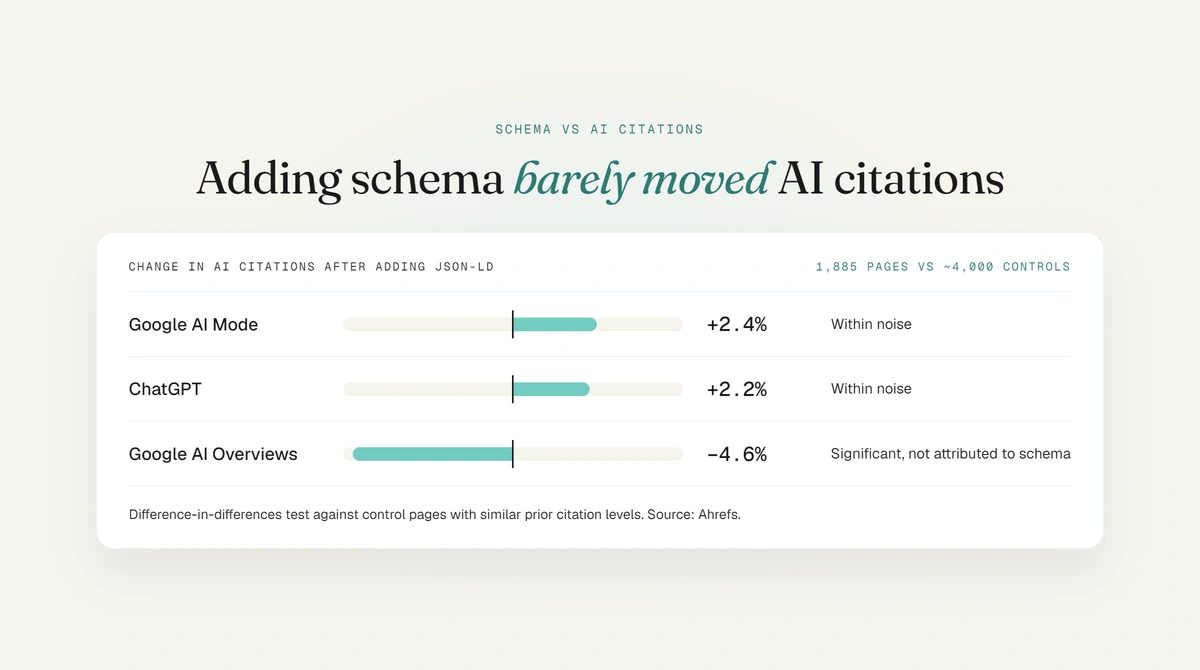
In May 2026, Ahrefs published the first real causal test. Louise Linehan and Xibeijia Guan tracked 1,885 pages that added JSON-LD between August 2025 and March 2026, matched them against roughly 4,000 control pages with similar prior citation levels, and measured the change across Google AI Overviews, AI Mode and ChatGPT using a difference-in-differences design.
The result: no meaningful uplift anywhere. AI Mode moved about 2.4 percent, ChatGPT about 2.2 percent, both indistinguishable from noise. AI Overviews fell about 4.6 percent, which was statistically significant but not something Ahrefs was willing to pin on the markup itself. Four separate statistical tests told the same story. The correlation everyone quotes, that AI-cited pages are around three times likelier to carry JSON-LD, survived only until the confounders were controlled for. Sites that ship schema also ship better content and earn more links.
A related searchVIU experiment tested whether five systems, including ChatGPT, Claude, Perplexity, Gemini and Google AI Mode, read markup when fetching a page live. During direct retrieval, every system pulled visible rendered content only. JSON-LD and hidden microdata were skipped.
One caveat is worth keeping. Every page in the Ahrefs sample already had 100 or more AI Overview citations before the change. Adding markup to a page an engine already understands well is optimisation on top of optimisation. It does not tell you much about a service page that no assistant has ever mentioned, which is the situation most local businesses are actually in.
Why We Still Ship Schema on Every Answer Engine Optimization Project
None of the above is an argument for removing your markup. It is an argument for being honest about the job it does. On our answer engine optimization engagements, schema earns its place for four reasons that have nothing to do with a promised citation lift.
Bing Copilot is confirmed to use it, and Copilot sits inside Windows and Edge for a large slice of Canadian desktop users. Rich results in classic search still depend on it, and organic clicks remain most local businesses' biggest channel. Entity disambiguation is genuinely load-bearing when your business name is generic or shared. And the markup is close to free once it exists, which makes the cost-benefit trivial even if the upside is uncertain.
What schema will not do is compensate for a thin service page, an unclaimed profile or a brand nobody else on the web mentions. Those are the actual constraints on most generative engine optimization work, and no amount of JSON-LD moves them.
Schema Types Worth Implementing for Local SEO and AI Visibility
Priority here is different for a local service business than for an ecommerce catalogue. This is the order we work in for GTA clients.
Organization and LocalBusiness: Your Entity Home
This is the foundation. Legal name, logo, phone, address, opening hours, areas served, and sameAs links pointing to your Google Business Profile, LinkedIn, Facebook and any industry directory where you are listed. The sameAs array is the part most implementations skip, and it is the part that helps a system confirm that the business on your site is the same business it saw elsewhere.
Keep every value identical to what appears on your profile and your citations. An address formatted three different ways across your site, your Google Business Profile and your directory listings is a conflict, and conflicts are resolved by ignoring the least confident source. Google's own generative AI guidance is blunt about where local details come from: Business Profiles and Merchant Center feeds, not markup.
Service and Product Markup for What You Actually Sell
Service markup on each service page states the service name, the provider, the area served and the price range where you publish one. Product markup with a nested Offer does the same job for ecommerce, and stale availability data is the fastest way to get a product dropped from a comparison answer. Match the markup to the page. Product schema on a blog post is a mismatch, not a shortcut.
Person and Article Markup for Authorship Signals
Article or BlogPosting with a real author who has a Person node, a real publish date and a real modified date. This is where LLM SEO and classic E-E-A-T work overlap. Assistants reaching for a source on a technical topic weigh who is behind the claim, and an author byline that resolves to a named person with credentials is easier to trust than a house account.
FAQPage Markup After the May 2026 Deprecation
Google retired FAQ rich results on 7 May 2026, for every site including the government and health domains that kept eligibility after the 2023 restriction. The Search Console report and Rich Results Test support went in June, and API support in August.
Two things follow. The FAQPage type itself is not deprecated, Google says it still uses the data to understand pages, and leaving valid markup in place causes no problems. But FAQ schema is now a poor reason to build an FAQ section. Build the section because the questions are real, keep the answers in visible HTML where retrieval systems will actually read them, and treat the markup as a formality rather than a lever. Any guide still selling FAQ schema as an AI visibility tactic was written before May.
BreadcrumbList and Site Structure
Breadcrumbs map a page into your hierarchy, which helps crawlers understand how your service and location pages relate. Paired with sensible internal linking, this does more for how your site is understood than any single markup type. It is unglamorous technical SEO that keeps paying.
Connecting Your Markup Into One Entity Graph
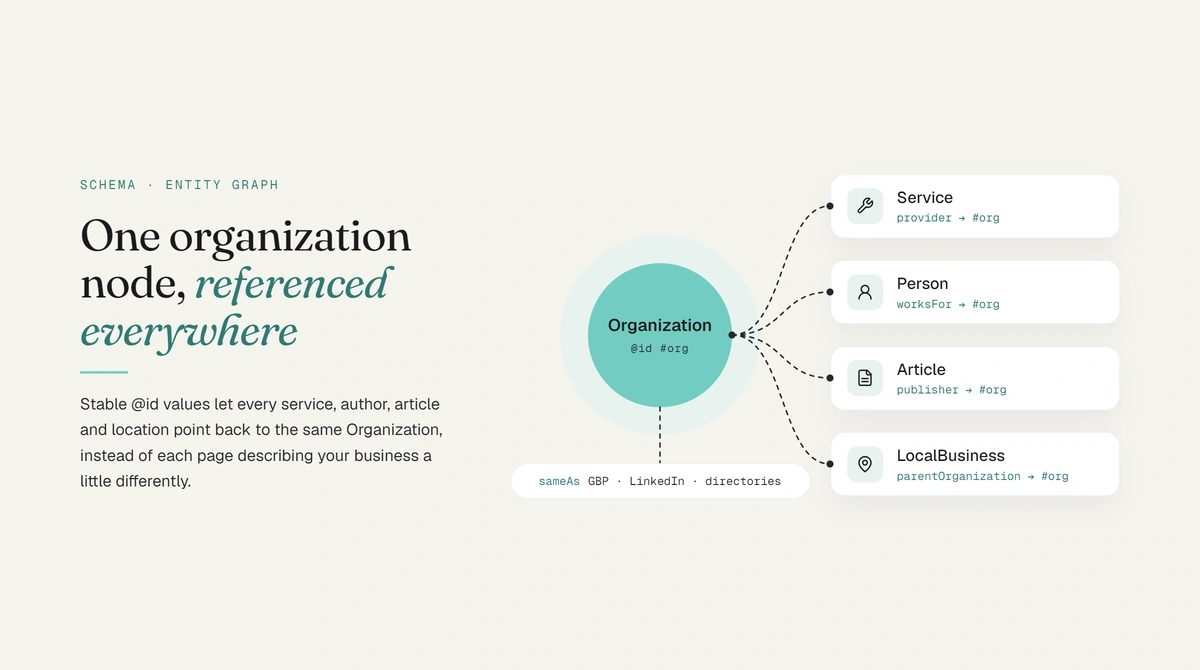
Most implementations drop isolated blocks on individual pages. A better pattern is a connected graph, where stable @id values let nodes reference each other across the whole site.
{ "@context": "https://schema.org", "@graph": [ { "@type": "Organization", "@id": "https://example.ca/#organization", "name": "Example Plumbing Inc.", "areaServed": "Markham, ON", "sameAs": [ "https://www.linkedin.com/company/example", "https://maps.google.com/?cid=123456789" ] }, { "@type": "Service", "@id": "https://example.ca/drain-repair/#service", "name": "Drain repair", "provider": { "@id": "https://example.ca/#organization" } } ] }
The value is consistency. One organization node, referenced everywhere, instead of forty pages each asserting a slightly different version of who you are. That is the difference between a pile of hints and a small internal knowledge graph, and it is also the version that survives a redesign.
How to Implement It Without Breaking Anything
Audit before you build. Most sites already carry partial markup from a theme, a plugin or an old SEO project, and duplicate conflicting blocks are more common than missing ones. Pull the current state first.
Then work in this order. Validate what exists using the Schema Markup Validator and Google's Rich Results Test. Remove duplicates, usually caused by two plugins writing the same type. Build or repair Organization and LocalBusiness with a complete sameAs array. Add Service or Product markup to your money pages. Add Article and Person to editorial content. Re-test after deployment, then put a recurring audit in the calendar, because markup drifts every time a plugin updates or a page gets rebuilt.
On WordPress, Rank Math or Yoast handles most of this, with the caveat that defaults are generic and usually need editing. On a custom build, write the JSON-LD directly into the template so it renders server-side rather than through JavaScript.
Mistakes That Cost More Than Missing Markup
- Markup that contradicts the page. Schema claiming a price, rating or address the visitor cannot see is a guidelines violation and a trust problem. Systems that cross-check will downgrade the source.
- Invented review data. AggregateRating built from numbers you do not have earns a manual action, not a citation.
- Duplicate conflicting blocks. Two plugins asserting different opening hours gives a parser no reason to trust either.
- Broken JSON-LD. One stray character drops the whole block silently. Nothing warns you.
- Stale data. Last year's hours, a closed location, a phone number you no longer answer. Worse than no markup.
- Treating it as the strategy. Two hours on schema and none on your profile, your reviews or your service pages is time spent on the smallest variable.
What Actually Moves AI Citations
If markup is not the lever, the fair question is what is. From what we see across accounts, four things carry the weight.
Visible content structure comes first, because retrieval reads rendered HTML. Clear headings, direct answers near the top of a section, specifics rather than padding. Entity consistency comes second: the same name, address and phone number everywhere the web mentions you, which is the whole point of local citation building. Third-party corroboration comes third, since assistants weigh what other sites say about you more heavily than what you say about yourself. And for anything local, your Google Business Profile does more than every markup type combined, which is why local SEO and AI visibility stopped being separate projects.
Freshness matters too. Canel's follow-up point at SMX was that generative systems favour recent content partly as a check against their training data, and that updating a page and pushing it through IndexNow is a faster signal than waiting for a recrawl. For how this plays out inside Google specifically, our breakdown of Google AI Mode SEO covers how sources get selected there.
Where Schema Fits in an AI Search Strategy
Ship it, keep it accurate, stop expecting it to do the heavy lifting. Schema markup is infrastructure: cheap, durable, confirmed useful by Bing, still required for rich results, and helpful for making sure a machine knows which business you are. It is not the reason ChatGPT names your competitor instead of you, and that is roughly where Google's own guidance on generative AI search leaves it as well.
That reason is almost always upstream. A service page too thin to answer the question, a profile that has not been touched in a year, or a brand that no other site on the web has written about. Fix those and the markup starts to matter, because there is finally something worth understanding.
FAQ
Frequently asked questions
Does Schema Markup Get You Cited by ChatGPT?
There is no evidence that it does. The Ahrefs study found no meaningful citation change on ChatGPT, AI Mode or AI Overviews after pages added JSON-LD, and OpenAI has never confirmed that its retrieval uses structured data. Keep the markup for search engines, not as a citation tactic.
Should FAQ Schema Be Removed Now That Google Dropped the Rich Result?
No. Google says unused structured data causes no problems and that it still uses FAQ data to understand pages. Leave valid markup in place, just stop counting on it for visibility.
Which Schema Type Should a Local Business Add First?
Organization and LocalBusiness, with a complete sameAs array and values that match the Google Business Profile exactly. Service markup on the money pages comes next.
Is JSON-LD Still the Right Format?
Yes. Google recommends it, it sits in one block that is easy to maintain, and it does not entangle your markup with your page templates the way microdata does.
How Often Should Schema Be Audited?
Quarterly for a small site, and after every redesign, plugin update or platform migration. Markup breaks quietly, and nothing in Search Console will tell you the day it happens.
Continue reading
Read the latest issues


Discussion