
Why You're Not Ranking in the Google Map Pack
You have a verified Google Business Profile. You have decent reviews. You may even rank on page one organically. And yet when someone searches for your service in your city, three other businesses sit in the Map Pack and you are nowhere in sight.
This is the most common local search problem we diagnose at Mehrana Agency, and in almost every case the cause is not the one the business owner assumed. It is rarely "not enough reviews." It is usually a relevance problem, a proximity problem, a trust problem, or a measurement problem that has been mistaken for a ranking problem. Most of those trace back to fields inside your profile, which is why a proper Google Business Profile optimization audit comes before any other work.
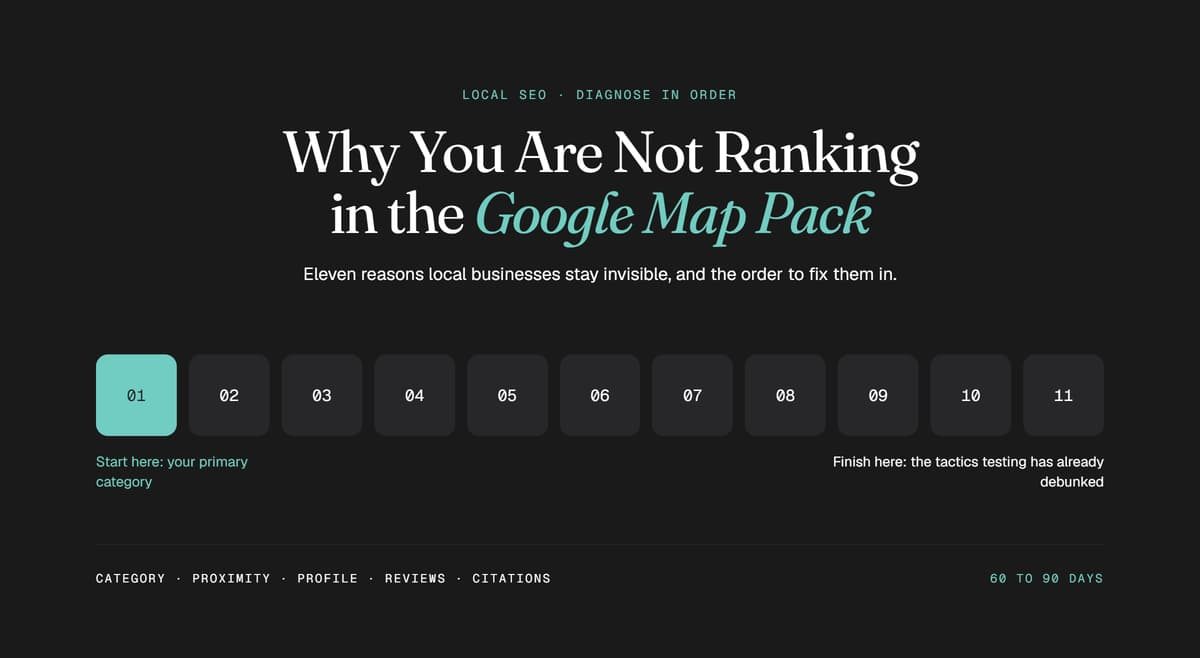
Below are the eleven reasons local businesses stay locked out of the Map Pack, ordered roughly by how often they turn out to be the actual culprit. Work through them in order. Most businesses find their answer in the first four.
First, Confirm You Are Actually Not Ranking
Before you change anything, rule out the single most common false alarm in local SEO.
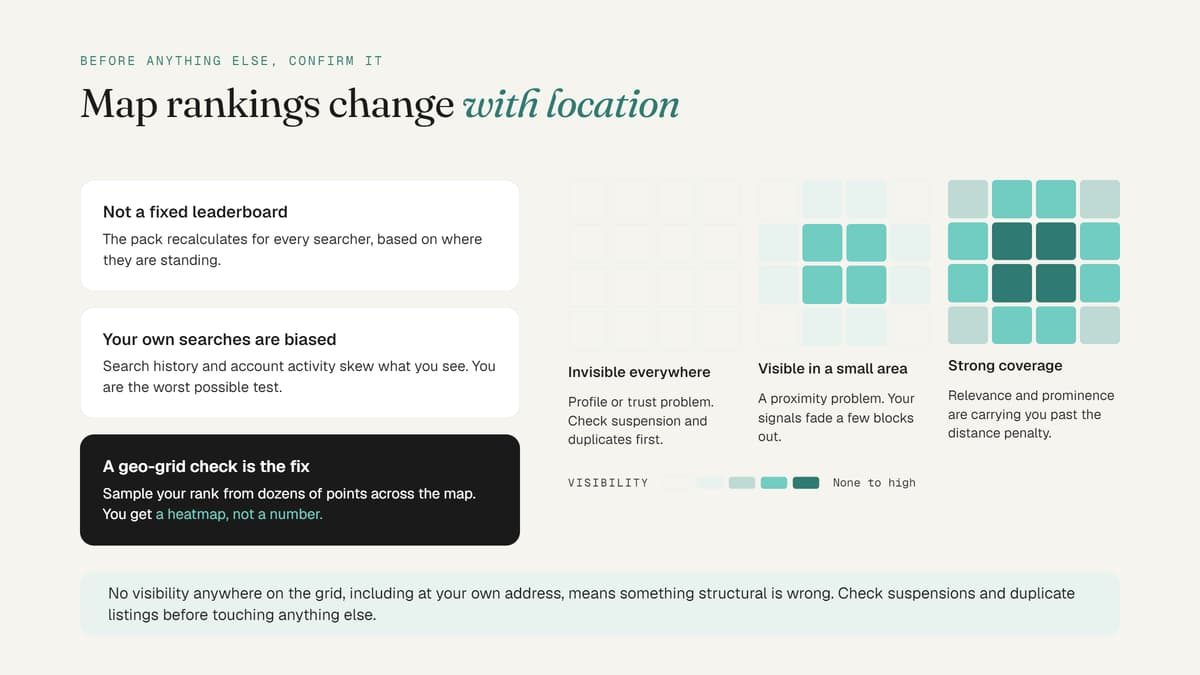
The Map Pack is not a fixed leaderboard. It is recalculated for every searcher based on where that searcher is standing. When you search your own keyword from your office, you are seeing one data point out of hundreds across your service area. You might be ranking third from a coffee shop two kilometres away and twelfth from your own desk, or the reverse.
Checking your rank by Googling yourself also produces distorted results, because your search history and account activity influence what you see. Incognito mode helps but does not fully remove location bias.
The fix is a geo-grid rank check. Tools that sample your ranking from dozens of points across a map show you a heatmap instead of a single number, and that heatmap is the real diagnostic. It tells you whether you are invisible everywhere, which points to a profile or trust issue, or visible in a tight circle around your address and fading fast, which points to a proximity and authority issue. Those two problems have completely different solutions, and treating one as the other is how businesses waste six months.
If the grid shows you have no visibility anywhere, including at your own address, skip ahead to the sections on suspensions and duplicate listings. Something structural is wrong.
11 Reasons You're Not Ranking in the Google Map Pack
Each of the eleven causes below is a separate diagnosis with its own fix and its own timeline, ordered by how often it turns out to be the real problem rather than the one that sounds most familiar. Work through them in sequence, because most businesses find their answer in the first four, and a good number find it before the numbered list even starts.
1. Your Primary Category Is Wrong
This is the highest-leverage field on your entire Google Business Profile and the most frequently misconfigured.
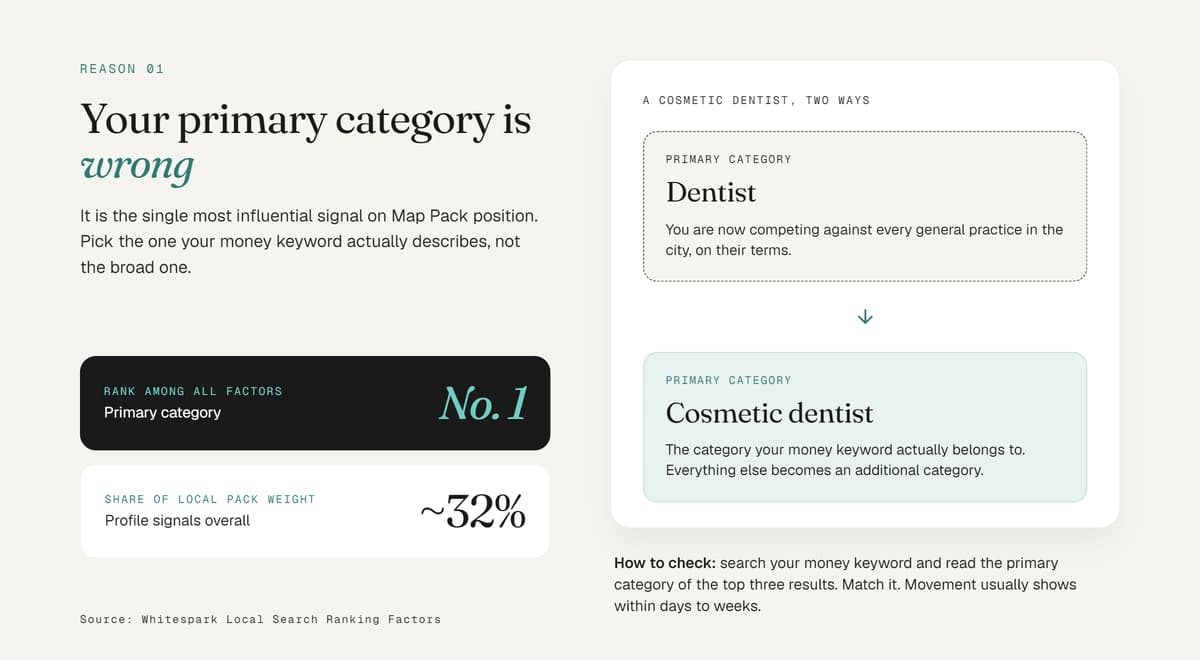
Whitespark's 2026 Local Search Ranking Factors report surveys 47 of the industry's most active local SEO practitioners across 187 individual factors, and it identifies the primary category on your Google Business Profile as the single most influential signal for Map Pack ranking. Profile signals as a whole account for roughly 32 percent of local pack weight, and the primary category is the heaviest item inside that group.
Google uses your primary category to decide which query sets you are eligible for at all. If you are a cosmetic dentist and your primary category is "Dentist" instead of "Cosmetic Dentist," you are competing in a category where every general practice in the city outranks you on volume, while the higher-intent cosmetic searches pass you by. If you are an HVAC contractor whose primary category is "Contractor," you are effectively invisible for furnace and air conditioning queries.
How to fix it: Search your money keyword, open the top three Map Pack results, and check their primary category using a browser extension or by inspecting the profile. If all three share a category you are not using, that is your answer. Change your primary category to match the search you actually want to win, and move your current category into a secondary slot. Keep secondary categories tight and genuinely applicable. Adding ten loosely related categories dilutes relevance rather than expanding it, and it is one of the patterns that triggers manual review.
Expect movement within days to a few weeks, not months. Category changes are among the fastest-acting levers in local search, which is exactly why Map Pack ranking work always starts here.
2. You Are Too Far From the Searcher
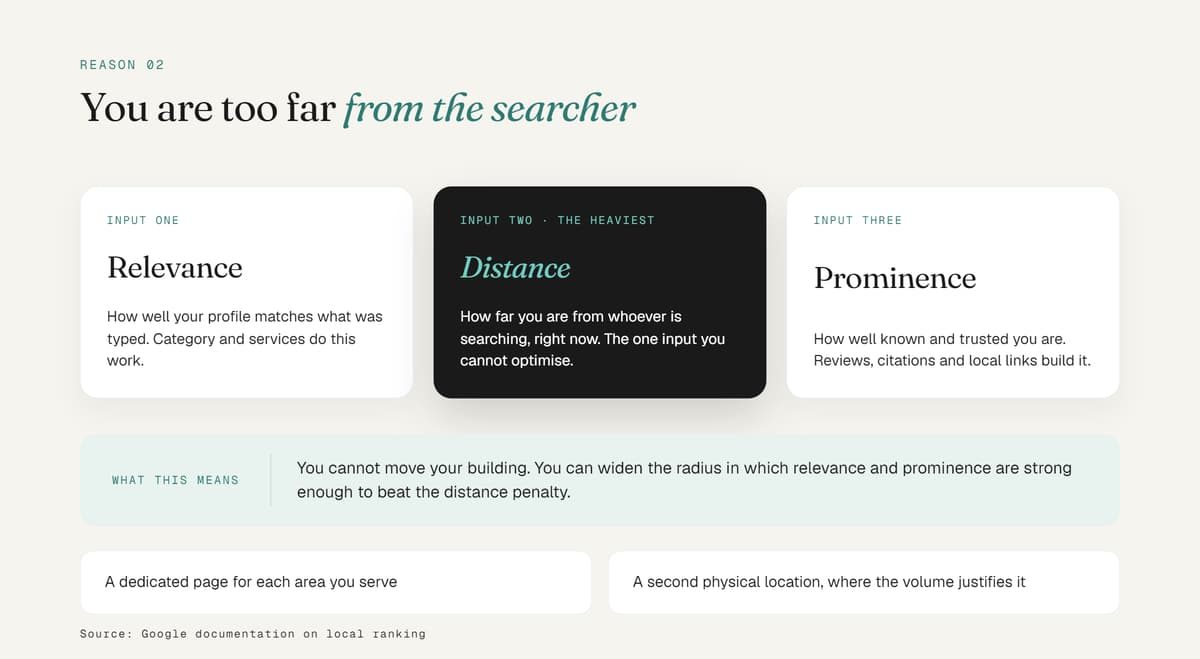
Google's own documentation on local ranking names three inputs: relevance, meaning how closely your profile matches the search; distance, meaning how far you are from the person searching; and prominence, meaning how well known your business is based on signals like links and reviews.
Distance is the input nobody wants to hear about, because you cannot optimize your way out of geography. A business in Etobicoke will struggle to appear in the Map Pack for a search performed in Scarborough, no matter how strong the profile. Proximity is consistently reported by practitioners as the heaviest single input in local pack results.
What you can do is expand the radius at which your other signals are strong enough to overcome distance. A business with an excellent profile, high review velocity, and real local authority will hold Map Pack positions several kilometres further out than a weak competitor sitting closer to the searcher. That extra radius is the entire game in a dense metro like the GTA.
How to fix it:
- Build dedicated location pages, not a service area list. A genuine page for each neighbourhood you serve, with unique content, local project examples, and a real reason to exist, is what moves organic and reinforces local relevance. Our Local Authority program is built around adding one properly researched service area per month for exactly this reason.
- Do not expect your Google service area radius to do this work. Sterling Sky's long-running tests have found that the service areas listed in a Google Business Profile do not directly influence Map Pack ranking. Setting your service area to all of Ontario does not make you visible in Ottawa.
- If you have multiple physical locations, treat each as a separate ranking entity with its own profile, its own landing page, and its own review stream.
3. Your Address Is Hidden
If you run a service area business with no storefront, Google's guidelines instruct you to hide your address. Following that instruction has a measurable cost.
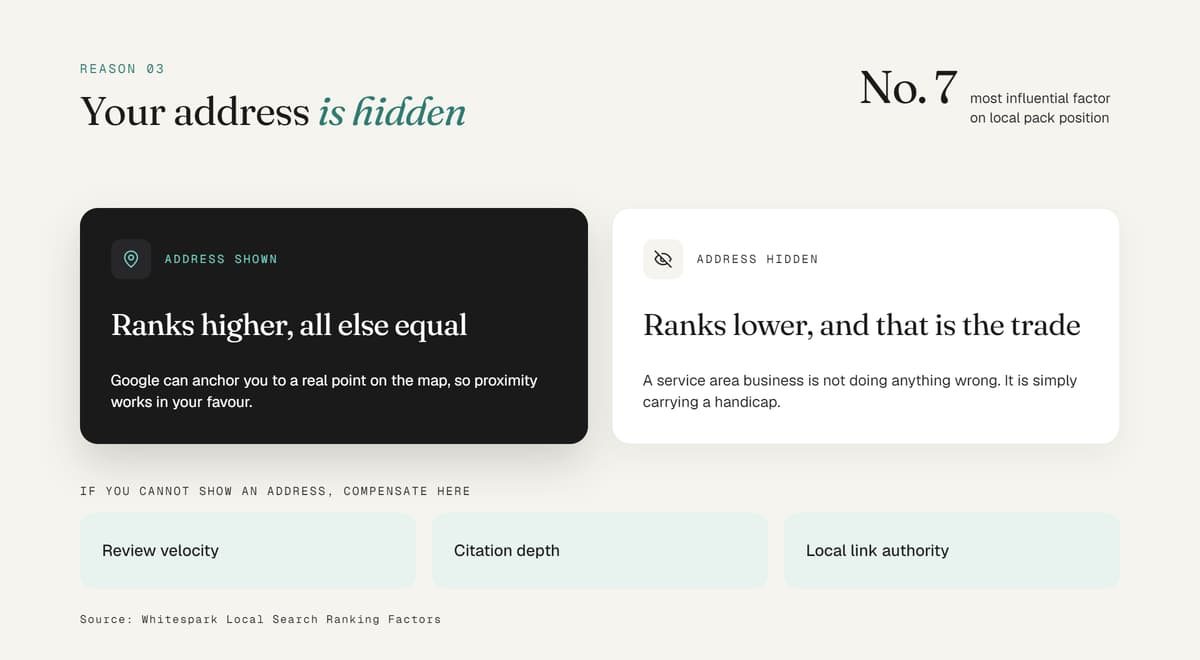
In the 2026 Local Search Ranking Factors report, having a visible address ranks as the seventh most influential factor on local pack position. Sterling Sky's controlled testing points the same way: hiding an address hurt rankings, while displaying one helped.
This puts service businesses in a genuine bind, and there is no clever trick around it. Renting a virtual office or a mailbox to display an address violates Google's guidelines and is one of the fastest routes to a suspension you will spend months undoing.
How to fix it: If you legitimately operate from a location where you meet clients, even part time, and you can demonstrate signage and staffed hours, you may qualify to display it. If you do not, accept the handicap and compensate through relevance and prominence. Service area businesses that win the Map Pack do it on review velocity, citation depth, and local link authority, because the address lever is closed to them.
4. Your Profile Is Incomplete in the Fields That Count
"Complete your profile" is the advice every article gives, and it is too vague to act on. Not all fields carry equal weight, and two of them shifted significantly in the most recent data.
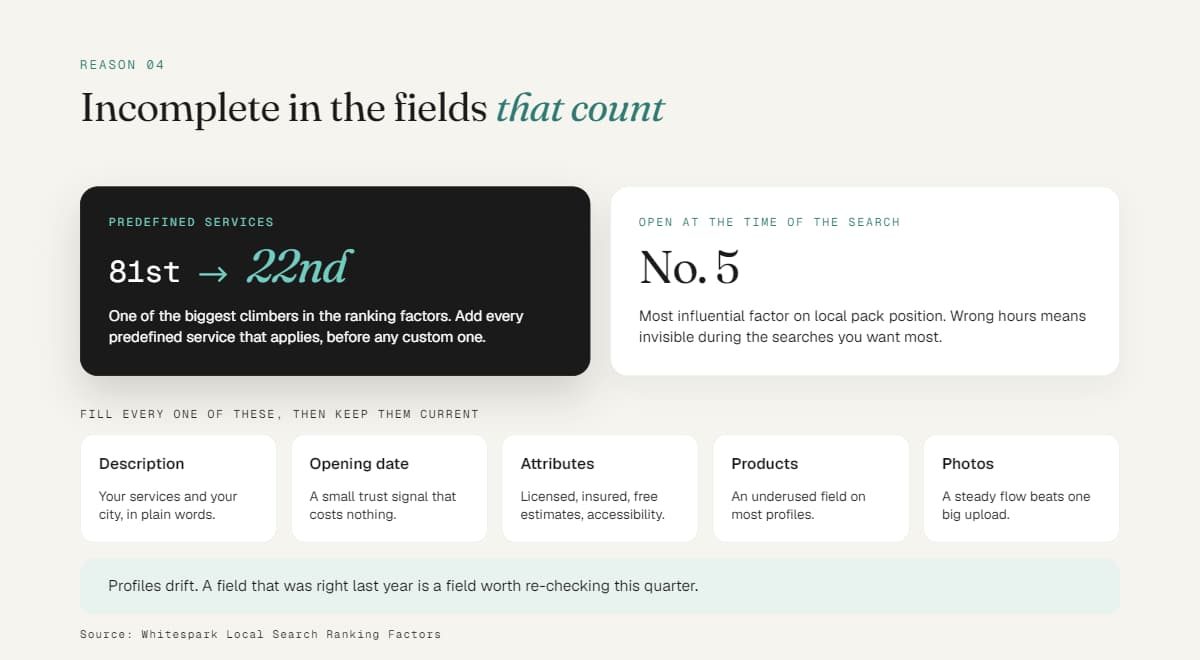
Predefined services. Google offers a list of predefined service options inside your profile, separate from custom services you type yourself. In the 2026 report, adding these predefined services jumped from the 81st most important factor to the 22nd. Sterling Sky's testing has found a mild but real ranking effect for keywords used in the services field, and the predefined options appear to behave differently from custom ones. Add every predefined service that genuinely applies before adding custom ones.
Business hours, and being open when people search. This is the finding most agencies have not caught up with. Practitioners now rank "business is open at the time the user searches" as the fifth most influential factor for Map Pack and Maps results. Individual businesses have been observed ranking first during open hours and dropping to fourth the moment they close, every single day.
If your competitors advertise extended or emergency hours and you close at five, you are invisible for every evening search in your category. For emergency-driven verticals like plumbing, HVAC, locksmiths, and towing, this alone can explain the entire ranking gap. If you genuinely answer the phone after hours, your profile hours should reflect it. If you do not, this is a business decision with a direct visibility cost attached, and it is worth pricing.
Everything else that matters: business description with your services and city stated plainly, opening date, attributes, products where applicable, and a steady flow of photos. Restaurants and retailers should populate menus and product listings, because Google matches item-level searches against them.
None of this is a one-time task. Profiles drift, Google adds fields, and owner edits get overwritten by user-submitted suggestions.
5. Your Reviews Are Stale, Not Few
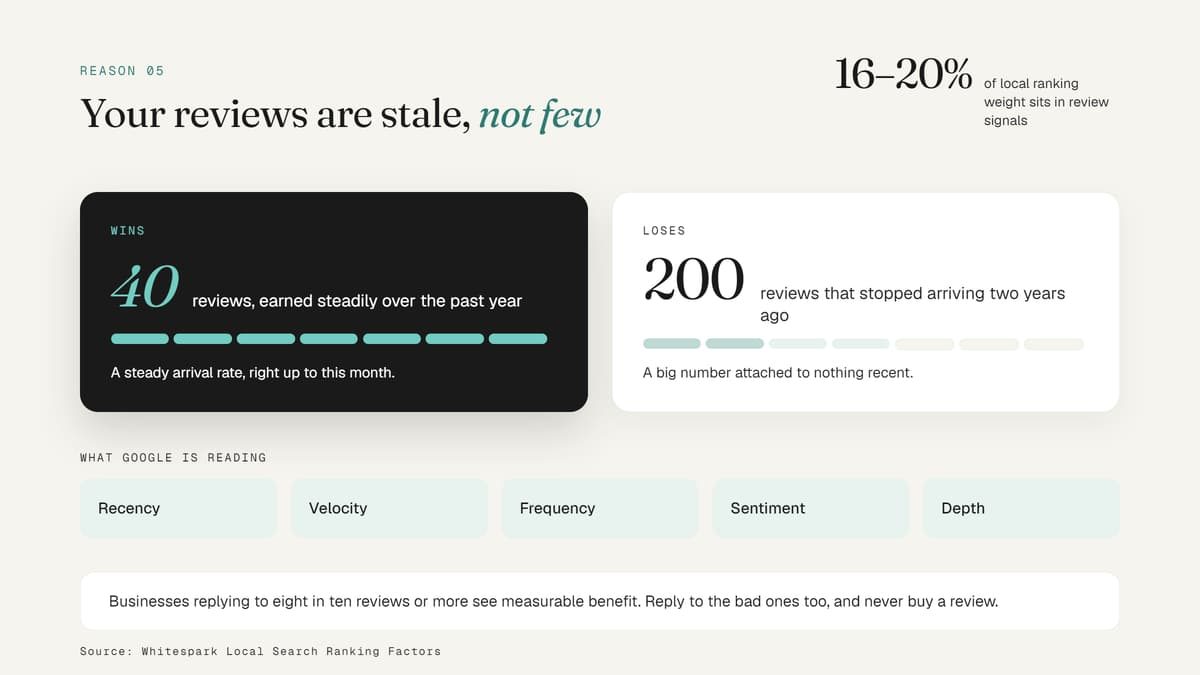
Review count is the metric owners fixate on and the one that explains the least. A profile with 40 reviews earned steadily over the past year routinely outranks a profile with 200 reviews that stopped arriving in 2024.
Review signals were among the two fastest-growing factor groups in the 2026 data, and what moved was recency, frequency, sentiment, velocity, and depth, not raw volume. Reviews account for roughly 16 to 20 percent of local ranking weight, and businesses that respond to 80 percent or more of their reviews see measurable ranking benefit.
Google is reading your review stream as evidence that the business is currently operating and currently satisfying customers. A gap of six months reads as a business that may have closed.
How to fix it:
- Make review generation a process, not a campaign. A consistent trickle beats a burst, and bursts look manipulated.
- Use a direct review link so the customer lands on the review box in one tap.
- Respond to every review, positive and negative, within a few days. Responses are a trust signal and a conversion signal.
- Never incentivize, gate, or buy reviews. Sudden velocity spikes on a previously quiet profile are one of the clearest triggers for filtering and suspension.
- Encourage detail. Reviews that name the specific service and the neighbourhood carry relevance value that a bare five stars does not.
6. Your Citations Are Inconsistent or Missing
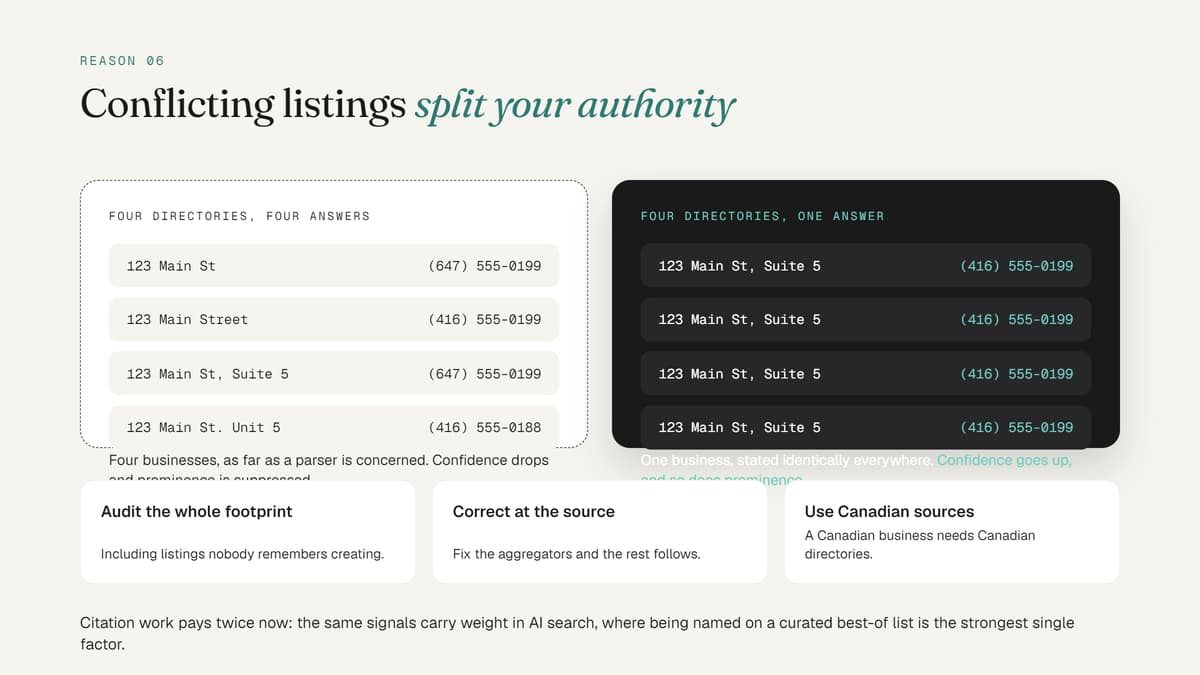
Your name, address, and phone number appear across dozens of directories, aggregators, and data providers. When those records conflict, Google's confidence in your business data drops, and low confidence suppresses prominence.
Duplicate and conflicting listings continue to cause real damage by splitting authority and reducing your chances of appearing in the Map Pack or in AI-generated answers. This matters more now than it did two years ago, because the same data pool feeds both traditional local results and AI assistants.
Common causes: an old suite number from a previous office, a tracking phone number used in one directory and the main line everywhere else, an abbreviation mismatch, or a listing created by a former employee or a previous agency that nobody remembers.
How to fix it: Audit the full citation footprint, correct the conflicts at the source including the data aggregators, and build out the directories relevant to your category and country. Canadian businesses need Canadian sources, not the generic US list most tools default to. Local citation building is unglamorous work, but it is foundational, and it is usually the fastest fix for a profile that ranks nowhere despite looking correct.
7. Your Website Cannot Support the Profile
The Map Pack pulls from your Google Business Profile, but your website is what gives that profile credibility. Weak sites cap Map Pack performance, and this connection has strengthened.
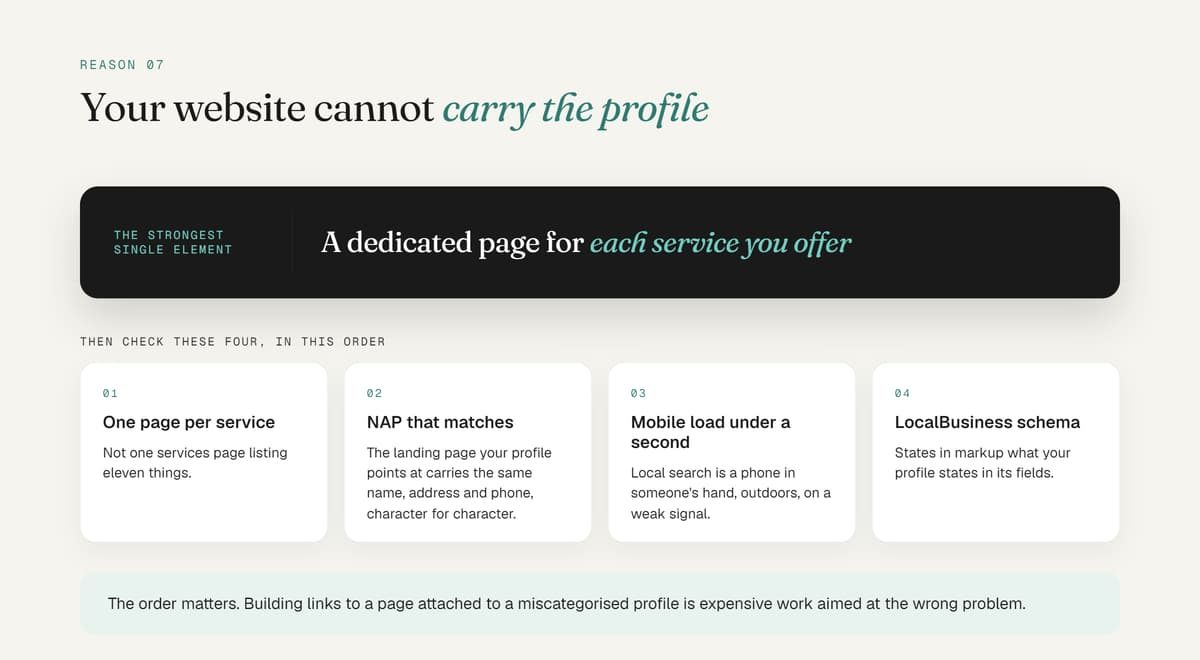
On-page signals rank as critical across all three surfaces measured in the 2026 report: local pack, local organic, and AI search visibility. For local organic results specifically, the single most influential element is having a dedicated page for each product or service.
Diagnose these:
- One page per service, not one page listing all services. A single "Services" page cannot rank for eight different queries.
- The landing page your profile points to. It should match the profile's NAP exactly, name the city, and address the query the profile is targeting. Pointing every profile at your homepage wastes the strongest link you control.
- Load speed on mobile. Local search is overwhelmingly mobile and overwhelmingly urgent. A site that loads in under a second converts the traffic you fight for; a four-second site leaks it.
- LocalBusiness schema with consistent NAP, hours, and geo coordinates, so machines can parse what humans read.
If your site is a template with thin content and no service-level depth, no amount of profile optimization will carry you. That is when the work moves to SEO and content or, in some cases, a rebuild.
8. You Have No Local Authority
Prominence, in Google's own framing, is partly a function of who links to and talks about your business. Most local businesses have effectively zero local authority: no mentions in community publications, no local sponsorships, no supplier or association pages linking back, no press.
A competitor with a link from a Toronto news site, a BIA member page, and three trade association directories has a prominence signal you cannot match with reviews alone.
How to fix it: Pursue links that a business in your city could plausibly earn. Local news, chambers of commerce, industry associations, supplier and partner directories, sponsorships of teams and events, and genuine community involvement. Avoid link networks and PBNs entirely; in local search the risk is concentrated on a single profile that is expensive to recover. Our link building work is deliberately built on Canadian, editorially placed links for that reason.
9. Your Profile Is Suspended, Filtered, or Duplicated
If your geo-grid shows zero visibility everywhere, including at your own address, you are not dealing with a ranking problem. You are dealing with an eligibility problem.
Three distinct scenarios:
Suspension. The profile is removed from search entirely, usually triggered by an address change, a category change, keyword stuffing in the business name, a virtual office, or a guideline violation on a related profile. Reinstatement requires documentation and a formal appeal.
Filtering. The profile exists and is visible on Maps, but Google suppresses it in the local pack because it considers it too similar to another listing at the same or a nearby address. Common for businesses sharing a building with a competitor, and for law firms and clinics where individual practitioners each hold a profile.
Duplicates. Two or more profiles for the same business split your reviews, your signals, and your authority. Often created accidentally, often years ago. These need to be merged or removed, not simply ignored.
How to fix it: Do not experiment. Address changes and business name edits on a suspended or at-risk profile can trigger re-verification and, in the worst case, permanent removal. This is one of the few areas of local SEO where a wrong move costs you months, and it is the main reason ongoing profile management exists as a service.
10. Your Business Name Is Keyword Stuffed
Adding keywords to your Google Business Profile business name works. It is also a direct guideline violation, it is trivially reportable by competitors through Google's redressal process, and it is one of the most common causes of suspension.
If you have done it, the safest path is to correct it before someone else reports it. If a competitor has done it and is outranking you because of it, report the listing rather than copying it. Building a local presence on a violation is building on a profile that can vanish in a week.
11. You Are Optimizing for Tactics That Testing Has Debunked
Several tactics still recommended widely have failed under controlled testing. If you have been doing these instead of the work above, that is your gap.
Google Posts do not move rankings. Controlled multi-week testing across hundreds of keywords found no ranking movement attributable to posting. Posts do influence click-through and engagement, which is a real reason to publish them, but they are a conversion tool, not a ranking lever. Publish them for customers, not for the algorithm.
Geotagging photos does nothing. This has been repeatedly debunked by controlled studies. Upload real, current photos because they influence engagement and conversion, and because staleness is visible to customers.
Widening your service area does nothing for rank. Covered above. It affects who you appear eligible to serve, not where you rank.
Embedding a Google Map on your contact page is not a ranking factor. It is fine for usability. It is not a lever.
The Part Most Businesses Are Now Missing: AI Search
The Map Pack is no longer the only local answer surface. When someone asks ChatGPT, Gemini, Perplexity, or Google's AI Overviews for a recommendation in your category and city, the answer is assembled from a data pool that overlaps heavily with the one feeding local search.
The 2026 Local Search Ranking Factors data shows local search signals and AI search signals have effectively merged: the same inputs now determine whether you are recommended or ignored across Google, Maps, ChatGPT, Perplexity, and Apple. Citation signals carry noticeably more weight for AI search visibility than they do for the traditional local pack, and the strongest single factor for appearing in AI results is being named on expert-curated "best of" lists.
The practical implication is that the citation cleanup and local authority work in sections 6 and 8 now pay off twice. The businesses treating Map Pack visibility and AI search visibility as one project are compounding, and the ones treating them as separate budgets are paying twice for overlapping work. If you want the mechanics of how AI assistants select and cite local businesses, that is the subject of answer engine optimization.
How Long Map Pack Fixes Take
Realistic expectations, assuming the work is done properly and consistently:
- Category and profile field corrections: days to three weeks. Fastest-acting fixes available.
- Review velocity and response rate: four to eight weeks before the pattern registers.
- Citation cleanup and duplicate removal: four to twelve weeks, depending on how deep the bad data has propagated into aggregators.
- Local links, service pages, and location pages: three to six months for compounding effect.
- Suspension reinstatement: one to eight weeks, highly variable, and dependent entirely on documentation quality.
Most businesses see measurable improvement within 60 to 90 days of consistent optimization, though genuinely competitive metros can take six to twelve months. A new business with no citations and no reviews starts from further back than an established one with messy data.
Anyone who promises you a top-three Map Pack position in thirty days in a competitive GTA category is either not measuring across a grid or is not telling you what happens after.
Diagnose in This Order
- Run a geo-grid rank check to establish whether this is a ranking problem or an eligibility problem.
- Confirm the profile is not suspended, filtered, or duplicated.
- Fix the primary category to match what the top three are using.
- Complete predefined services, hours, description, attributes, and photos.
- Restart review velocity and respond to every review.
- Audit and correct the citation footprint at the source.
- Build a dedicated page for every service and every real service area.
- Earn local links and community mentions.
- Re-measure on the same grid at 30, 60, and 90 days.
The order matters. Building links to a page attached to a miscategorized profile is expensive work aimed at the wrong problem.
Frequently Asked Questions
Why do my competitors rank in the Map Pack with fewer reviews than me? Because reviews are one input among many and account for roughly 16 to 20 percent of local ranking weight. A competitor with a more accurate primary category, a visible address, stronger citation consistency, and recent review activity will outrank a business with a higher raw review count and weaker signals everywhere else.
Why do I rank in the Map Pack sometimes and not other times? Map Pack results are recalculated per searcher based on their location, and being open at the time of search is now a significant factor. The same query can return different results from two points a kilometre apart, and different results before and after your closing time.
Does my website affect Map Pack ranking? Indirectly but meaningfully. The Map Pack pulls from your Google Business Profile, but on-page signals and dedicated service pages are consistently rated among the strongest factors across local pack, local organic, and AI search results. A weak website caps how far your profile can go.
How do I know if my Google Business Profile is suspended? A suspended profile disappears from search and Maps, and your dashboard will typically show a suspension notice. If the profile appears in Maps but never in the local pack, you are more likely dealing with a filter or a duplicate than a suspension.
Can I rank in the Map Pack without a physical address? Yes, but at a disadvantage. A visible address ranks as the seventh most influential local pack factor, so service area businesses need to compensate through review velocity, citation depth, and local link authority. Renting a virtual address to display is a guideline violation and risks suspension.
How long does it take to rank in the Google Map Pack? Profile-level fixes can move rankings within days to three weeks. Most businesses see measurable improvement in 60 to 90 days, while competitive metropolitan categories can take six to twelve months.
Continue reading
Read the latest issues

Discussion