
What Is SEO and Why Does It Matter
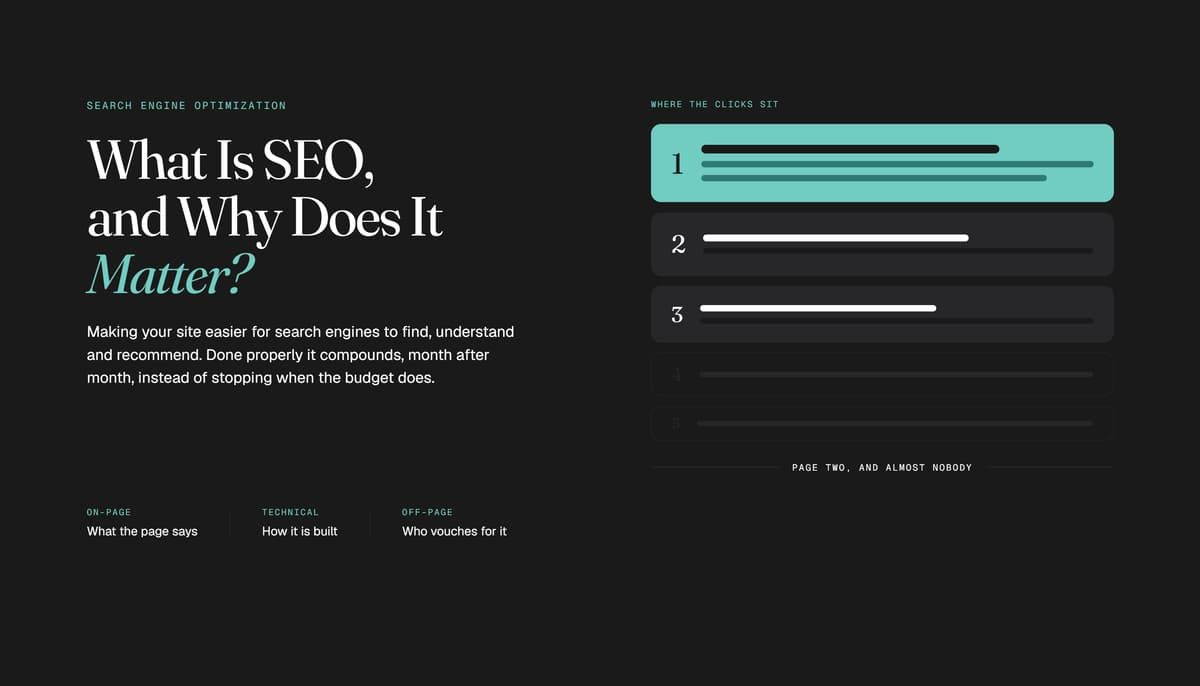
Most business owners have heard of SEO. Far fewer actually understand what it does, why it works, or why ignoring it is one of the most expensive mistakes a business can make. This guide breaks it down without the jargon, so you can make smarter decisions about your digital presence.
SEO (Search Engine Optimization) is the process of making your website easier for search engines to find, understand, and recommend to users. When done right, it brings a steady stream of qualified visitors to your site, without paying for every click.
Finding a reliable SEO service in Toronto means looking past the marketing jargon and focusing on the underlying mechanics of search. A properly engineered foundation turns your website into a compounding asset that outpaces competitors month over month.
The Simple Definition of SEO
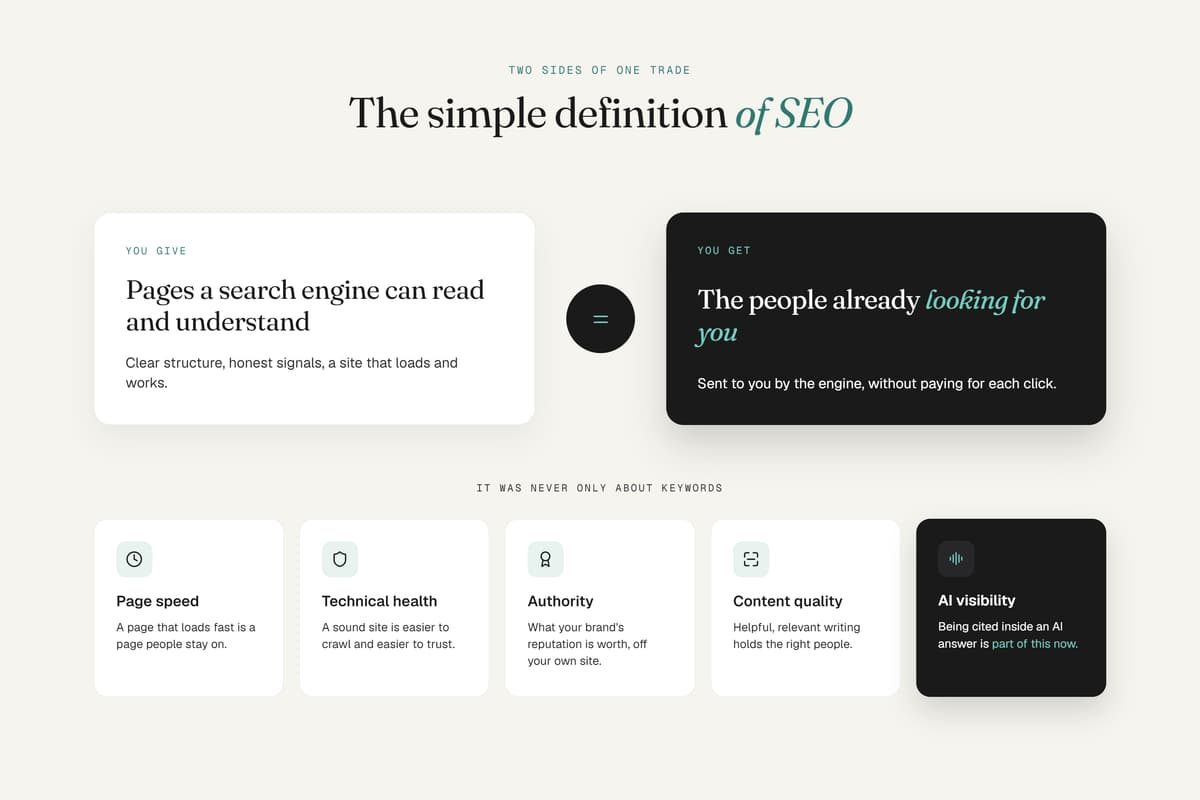
SEO stands for Search Engine Optimization. It is the practice of improving your website so that it appears higher in search engine results pages (SERPs) when people search for topics related to your business.
At its core, SEO is a two-sided equation: you help search engines understand what your pages are about, and in return, those search engines send you the people actively looking for what you offer.
But SEO is not just about keywords or blog posts. It covers how fast your pages load, whether your site is technically sound, how authoritative your brand appears online, and now, whether AI tools like ChatGPT reference you in their answers.
How Search Engines Actually Work
Search engines use automated programs called crawlers to systematically explore the web. These crawlers follow links from page to page, reading the content they find and storing it in a massive index. When someone performs a search, the engine pulls from that index and ranks the most relevant, trustworthy results against each other.
Your position in those rankings is determined by hundreds of signals: the quality and relevance of your content, how your site is structured, how many credible websites link to you, and how well your pages perform for real users. The goal of SEO is to send as many of those signals in your favor as possible.
Organic Search vs. Paid Ads: What's the Difference?
There are two ways to appear at the top of Google: pay for it, or earn it.
Paid ads (Google Ads / PPC) place your website at the top of results immediately, but the arrangement is purely transactional. The moment your ad budget runs out, your visibility disappears with it.
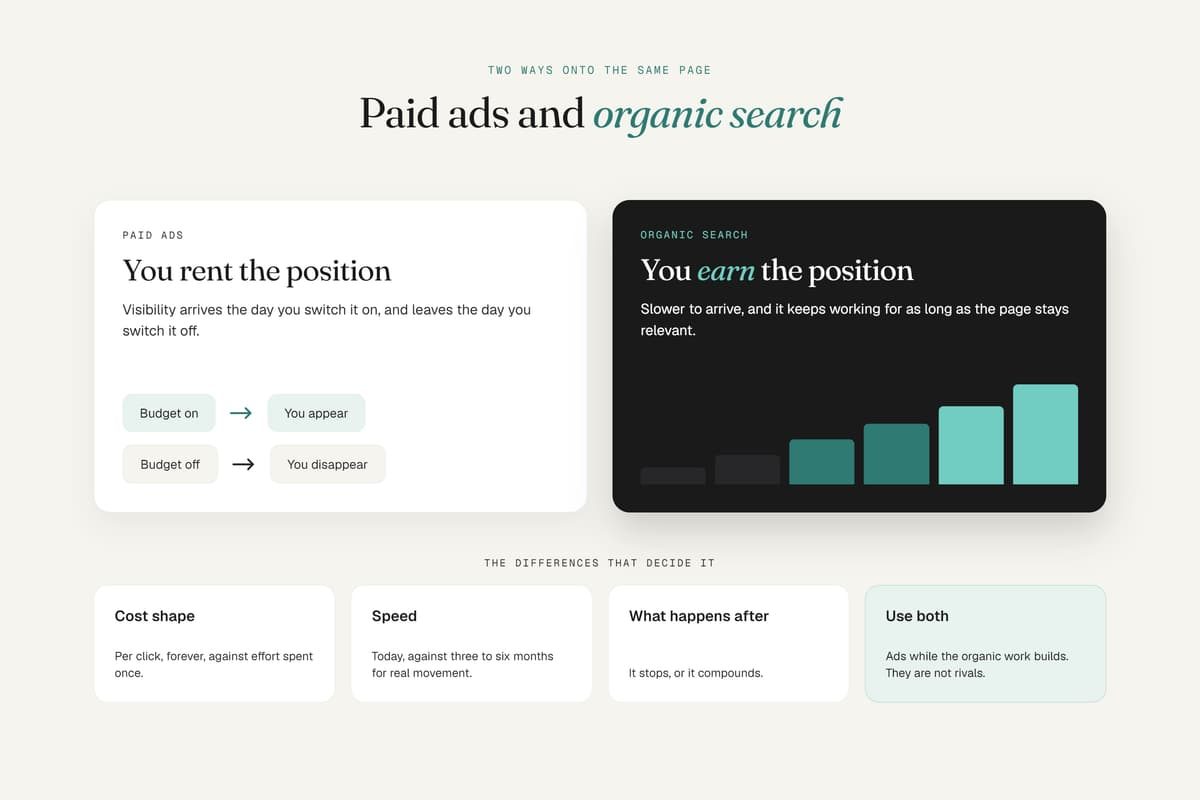
Organic SEO works differently. You invest time and effort upfront to build a presence that does not require ongoing payment to maintain. A well-optimized page can attract visitors for years, long after the initial work is done. That compounding effect is why businesses that invest in SEO early consistently outperform competitors who rely exclusively on ads.
| Factor | SEO (organic) | Paid ads (PPC) |
|---|---|---|
| Cost model | Time and effort upfront; no per-click cost | Pay for every click; cost scales with volume |
| Speed to results | 3–6 months for meaningful movement | Immediate visibility once campaign is live |
| Longevity | Builds compounding value over time | Stops the moment the budget runs out |
| Trust signals | Organic listings perceived as more credible | Labeled "Sponsored" — lower click trust |
| Click share | ~53% of all web traffic comes from organic | ~27% — users skip ads more than ever |
| Long-term ROI | High — results compound monthly | Variable — stops when spending stops |
| Best for | Sustainable, long-term growth strategy | Fast launches, promotions, testing offers |
Why SEO Matters for Your Business
The Numbers That Make the Case
The scale of organic search is difficult to overstate. Across the web, organic traffic accounts for the majority of visits to most business websites, and a significant portion of those journeys start with a Google search.
Consider what happens at the top of the results page: the first organic result captures roughly a third of all clicks for a given search. By the third position, that share has dropped considerably. Pages on the second page of results receive almost no traffic at all.
For any business that relies on customers finding them, that concentration of clicks at the top of page one is the entire argument for SEO.
SEO Builds Trust, Not Just Traffic
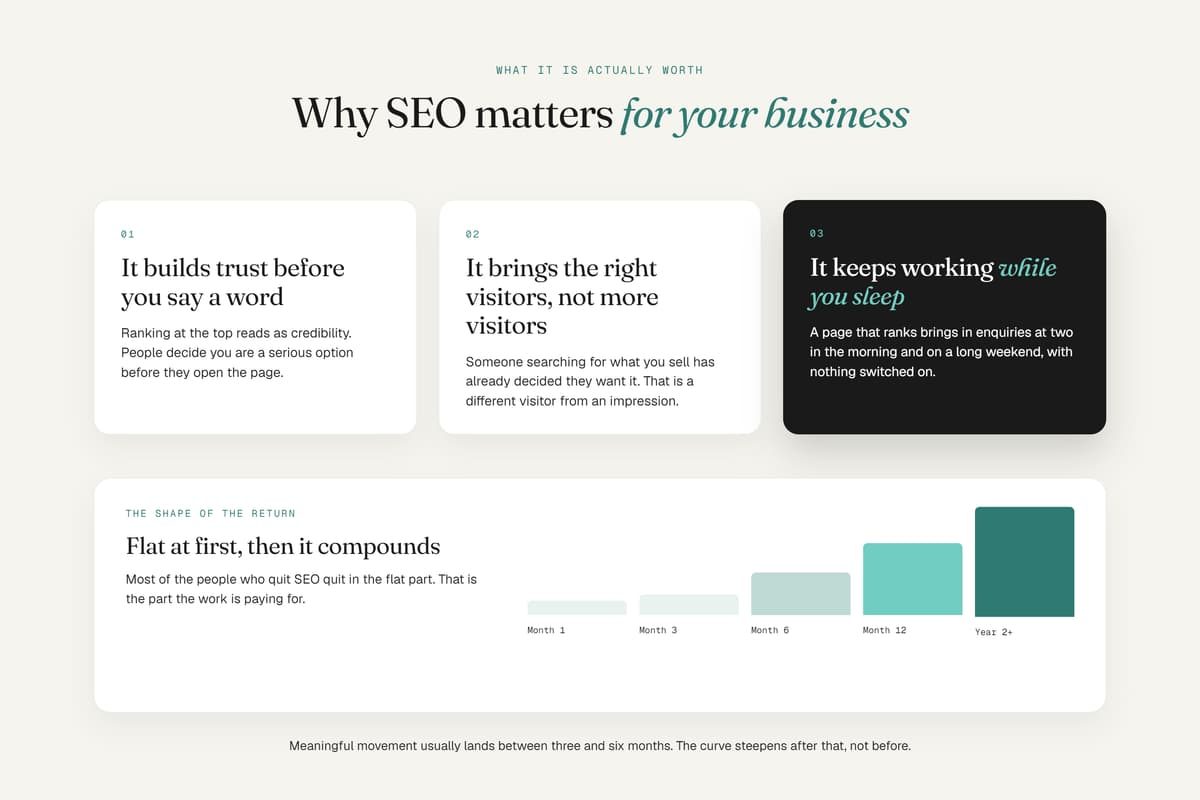
There is a psychological dimension to search rankings that most people overlook. When a website consistently appears at the top of Google, users interpret that position as a signal of authority and credibility. You are not just getting clicks; you are earning trust before a potential client has read a single word on your site.
This trust compounds over time. A business that ranks well for "immigration lawyer Toronto" or "local SEO agency Toronto" is perceived as the category leader, regardless of how long it has been in business.
At Mehrana Agency, we help Toronto businesses build exactly that kind of authority. Our SEO services are built around ranking you for the keywords your customers are actively searching, not just the ones that look good in a report.
SEO Works While You Sleep
Unlike a sales team that needs rest, a well-optimized website generates leads around the clock. A potential client researching at 11pm on a Sunday will contact whoever they find first. If that is your site, you benefit without lifting a finger. If it is your competitor's, you have already lost that lead before the week even started.
This is the quiet, compounding advantage of SEO that paid advertising simply cannot replicate.
The Three Pillars of SEO
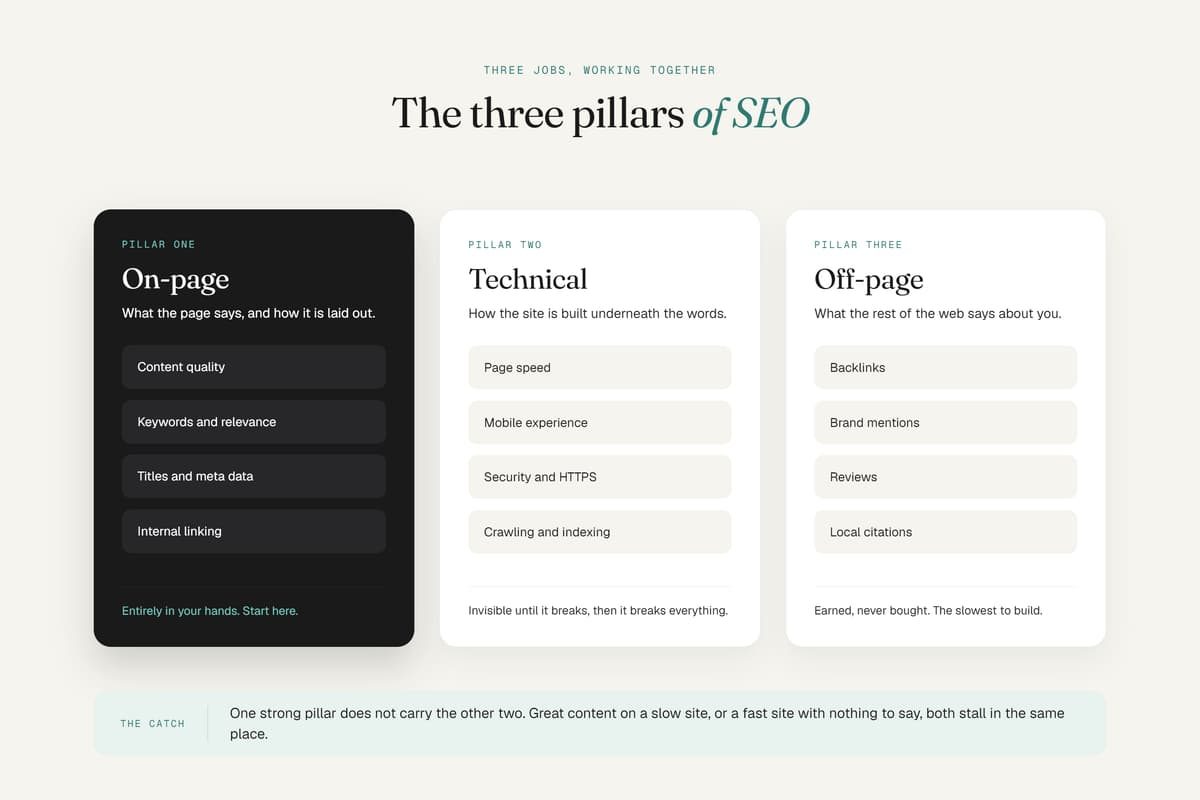
Think of SEO as a three-legged stool. Remove any one leg and the whole thing falls over.
On-Page SEO
On-page SEO covers everything you control directly on your website: the content you publish, how your headings are structured, which keywords appear in your page titles and meta descriptions, how images are labeled, and how well your internal links connect related pages together.
Good on-page SEO starts with understanding exactly what your audience is searching for and what they expect to find when they get there. It means writing content that answers real questions, structured in a way that both humans and search engines can navigate easily. It also means making sure each page has a clear, singular focus, rather than competing against itself.
Technical SEO
Technical SEO is the foundation everything else sits on. A beautifully written page on a slow, broken, or poorly structured website will not rank, no matter how good the content is.
Technical SEO covers:
- Page load speed and Core Web Vitals
- Mobile responsiveness across all devices
- Site architecture and how easily crawlers can access your pages
- HTTPS security
- Structured data (schema markup) that helps Google understand what your content means, not just what it says
- Crawl errors, duplicate content, and redirect issues
Off-Page SEO
Off-page SEO refers to everything that happens outside your website that signals to Google your site is worth ranking. The most important off-page signal is backlinks: links from other reputable websites pointing to yours. Each one functions as a vote of confidence in your content and your brand.
Off-page SEO also includes brand mentions, reviews, local business citations, and your presence across platforms and directories that Google considers authoritative. For local businesses in particular, building a consistent and accurate citation profile across the web is one of the highest-leverage activities in the entire SEO playbook.
SEO in the Age of AI Search
This is where most SEO guides stop. But in 2025 and beyond, understanding traditional SEO is not enough.
What Is AEO (Answer Engine Optimization)?
Search behavior is changing faster than at any point in the past decade. Users are increasingly getting their answers directly from AI tools rather than clicking through to websites. When someone asks ChatGPT, Perplexity, or Google's AI Overviews a question, those systems pull from web content to construct their response.
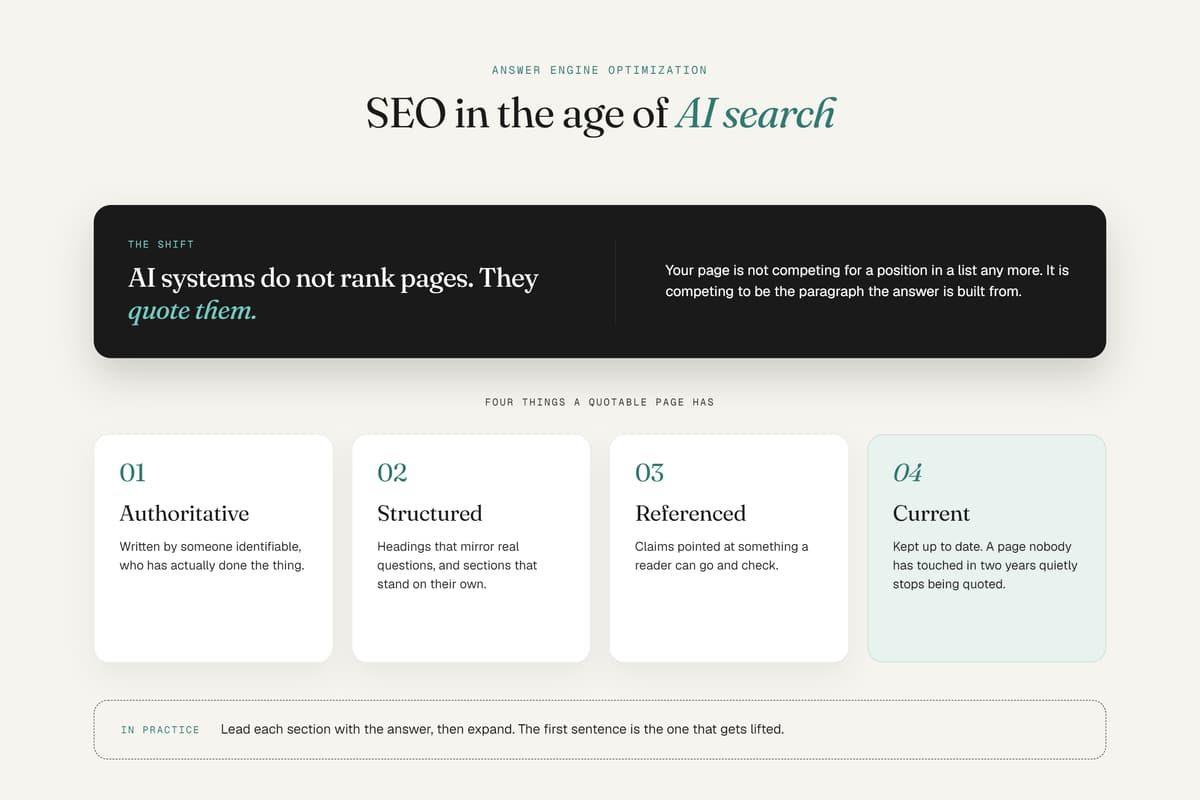
Whether your business gets cited in that response depends on AEO: Answer Engine Optimization.
AEO is about structuring your content so AI tools can extract and reference it with confidence. This means writing clear, direct answers to common questions, using proper schema markup, building brand authority so AI models recognize you as a trustworthy source, and earning mentions across credible external sites.
How ChatGPT, Perplexity, and Gemini Use Your Content
AI language models are trained on large datasets that include content from across the web. When a user asks a question, the model retrieves information from authoritative, well-structured sources to back up its answer. To become one of those sources, your content needs to meet a high bar:
Authoritative: Written by or clearly attributed to someone with demonstrable expertise (Google refers to this as E-E-A-T: Experience, Expertise, Authoritativeness, Trustworthiness)
Structured: Formatted in a way that machines can parse reliably, not just humans can read
Referenced: Cited or linked to by other credible websites across the web
Current: Outdated information signals low trust to both Google and AI retrieval systems
This is not a replacement for traditional SEO. It is an additional layer on top of it. Businesses that master both will build a search presence their competitors cannot replicate.
At Mehrana, we offer dedicated AI Search SEO services designed to get your brand cited by ChatGPT, Perplexity, Gemini, and Claude, alongside your traditional Google rankings.
How Long Does SEO Take to Work?
This is the most common question we hear, and the honest answer is: it depends, but most businesses see meaningful movement within three to six months of consistent work, with compounding gains continuing for years after that.
Here is a realistic timeline for a new or under-optimized site:
- Months 1 to 2: Technical fixes, content foundation, initial indexing
- Months 3 to 4: Early ranking improvements for lower-competition keywords, increased crawl activity
- Months 4 to 6: Measurable organic traffic growth, first-page appearances for target keywords
- Months 6 to 12: Compounding traffic gains as content builds authority and backlinks accumulate
- Year 2 and beyond: Sustainable, high-volume organic traffic that functions independently of ad spend
SEO is not instant. But unlike paid advertising, it does not stop the moment you pause a campaign. Every month of good SEO work builds on the previous month.
Local SEO vs. Traditional SEO: Which Do You Need?
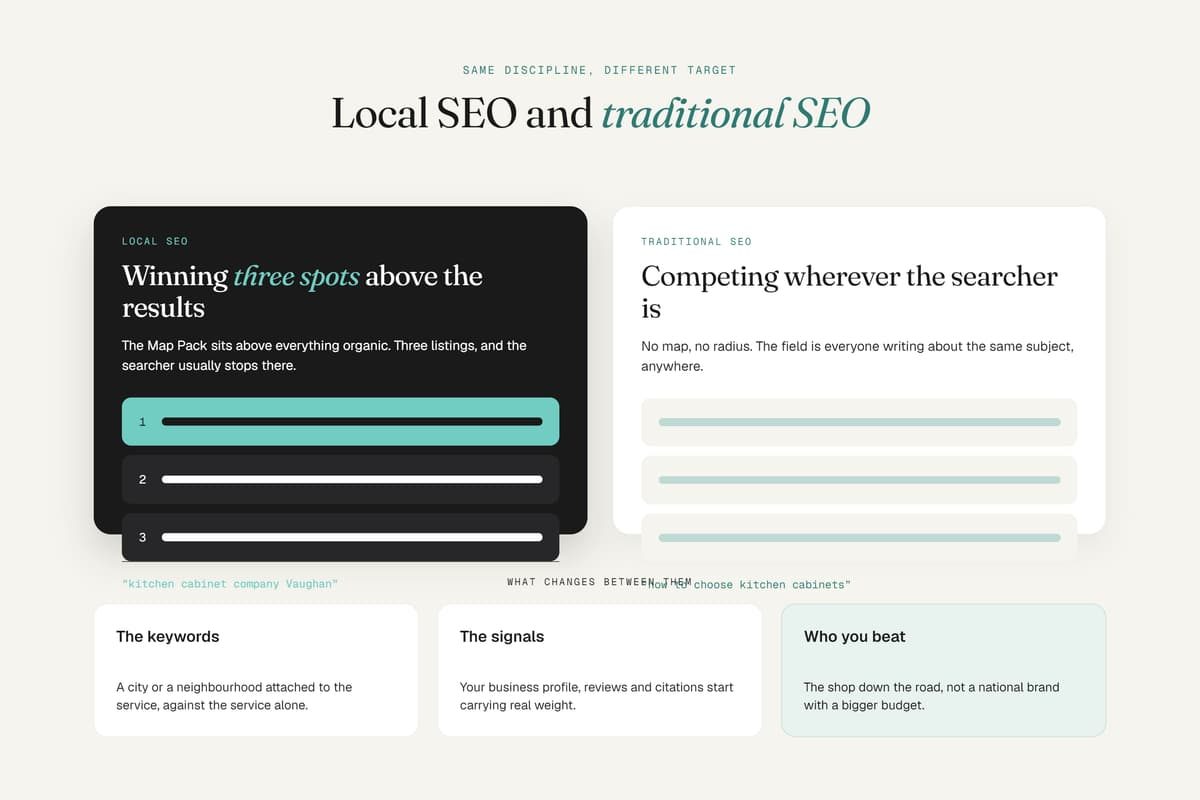
If your business serves customers in a specific geographic area, whether you are a plumber in Mississauga, a dentist in North York, or an immigration consultant in Toronto, you need local SEO alongside traditional SEO.
Local SEO focuses on appearing where location-based decisions get made:
- Google's Map Pack (the three business listings that appear above the organic results)
- "Near me" searches
- Localized keyword searches like "kitchen cabinet company Vaughan" or "SEO agency Toronto"
The core components of local SEO include optimizing your Google Business Profile, building citations across local directories, generating and managing reviews, and creating location-specific pages on your website that signal geographic relevance to Google.
Our Local SEO service is built specifically for GTA businesses that need to rank in their city, not just somewhere on the internet. We handle Map Pack optimization, GBP management, citation building, and review strategy.
Common SEO Mistakes That Hold Businesses Back
Even well-intentioned SEO efforts fail when these patterns show up:
Targeting keywords no one searches for. Choosing keywords based on intuition rather than data leads to content that ranks for terms with no search volume. Keyword research is not optional.
Publishing content that does not match search intent. Writing a blog post when the searcher wants a service page, or targeting an informational keyword with a sales page, sends the wrong signals to Google and the wrong experience to your visitors.
Ignoring technical issues. Slow pages, crawl errors, duplicate content, and broken redirects quietly suppress rankings regardless of how strong the content is.
Expecting fast results and abandoning the strategy. Businesses that stop SEO after 60 days without results never reach the compounding phase where the real returns appear.
Neglecting internal linking. Every page on your site should connect logically to related pages. A well-linked site is easier for Google to crawl and helps spread authority across your entire domain.
Skipping local optimization. For any business with a physical location or defined service area, an incomplete Google Business Profile and missing local citations are leaving significant traffic on the table.
How to Get Started with SEO
Getting started does not require overhauling your entire website overnight. Here is a practical sequence that works:
Step 1: Audit what you have. Understand where your site currently stands: what keywords you rank for, what technical problems exist, and where the content gaps are.
Step 2: Fix the technical foundation. Address crawl errors, page speed issues, and any indexing problems before investing in new content.
Step 3: Target the right keywords. Build a keyword strategy around what your actual customers search for, mapped to clear intent at each stage of the buying journey.
Step 4: Create and optimize content. Publish content that answers real questions and is structured to rank, with proper headings, schema markup, and internal links connecting it to the rest of your site.
Step 5: Build authority off the page. Earn backlinks, build citations (especially for local SEO), and grow your brand's presence across authoritative external sources.
Step 6: Track and iterate. Use Google Search Console and Analytics to monitor what is working, what is not, and where to focus next.
If you want a professional team to handle this, our Lead Foundation package is built for businesses starting their SEO journey, and our Authority Plus solution is for those ready to own their category.
FAQs
What does SEO stand for? SEO stands for Search Engine Optimization. It is the process of improving a website so that it ranks higher in search results for relevant queries, attracting organic (unpaid) traffic from people actively looking for what the business offers.
Is SEO still worth it in 2025? Yes, more so than in previous years. With AI-generated answers now appearing at the top of Google results, appearing in both traditional organic rankings and AI citations gives businesses a compounding visibility advantage. Organic traffic continues to account for the largest share of web visits across most industries.
How is SEO different from Google Ads? Google Ads places your site at the top of results immediately in exchange for payment per click. When the budget stops, so does the traffic. SEO builds your position organically over time, and once established, that traffic does not require ongoing ad spend to maintain.
What is the difference between on-page and off-page SEO? On-page SEO covers everything within your website: content, headings, meta tags, internal links, and technical structure. Off-page SEO covers everything outside your site that influences your rankings, primarily backlinks from other websites, brand mentions, and local business citations.
How long does it take to see results from SEO? Most businesses see meaningful improvements within three to six months of consistent work. Competitive industries may take longer. The compounding nature of SEO means results grow over time, which is the fundamental advantage over paid advertising.
What is local SEO and do I need it? Local SEO focuses on ranking your business in location-specific searches and Google's Map Pack. Any business that serves customers in a defined geographic area, rather than purely online, needs local SEO. It involves optimizing your Google Business Profile, building local citations, and creating location-targeted content on your website.
What is AEO and how is it different from SEO? AEO (Answer Engine Optimization) is the practice of structuring your content to be cited by AI tools like ChatGPT, Perplexity, and Google AI Overviews when they generate responses. Traditional SEO targets Google rankings. AEO targets the AI systems that are increasingly answering questions before users ever click a link. A strong strategy today needs to cover both.
Ready to see how your website performs in search? Start with a free audit and we will show you exactly where you stand and what it would take to rank.
Continue reading
Read the latest issues
Discussion