
Local Services Ads vs Local SEO for Service Businesses
Both channels put a service business at the top of Google for the same searches, and that is where the similarity ends. Local Services Ads charge a fee every time a customer makes contact. Local SEO builds visibility you keep. Fund the wrong one first and you either burn a budget you cannot sustain or wait four months for leads you needed last quarter. The answer for a Toronto plumber is also not the answer for a Toronto dental clinic, and the reason is worth knowing before you set a budget.
How Google Local Services Ads Work
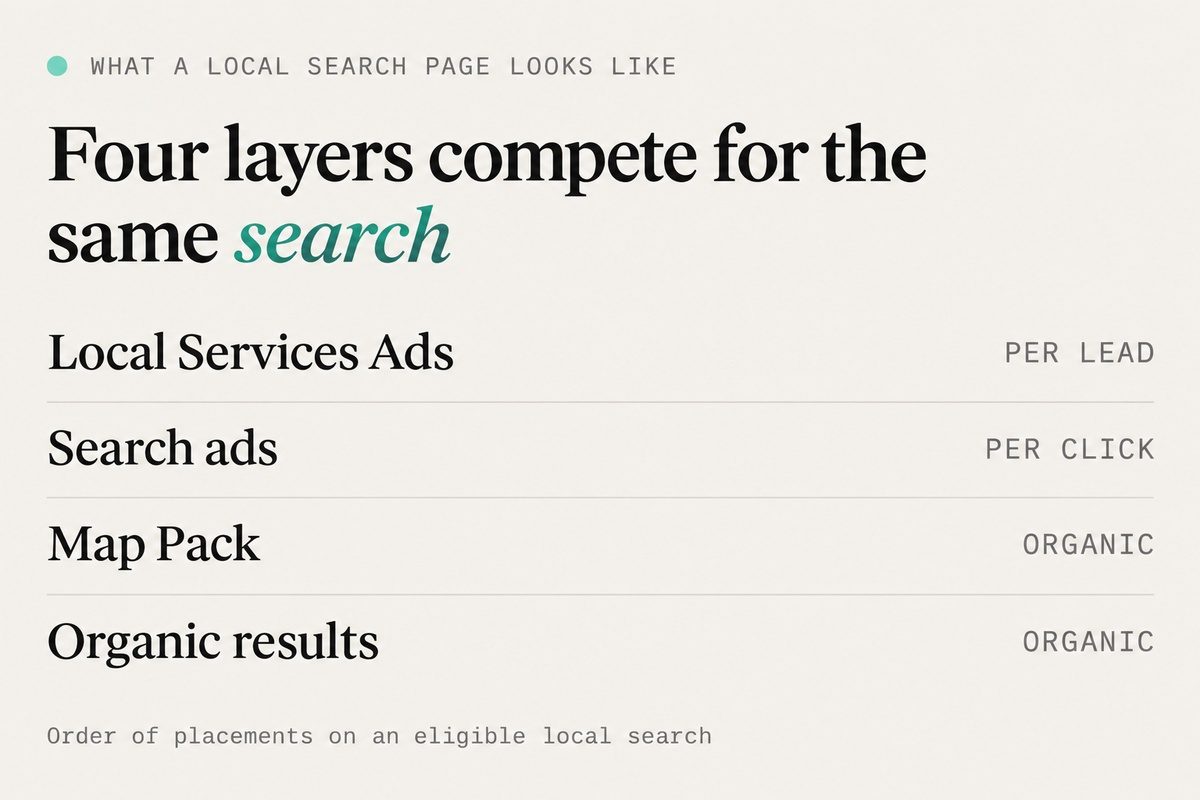
Local Services Ads sit at the very top of the results page, above the standard search ads and above the map. They are keywordless: you select the services you offer and the area you cover rather than bidding on search terms.
The billing model is the structural difference from every other Google ad product. Google's own documentation states that you pay only when a customer gets in touch from your ad, not when someone clicks it. The Google Verified badge signals that a business has passed Google's proprietary screening process. Going live requires a license or business registration, reviews depending on category, and billing with a budget; listings that have not finished onboarding appear below providers who have.
Placement order is decided by factors including your review score and number of reviews, proximity to the searcher, responsiveness and business hours. Google states plainly that frequently missing calls or messages may affect your ad ranking, which is why the channel rewards the business with the best phone coverage rather than the biggest budget.
How Local SEO Builds Map Pack and Organic Visibility
Local SEO competes on two surfaces that reward different work. Map Pack ranking runs almost entirely on your Business Profile, the organic listings below the map on your website.
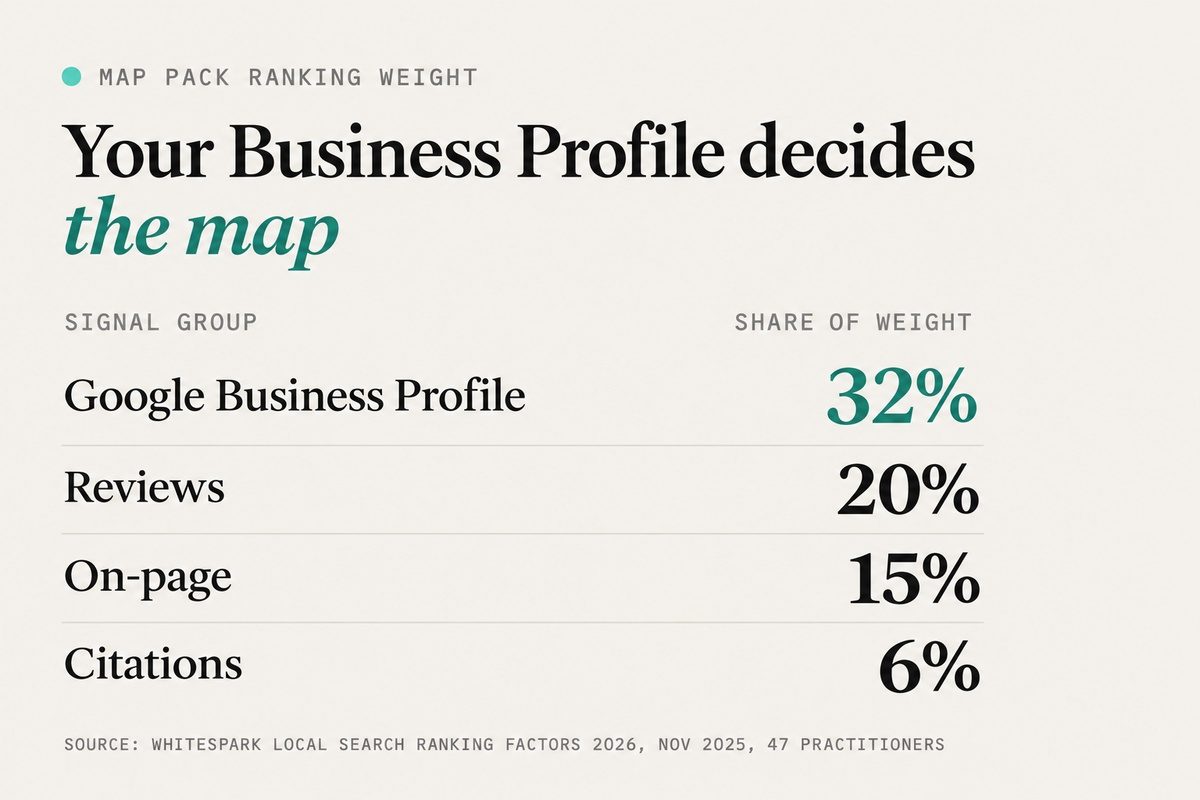
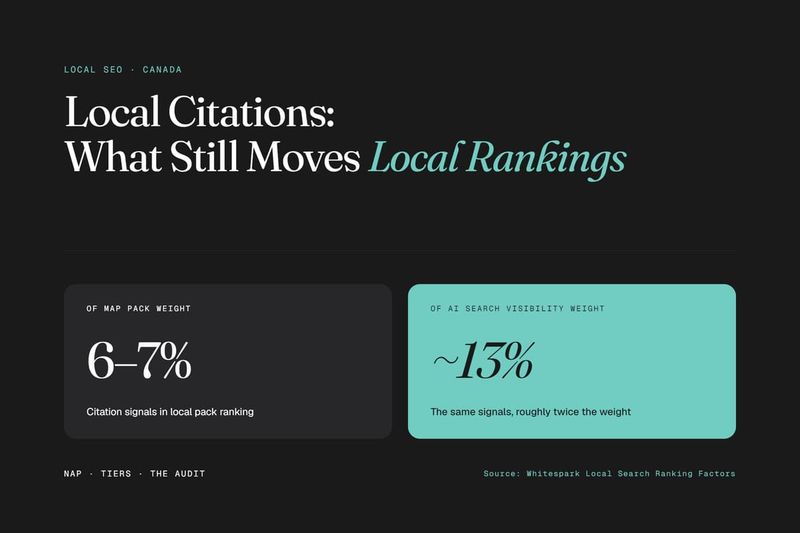
Whitespark's 2026 Local Search Ranking Factors survey, published November 2025 from 47 practitioners scoring 187 factors, puts Google Business Profile signals at roughly 32 percent of Map Pack weight, reviews at roughly 20 percent, on-page at roughly 15 percent and citations at roughly 6 percent. For local organic rankings the balance inverts, on-page leading at roughly 33 percent.
So category, profile completeness and review flow decide the map, the work handled through Google Business Profile management. Local citation building keeps your name, address and phone number consistent across the directories Google cross-references, and service pages built on real search phrases carry the organic side. None of it bills per call, and a local SEO program holding the Map Pack keeps that position through a month where you spend nothing.
Local Services Ads vs Local SEO: The Core Differences
| FACTOR | LOCAL SERVICES ADS | LOCAL SEO |
|---|---|---|
| What you pay for | Each qualifying call or message | The work, monthly or in-house hours |
| Time to first leads | Days, once screening clears | Weeks to months, then compounds |
| What happens when you stop | Leads stop the same day | Rankings and calls continue |
| Who can use it in Canada | Listed home service categories only | Any business with a verified profile |
| Main lever you control | Answering every lead quickly | Profile, reviews, citations, site |
| Cost direction over time | Rises with competition | Falls per lead as rankings hold |
| Where it appears | Above search ads and the map | Map Pack and organic results |
Do Local Services Ads Affect Your Map Pack Rankings?
They do not. Google has stated consistently that the ad auction and organic ranking run as separate systems, and that paying for ads does not lift organic position. Your Local Services Ads profile is verified separately too, with its own categories and service area.
One genuine connection is worth building around. Ad placement uses your review score and review count, and those reviews come from your Business Profile, so review work pays into both channels at once. Citations and on-page work pay into the organic side only.
What does change is the shape of the page. Where eligible competitors advertise, the ads take the space above the map, so the Map Pack sits lower on screen. Owners read that as a ranking drop. The ranking did not move, the real estate above it grew.
Not sure which channel fits your category and your call volume? Request a free local visibility audit and we will map both.
Which Channel to Fund First, by Situation
You Need Booked Jobs This Month
Local Services Ads, with one condition. The channel bills per contact and ranks partly on responsiveness, so a business that misses half its calls pays for leads it cannot convert while pushing its own placement down. Fix the phone coverage before funding the ads.
You Are New and Have Few Reviews
Run both, and know what each is doing. Reviews are a ranking input for the ads and roughly a fifth of Map Pack weight, so a thin review profile limits both at once. Ads produce jobs now, and every job is a review request. New plumbing and contracting businesses should treat early ad spend as review acquisition, not pure lead buying.
You Have Steady Work and Want Lower Lead Costs
Local SEO first. If the calendar is reasonably full, the problem is lead cost, not lead volume. Paying per contact indefinitely for work you could rank for organically is the most common way established service businesses overspend on Google. Build the profile, reviews and service pages, hold the Map Pack, then scale ads back to seasonal gaps.
Your Category Has No Local Services Ads Option
Then the comparison is settled for you. Google's Local Services Ads help page for Canada lists 16 eligible categories: appliance repair, carpet cleaning, cleaning, electricians, HVAC, junk removal, lawn care, locksmiths, movers, pest control, plumbers, roofers, tree services, water damage, window cleaning and window repair.
Dental practices, medical clinics and law firms are not on that list in Canada, even though those verticals can run Local Services Ads in the United States. If you run a clinic or a firm in the GTA, Local Services Ads are not a channel you are weighing against local SEO at all, and standard Google Ads is the paid option instead.
What Each Channel Costs to Run Properly in Toronto
The two behave differently as costs, not just at different amounts. Local Services Ads are a variable cost tied to demand: you set a budget, Google charges per qualifying lead, and the price moves with how many competitors in your category and city are bidding. Google's in-account estimates are the only figures worth planning against, because a published average from one trade in one city tells a Toronto roofer nothing.
Local SEO is a fixed cost that converts into a declining cost per lead: identical in month two and month twelve, while month twelve produces more calls from it. The risk reverses too. Ads waste money immediately in a month of missed calls, while local SEO spends early weeks on work the lead count cannot show yet.
How to Run Local Services Ads and Local SEO Together
The sequence that works for most eligible GTA trades is straightforward. Complete the Business Profile first, because it costs nothing and feeds the map. Start the ads to generate jobs while the organic work compounds. Turn every completed job into a review, since that signal serves both channels. Once the Map Pack holds, reduce ad dependence deliberately, keeping ads for the seasons and service lines where organic visibility is thinnest.
Two platform notes matter for 2026. Google is migrating Local Services Ads into Google Ads as a specialized Performance Max campaign type with pay-per-lead goals; per Google, the pay-per-lead model and the Search and Maps placements stay the same while bidding aligns to Google Ads models. Google also notes that a successfully disputed invalid lead is credited back in the United States and Canada only, so reviewing lead quality is worth the time here.
We run Map Pack, organic and paid local visibility for GTA service businesses as one program, reported in a single dashboard.
FAQ
Frequently asked questions
Can You Show in Local Services Ads and the Map Pack at the Same Time?
Yes. They are separate placements fed by separate profiles, so an eligible business can appear in the ads above the map and in the Map Pack on the same search. That is the strongest position available on a local results page.
Does the Google Verified Badge Improve Organic Rankings?
No. The badge indicates a business passed Google's screening process for the ads, and it displays on the ad unit only. It carries no weight in the Map Pack.
Can an Agency Manage Local Services Ads and Local SEO as One Program?
It should be one program, because the channels share a review engine and a phone line. Splitting them across two vendors produces duplicated review requests, mismatched categories, and nobody accountable for the lead response time both are scored on.

Discussion