
Local Citations in 2026: What Still Moves Local Rankings in Canada
Local citations still matter in 2026, but almost everything about how they matter has changed. They have quietly lost weight in Google's Map Pack algorithm at the same time as they have become one of the strongest signals deciding whether ChatGPT, Gemini and Perplexity mention your business at all. If you are running Local SEO in Toronto or anywhere in the GTA, that split is the single most important thing to understand about citations this year.
This guide covers what the current data actually says, which citation sources are worth your time in Canada, how to audit and clean up a messy listing profile, and what to stop paying for.
What Local Citations Do for Local Search Visibility
Whitespark's 2026 Local Search Ranking Factors report, published in November 2025 by Darren Shaw, surveyed 47 local search experts scoring 187 factors. It is the most cited annual study in the industry, and for the first time it scored every factor for AI search visibility as well as for Maps and organic.
Two findings define citation strategy for 2026:
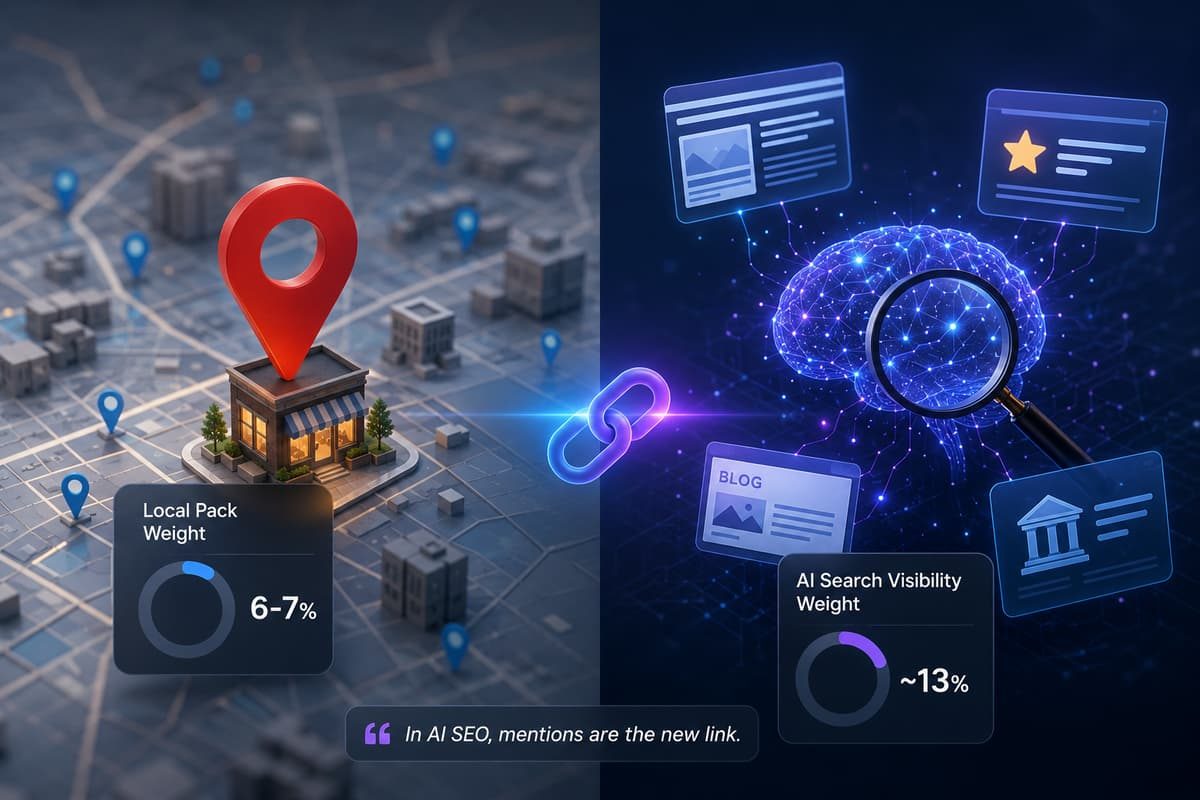
Citation signals carry roughly 6 to 7 percent of Local Pack weight. That number has been sliding for a decade and dropped again this edition. Google Business Profile signals sit at roughly 32 percent and review signals at roughly 20 percent, so citations are nowhere near the top of the Map Pack stack.
Citation signals carry roughly 13 percent of AI search visibility weight, roughly double their Map Pack weight. Three of the top five AI search visibility factors in the survey are citation factors: presence on expert-curated "best of" lists, prominence on key industry-relevant domains, and the quality and authority of unstructured citations such as newspaper articles, blog posts, government sites and industry association pages.
Shaw's own summary of it: in AI SEO, mentions are the new link.
So the honest position is not "citations are dead" and not "citations will get you to number one." It is this: citations are low-leverage for Map Pack rankings, high-leverage for AI visibility, and capable of holding back everything else when they are wrong.
Structured vs Unstructured Local Citations
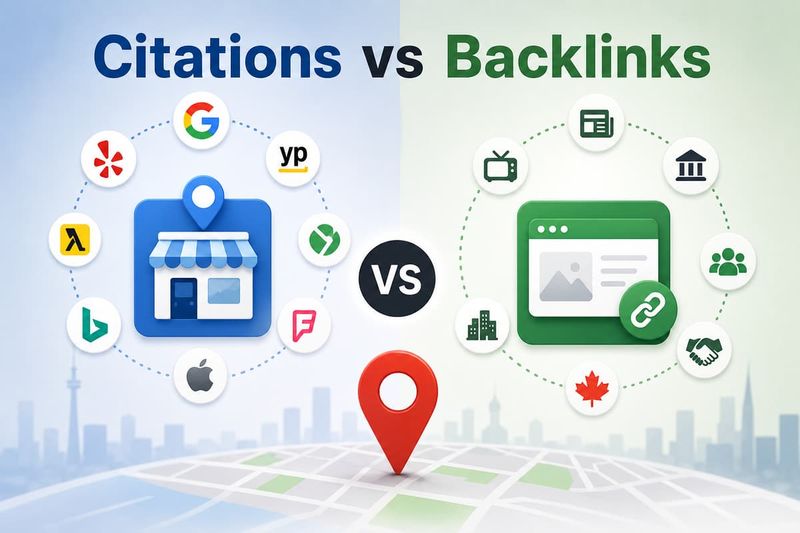
A local citation is any online mention of your business details, with or without a link.
Structured citations are directory-style listings with defined fields: Yellowpages.ca, Yelp, Apple Maps, Bing Places, n49. Predictable, buildable, and increasingly commoditised.
Unstructured citations are mentions inside editorial content: a blogTO round-up, a local news article, a BIA member page, a supplier's case study, a chamber of commerce announcement. Harder to earn, and this is where the 2026 value has moved.
In the Whitespark data the gap is visible. For local organic rankings, quality and authority of unstructured citations sits at position 37, while quantity of structured citations sits at position 80. For the Local Pack, structured citation quantity is all the way down at 110. Volume stopped being the game years ago. Nobody has updated their tactics.
Why AI Assistants Rely on Local Citations More Than Google
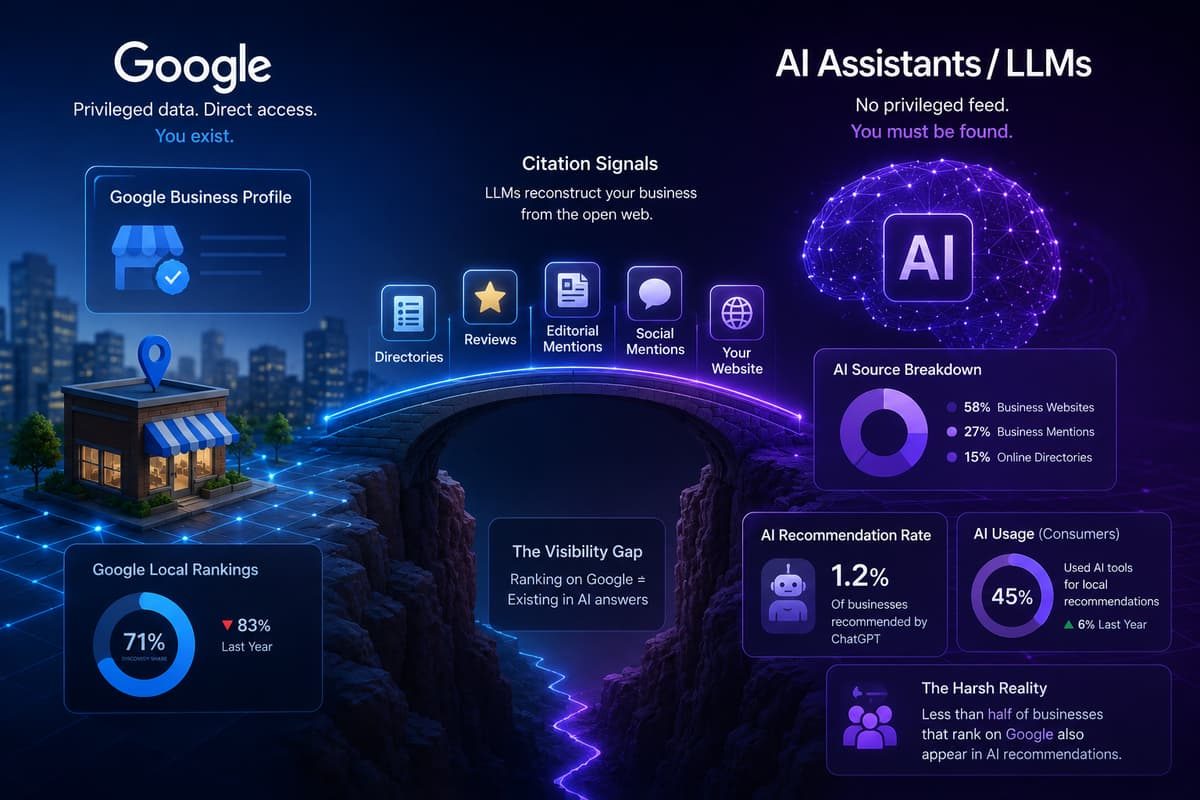
Google already knows your business exists because you verified a Google Business Profile and Google owns the data. An LLM has no such privileged feed. It reconstructs your business from whatever it can find across the open web, which means directories, review platforms, editorial mentions and your own site.
BrightLocal's analysis of ChatGPT Search sources found business websites accounted for 58 percent of local search sources, business mentions for 27 percent, and online directories for 15 percent. Well over a third of what the assistant is reading about you is not your website.
The demand side has moved fast. BrightLocal's 2026 Local Consumer Review Survey, published February 2026 with 1,002 US consumers, found 45 percent had used AI tools to find local business recommendations in the past year, up from 6 percent the year before. Over the same period Google's share as a local discovery channel fell from 83 percent to 71 percent.
The supply side is brutal. SOCi's 2026 Local Visibility Index analysed more than 350,000 business locations across 2,751 brands and found ChatGOT recommends only about 1.2 percent of them. Less than half the businesses that lead Google local results also appear in AI local recommendations.
That last statistic is the real argument for citation work in 2026. Ranking in the Map Pack no longer guarantees you exist inside the assistant. This is exactly the gap our AI Search SEO and answer engine optimization work is built to close.
NAP consistency: the part that decides whether anything else works
NAP consistency remains the highest-value citation task, and the Whitespark data supports that ranking. HTML NAP matching your GBP NAP sits at position 15 for the Local Pack, well above every other citation factor. Consistency across the primary search engines (Google Maps, Bing Maps, Apple Maps) sits at 28. Raw citation volume sits at 110.
Translation: getting five listings identical beats getting fifty listings approximate.
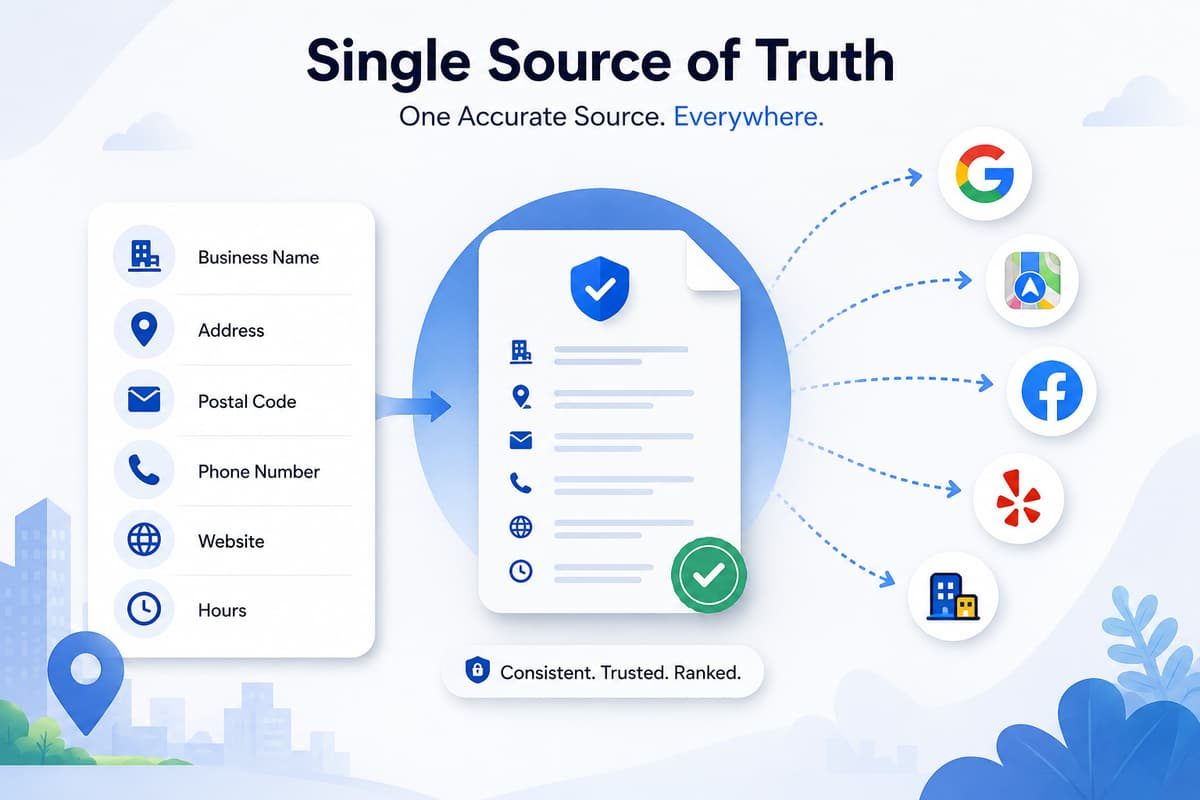
Build a single source of truth first
Before touching a single directory, write one document that every listing, profile and website footer copies from, character for character:
- Legal and display name. Decide whether "Inc.", "Ltd." or "Corp." appears in the public name. Do not add keywords to it. Keyword stuffing the business name is a live suspension risk, and Whitespark scored keyword stuffing as one of the highest suspension-risk behaviours in the 2026 report.
- Street address in one fixed format. Pick "Ave" or "Avenue", "Unit" or "Suite", and never mix them. "120 Eglinton Ave E, Suite 500" and "120 Eglinton Avenue East, Unit 500" are two different businesses to a parser.
- Postal code with the standard single space. M4P 1E2, not M4P1E2.
- One primary phone number in one format. Local GTA area codes (416, 647, 437, 905, 289, 365) carry a small trust benefit over toll-free as the primary line.
- Website URL with a fixed protocol and trailing-slash rule. https, www or non-www, pick one.
- Hours, in your real hours. Business open at time of search jumped to the number 5 Local Pack factor in 2026. Padding your hours to game it will earn you angry reviews at a brick-and-mortar location.
The Canadian-specific traps
Four things break NAP consistency for GTA businesses more than anything else:
- Call tracking numbers. Dynamic numbers on ad landing pages are fine. A tracking number published as your primary NAP across directories is not.
- Legacy addresses. Businesses that moved within the GTA almost always have live listings at the old address. These are the number one cause of Google placing your pin in the wrong place.
- Bilingual name variants. If you have ever operated with a French variant, decide which one is canonical.
- Suite versus unit on condo and plaza addresses. Extremely common across Mississauga, Markham and North York, and extremely common as a cause of duplicate listings.
The citation sources actually worth building in Canada
Skip the "500 directories" packages. Work in tiers.
Tier 1: non-negotiable
Google Business Profile, Apple Business Connect, Bing Places, Facebook, Yelp Canada, Yellowpages.ca, Foursquare. Fill every available field on each. Whitespark's guidance is that a complete, fully populated listing outperforms a bare one on the same platform, and completeness of GBP sits at position 16 for the Map Pack. Our Google Business Profile optimization process starts here for exactly this reason.
Tier 2: Canadian structured directories
From Whitespark's top 35 Canadian citation sources: n49, Cylex, HotFrog Canada, Websites.ca, GoldBook.ca, ProfileCanada, CanadaOne, OurBis, MapQuest, Infobel, Opendi, Brownbook, 2FindLocal, Find-Open, Better Business Bureau. Fifteen to twenty five accurate Tier 1 and Tier 2 listings is a complete foundation for most GTA businesses. Building three hundred is not a strategy, it is a rounding error with an invoice attached.
Tier 3: GTA local sources
This is where most Toronto businesses have nothing, and where the local trust actually lives. Toronto Region Board of Trade, your local Business Improvement Area, the Mississauga, Markham, Vaughan or Brampton chambers of commerce, community newspapers, neighbourhood association sites, and local event or sponsorship pages. Quantity of citations from locally-relevant domains scores far higher than generic directory volume in the Whitespark data.
Tier 4: industry-relevant platforms
Relevance beats reach, and this tier feeds AI recommendations directly. Contractors and trades: HomeStars, TrustedPros, Houzz. Restaurants: OpenTable, TripAdvisor, the delivery platforms. Healthcare and clinics: RateMDs plus the relevant Ontario college directory. Law firms: Canadian Law List and provincial law society listings. Prominence on key industry-relevant domains is a top-five AI visibility factor, so this tier is the highest-return work for a business chasing assistant visibility. We build these lists per vertical inside our industry playbooks for law firms, dentists, contractors and plumbers.
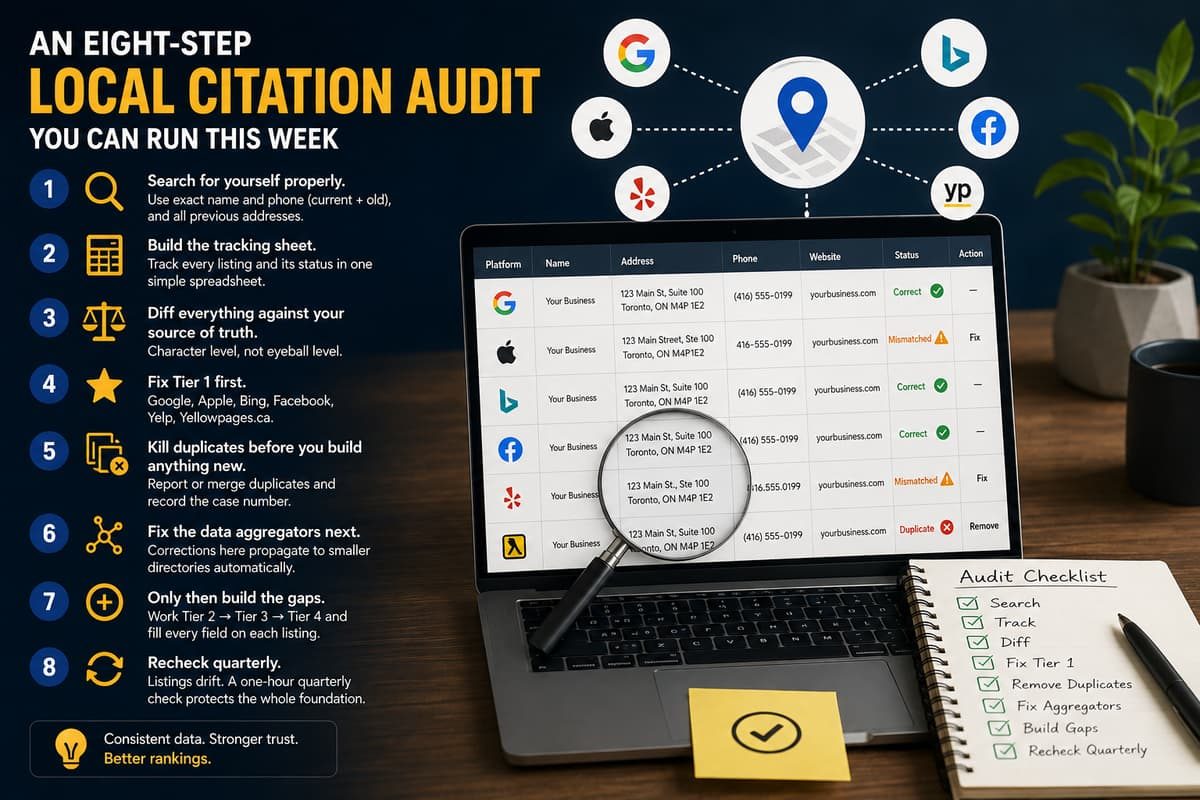
An eight-step local citation audit you can run this week
1. Search for yourself properly. Run your exact business name in quotes, then your current phone number in quotes, then every previous phone number and every previous address you have ever used. Old numbers surface the listings nobody remembers creating.
2. Build the tracking sheet. Columns: platform, listing URL, name as shown, address as shown, phone as shown, website as shown, claimed yes or no, status (correct, mismatched, duplicate, dead), action, date fixed.
3. Diff everything against your source of truth. Character level, not eyeball level.
4. Fix Tier 1 first. Google, Apple, Bing, Facebook, Yelp, Yellowpages.ca. Highest traffic, highest downstream influence.
5. Kill duplicates before you build anything new. Duplicate GBP listings, especially with overlapping service areas across multiple locations, are a scored suspension risk in the 2026 report. Report or merge them and record the case number.
6. Fix the data aggregators next. Corrections here propagate to smaller directories automatically. Fixing the source stops the same error reappearing three months later.
7. Only then build the gaps. Work Tier 2, Tier 3 and Tier 4 in that order and fill every field on each listing. A three-line listing does almost nothing.
8. Recheck quarterly. Listings drift. Platforms merge records, pull in stale aggregator data and auto-populate hours. A one-hour quarterly check protects the whole foundation.
If you would rather not spend six weeks on a spreadsheet, this is precisely what our local citation building service handles end to end.
Unstructured citations and "best of" lists: the 2026 differentiator
Presence on expert-curated "best of" lists is the highest-scoring AI search visibility factor in Whitespark's 2026 survey. Nobody can buy their way onto a genuinely curated list, which is exactly why the signal is trusted.
Realistic ways a GTA business earns these:
- Local sponsorship with a web presence. A minor hockey team, a school fundraiser, a BIA street festival. Cheap, and the sponsor page is a durable locally-relevant unstructured citation.
- Local press and community papers. A short op-ed or expert comment in a neighbourhood publication does more for AI visibility than a hundred directory submissions.
- Supplier, partner and association pages. Your distributor's "where to buy" page, your franchise's location directory, your trade association's member list.
- Award and round-up submissions. Local business awards, chamber recognitions, and "best in the GTA" round-ups that accept nominations.
- Genuine local collaboration. Co-hosted events, joint offers, guest content on local blogs.
There is real overlap between this work and link building, with one important difference: for AI visibility the mention counts even without a link.
What to stop doing in 2026
- Bulk citation packages. Hundreds of listings on unmaintained directories add noise, not trust, and often introduce the NAP inconsistencies you are trying to remove.
- Rented listing platforms you cannot exit cleanly. Some managed listing services publish through a subscription layer. Understand what happens to your listings when you stop paying before you sign.
- Keyword-stuffed business names. One of the highest suspension-risk behaviours scored in the 2026 report.
- AI-generated text and images on your GBP. Also scored as a negative and suspension-risk factor this edition. Use real photos and write your own descriptions.
- Listings in regions you do not serve. Irrelevant and occasionally harmful.
- Treating citations as a one-time project. They decay. Budget an hour a quarter.
How to tell whether the work is doing anything
Citation work is slow and invisible in most dashboards, so measure it deliberately:
- Grid rank tracking, not single-point rank tracking. A geo grid across your service area shows movement that a single ranking check hides. Useful for tracking Map Pack ranking progress properly.
- GBP performance data. Calls, direction requests and website clicks respond before rankings do.
- AI prompt testing. Write ten prompts a real customer would type ("best emergency plumber in Scarborough"), run them monthly across ChatGPT, Gemini and Perplexity, and log whether you appear. This is now a standard part of AI visibility reporting.
- Branded and direct traffic. Rising branded search volume is a genuine sign your entity presence is strengthening.
A realistic 90-day plan
Days 1 to 15. Write the source of truth document. Run the full audit. Build the tracking sheet. Identify every duplicate.
Days 16 to 45. Fix and claim Tier 1. Submit duplicate removals. Correct the data aggregators. Fill every field everywhere you touch.
Days 46 to 75. Build Tier 2 Canadian directories and Tier 4 industry platforms. Start outreach for Tier 3 local sources: chamber, BIA, one sponsorship, one local publication.
Days 76 to 90. Baseline your AI prompt tests, set up grid tracking, and put the quarterly recheck in the calendar.
Most GTA businesses see Map Pack movement inside 30 to 60 days on a broader local program, with citation work compounding underneath it rather than driving it on its own.
Local citations in 2026 are not a growth lever. They are the layer that lets your growth levers function. Get your NAP identical everywhere, build a focused set of Canadian and industry-relevant listings, earn unstructured mentions in your own city, and then put your real energy into Google Business Profile, reviews and site content.
If you want to know exactly where your listings stand today, start with a free audit and we will show you every mismatch, duplicate and gap we find across the GTA citation ecosystem.
Frequently asked questions
Do local citations still matter in 2026? Yes. They carry roughly 6 to 7 percent of Google Local Pack ranking weight and roughly 13 percent of AI search visibility weight according to Whitespark's 2026 Local Search Ranking Factors report. Their role is verification and trust, not raw ranking power.
How many citations does a local business need? Fifteen to twenty five accurate, complete listings across Tier 1 platforms, Canadian directories and industry-relevant sites covers most GTA businesses. Consistency matters far more than volume.
Does one wrong listing hurt my rankings? A single mismatch is unlikely to cause visible damage. A pattern of conflicting names, addresses or phone numbers across many sources creates ambiguity, and ambiguity is what suppresses local visibility.
Are citations different for AI search than for Google? Yes. Google already holds your verified GBP data. AI assistants reconstruct your business from directories, review platforms and editorial mentions, which is why citation signals weigh roughly twice as much for AI visibility as they do for the Map Pack.
How often should I audit my citations? Quarterly. Listings drift as platforms merge records and pull stale data from aggregators.
Do citations still work if I am a service area business without a public address? Yes, but you need to use platforms that support hidden addresses and keep your service area settings consistent. Setting service areas larger than roughly two hours of driving is a scored suspension risk.
Continue reading
Read the latest issues

Discussion