
Citations vs Backlinks
If you've been adding your business to every online directory you can find and your Map Pack position hasn't moved, you're probably hitting the wrong lever. Citations and backlinks are both local SEO signals, but they do different things, affect your ranking in different ways, and produce very different returns depending on where you are in your local SEO journey.
This article breaks down exactly what each signal does, what the 2026 ranking factor data we track as part of our Local SEO work in Toronto reveals about their relative weight, and when each one becomes the deciding factor between ranking in the top 3 and sitting invisible behind your competitors.
What Is a Citation in Local SEO?
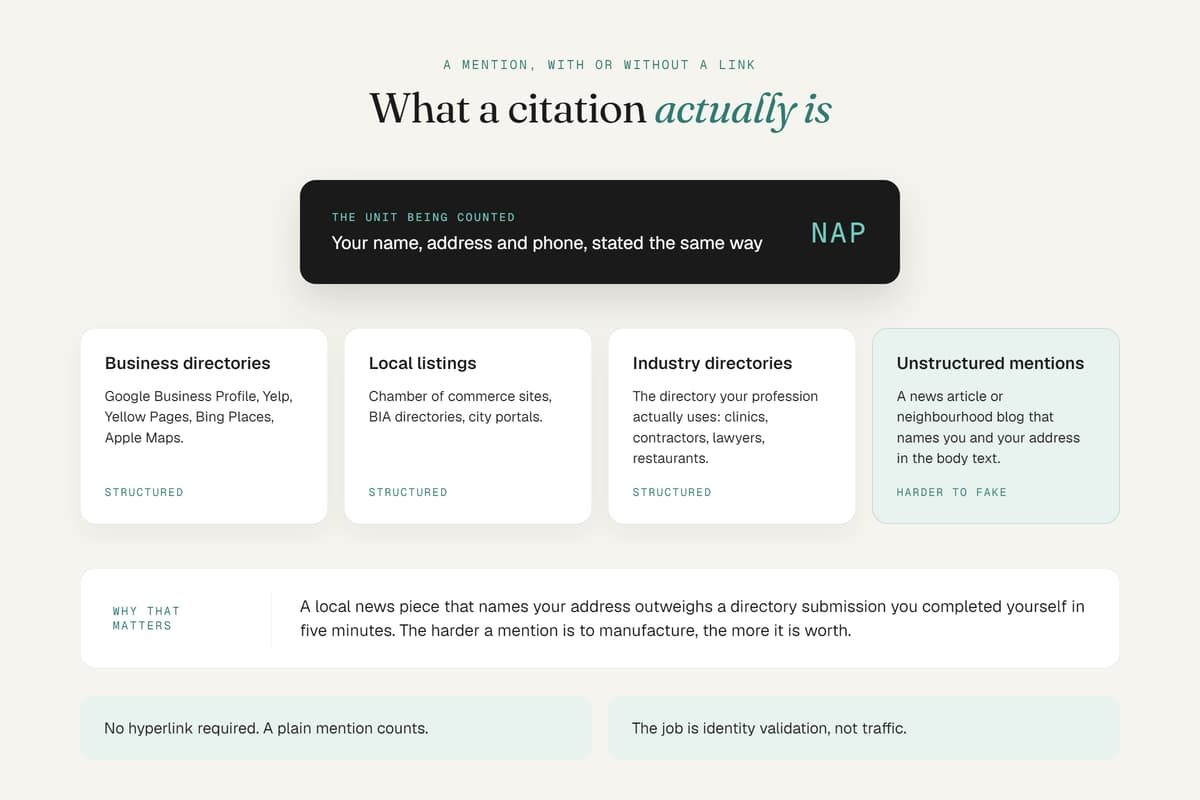
A citation is any mention of your business's Name, Address, and Phone number (NAP) on the web. It does not need to include a link to your website to count. Google reads citations from business directories, industry listings, news sites, and social profiles to confirm that your business exists where you say it does.
Common citation sources include:
- Business directories: Google Business Profile, Yelp, Yellow Pages, Bing Places, Apple Maps
- Local listings: Chamber of Commerce websites, BIA directories, city portals
- Industry directories: Healthgrades (clinics), Houzz (contractors), Avvo (lawyers), OpenTable (restaurants)
- Unstructured mentions: local news articles or blog posts that reference your business name and address
The distinction between structured and unstructured citations matters more than most businesses realize:
| Type | What It Is | Example |
|---|---|---|
| Structured | Full NAP listed in a directory format | Yelp, Yellow Pages, Foursquare |
| Unstructured | NAP referenced within editorial content | CBC Toronto article, neighborhood blog |
Unstructured citations often carry more weight because they are harder to manufacture. A local Toronto news article that mentions your business address is a stronger trust signal than a directory submission you completed yourself in five minutes.
The core function of a citation is not to drive traffic. It is to validate your identity. Google cross-references your NAP data across dozens of sources to confirm you are a real, operating business at a real physical location. Inconsistency is where citations can actively hurt you, but more on that shortly.
What Is a Backlink in Local SEO?
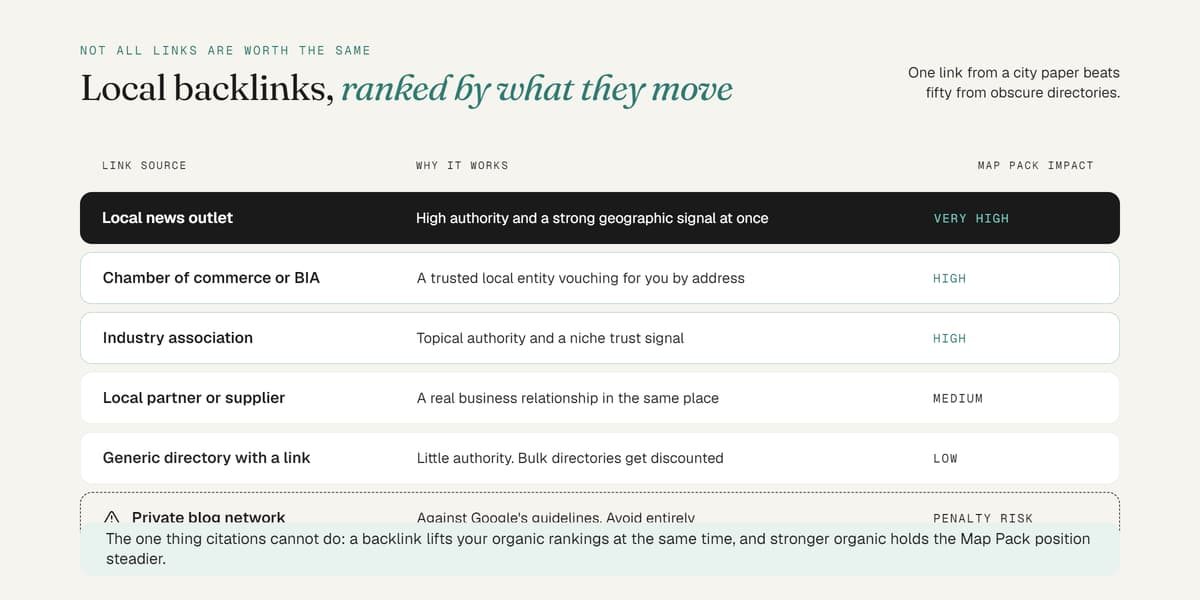
A backlink is a hyperlink from another website to yours. In local SEO, not all backlinks are equal, and volume without relevance is almost meaningless. A single link from the Toronto Star or the Etobicoke Board of Trade is worth more than 50 links from obscure third-party directories.
Backlinks serve two distinct purposes in the context of Map Pack ranking:
- Domain authority: They increase the overall trust and authority of your website, which supports both organic search rankings and Map Pack positioning.
- Geographic and topical relevance: A link from a Scarborough neighborhood blog or a Toronto industry association tells Google you are a real part of your local business community, not just a listing on a directory.
Here is how different backlink sources compare for local SEO impact:
| Link Source | Map Pack Impact | Why It Works |
|---|---|---|
| Local news outlet (Toronto Star, CBC Toronto) | Very high | High authority + strong geographic signal |
| Chamber of Commerce or BIA | High | Trusted local entity, direct geographic relevance |
| Industry association website | High | Topical authority, niche trust signal |
| Local business partner or supplier | Medium | Entity relationship and geographic co-location |
| Generic directory (with link) | Low | Minimal authority; Google discounts bulk directories |
| PBN (private blog network) | Penalty risk | Violates Google guidelines; avoid entirely |
One thing backlinks do that citations cannot: they boost your organic search rankings at the same time. A business ranking on page one of organic results for its target keywords tends to hold Map Pack positions more reliably than a business with a strong GBP profile but a weak website.
Citations vs Backlinks: Head-to-Head Comparison
Before diving into the ranking weight breakdown, here is a side-by-side comparison of what each signal actually does:
| Factor | Citations | Backlinks |
|---|---|---|
| Definition | NAP mention on another site (link not required) | Hyperlink from another domain to your site |
| Primary function | Validate business identity and location | Build domain authority and local relevance |
| Effect on Map Pack | Baseline trust signal | Stronger prominence signal |
| Effect on organic rankings | Indirect | Direct |
| Speed of impact | Faster (2 to 4 weeks) | Slower (1 to 3 months) |
| Volume needed | 40 to 60 quality citations | Fewer is fine; quality over quantity |
| Diminishing returns | Yes, after roughly 50 to 60 quality listings | Less pronounced if sources are varied |
| Risk level | Low | Medium (depends entirely on the source) |
The short version: citations confirm you exist; backlinks confirm you matter. Both signals are required for a complete local SEO presence, but they operate at different stages and with different levels of impact.
What Whitespark's 2026 Data Actually Says
Every year, Whitespark surveys local SEO professionals to assign percentage weights to the signals that drive Google's local ranking systems. The 2026 edition included 47 expert SEOs who collectively scored 187 individual factors.
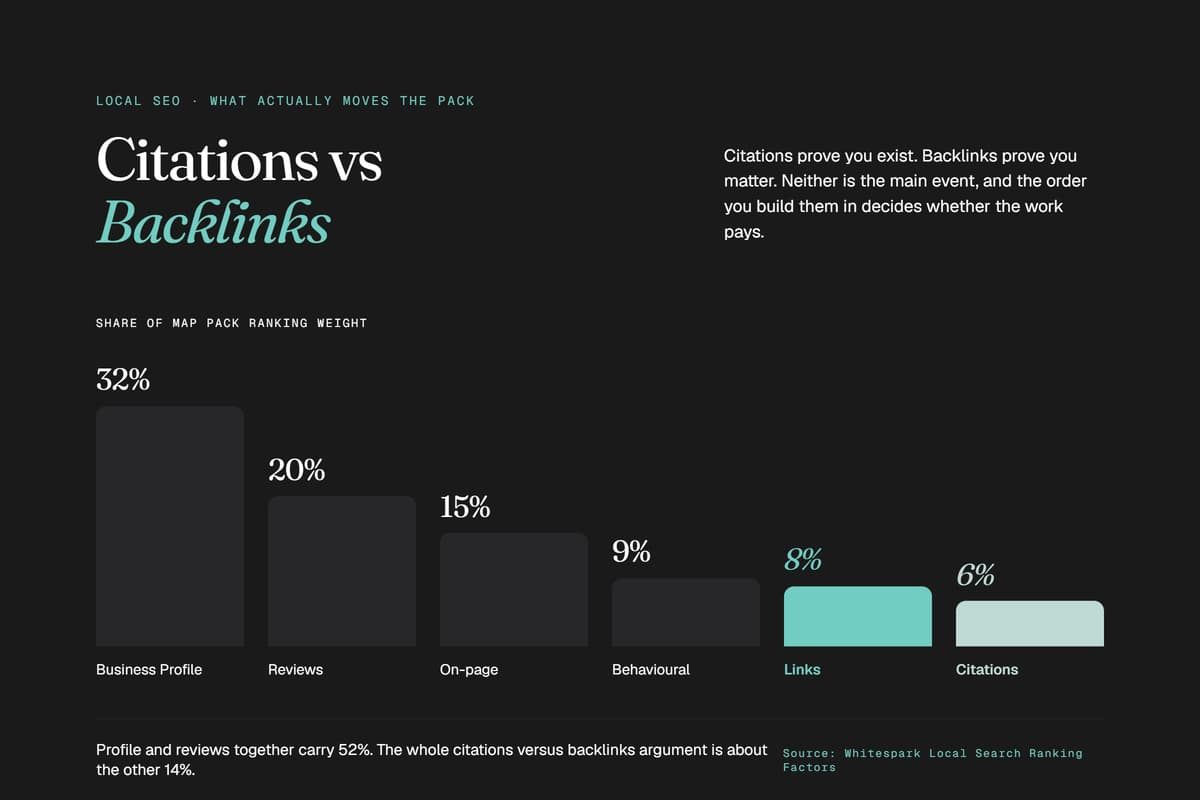
Here is how the major signal categories break down for Map Pack (Local Pack) rankings:
| Signal Category | Map Pack Weight |
|---|---|
| Google Business Profile signals | 32% |
| Review signals | 20% |
| On-page signals | 15% |
| Behavioral signals | 9% |
| Link signals | 8% |
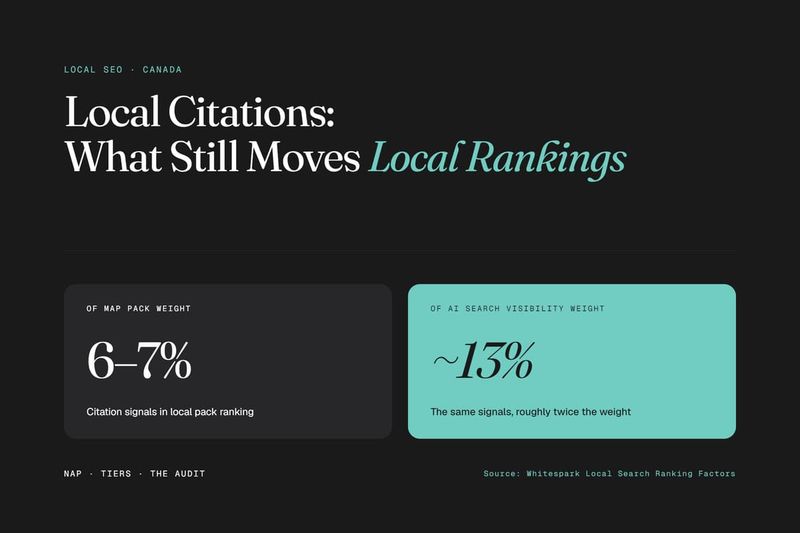
| Citation signals | 6% |
This data makes a few things immediately clear.
First, GBP and reviews together control 52% of your Map Pack ranking. Citation and backlink signals combined account for 14%. If your Google Business Profile is not fully optimized and you have fewer than 30 reviews, no amount of citation building or link acquisition is going to compensate.
Second, within that 14%, backlinks outweigh citations by a meaningful margin, 8% versus 6%. And the gap widens further once your GBP is already optimized. After that point, every additional citation produces diminishing returns, while a strong locally relevant backlink keeps compounding.
Third, there is a twist that changes the picture if AI search visibility matters to you:
"Three of the top five AI visibility factors are citation-related. In the AI search world, mentions across the web are the new backlinks." — Sam Bretzmann, Overview of Whitespark's 2026 Local Search Ranking Factors
If you want to show up when someone asks ChatGPT or Perplexity for a recommendation in your category and city, citation consistency across authoritative sources is far more important than it is for traditional Map Pack rankings. We will come back to this.
When Citations Move Your Map Pack Rank
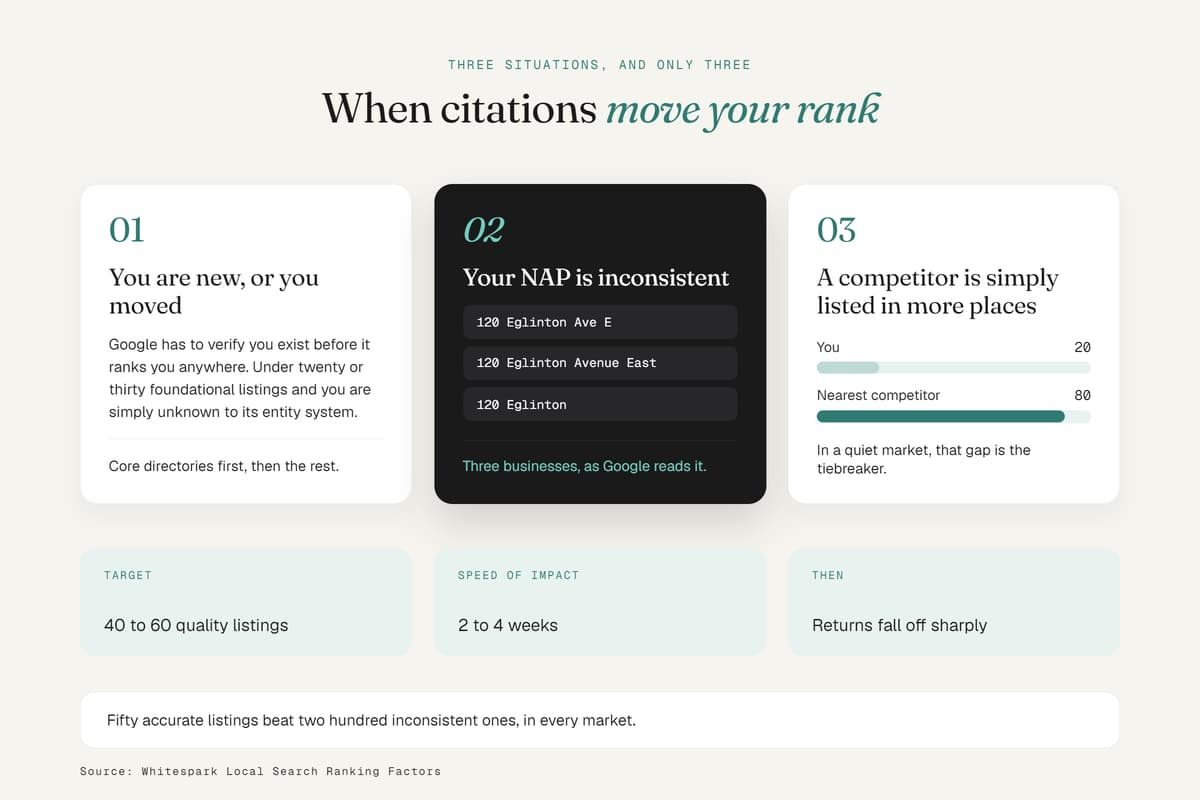
Citations have the biggest impact in three specific situations:
1. Your business is new or recently moved Google needs to verify that you exist before it ranks you anywhere. A new business with fewer than 20 to 30 foundational citations is effectively unknown to Google's entity recognition system. Getting listed on the core directories (Google Business Profile, Yelp Canada, Yellow Pages Canada, BBB.org, Bing Places, Apple Maps, Foursquare) is the fastest way to establish that your business is real, located where you say, and open.
2. Your NAP is inconsistent If your business address appears as "120 Eglinton Ave E" on your website, "120 Eglinton Avenue East" on Yelp, and "120 Eglinton" on a third directory, Google sees three conflicting signals about the same business. Inconsistent NAP actively suppresses your Map Pack rank. Citation cleanup, finding and correcting every version of your NAP across the web, is often the highest-ROI action a business can take in local SEO.
3. Your competitors have a stronger citation profile In lower-competition markets, citation volume and consistency can be the tiebreaker between two businesses with similarly built GBP profiles. If your nearest competitor is listed accurately on 80 quality directories and you are on 20, that gap is a measurable ranking disadvantage.
Our Local Citation Building service covers both foundational citation build and NAP audit to eliminate conflicting listings.
When Backlinks Move Your Map Pack Rank
Backlinks become the dominant variable once your GBP is built out and your citation foundation is clean. Here is when link signals take over:
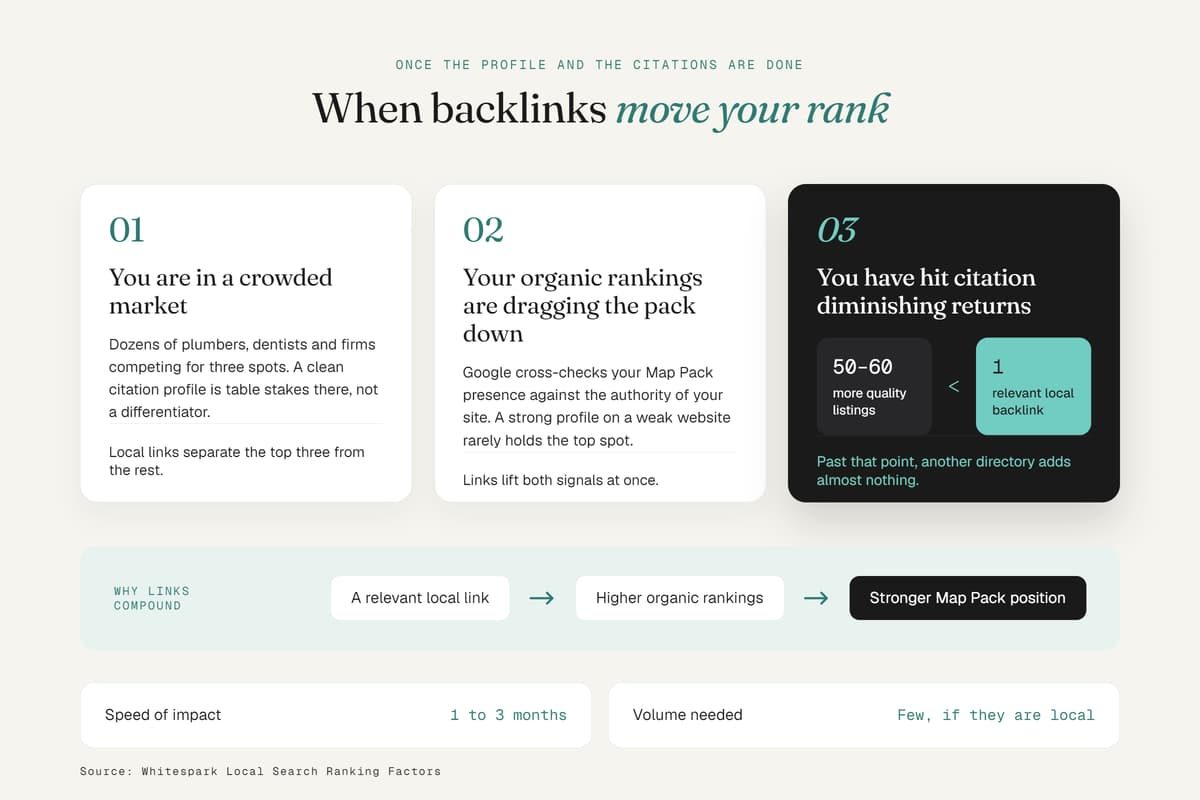
1. You are competing in a high-density market Toronto is one of the most competitive local SEO markets in Canada. Dozens of plumbers, dentists, law firms, and HVAC contractors are fighting for three spots in the Map Pack for nearly every valuable keyword. In those conditions, a solid citation profile is table stakes, not a differentiator. Locally relevant backlinks, from Toronto media, neighborhood organizations, local industry bodies, and geographic business partners, are what separate the top 3 from the rest of the pack.
2. Your organic rankings are dragging your Map Pack position Google cross-validates your Map Pack presence against your website's authority. A business with a strong GBP profile but a weak website rarely holds a top Map Pack position in competitive markets. Backlinks improve both signals simultaneously: they raise your organic rankings and contribute to the prominence signal that feeds your Map Pack position. Our Link Building service focuses specifically on locally relevant Canadian sources rather than generic directory links.
3. You have hit citation diminishing returns After 50 to 60 quality, non-duplicate citations, each additional directory listing adds almost no ranking value. At that stage, every hour spent on citation building would produce better returns if spent on acquiring a single relevant local backlink. Most businesses never audit for this, and end up spending months on citation work that ran out of upside six months earlier.
The Right Order of Operations for Map Pack Rankings
The most common mistake in local SEO is not choosing between citations and backlinks. It is doing them in the wrong order, or continuing to build one signal long after it has stopped producing returns.
Here is the sequence that maps to actual ranking outcomes:
| Priority | Action | Signal Type | Estimated Impact |
|---|---|---|---|
| 1 | Fully optimize your GBP: categories, services, photos, regular posts | GBP signals | 32% of ranking weight |
| 2 | Generate and respond to Google reviews consistently | Review signals | 20% of ranking weight |
| 3 | Build 40 to 60 core citations across quality Canadian directories | Citation signals | Baseline + 6% |
| 4 | Audit and correct every inconsistent NAP across the web | Citation cleanup | Removes active ranking suppression |
| 5 | Acquire locally relevant backlinks from Toronto-area sources | Link signals | 8% of ranking weight + organic boost |
| 6 | Optimize individual service pages on your website | On-page signals | 15% of ranking weight |
The Local Authority plan at Mehrana Agency runs steps 3 through 5 as a monthly system: citations, NAP consistency, and locally sourced backlinks running in parallel rather than sequentially. This is how Map Pack rankings compound over time rather than plateau after the initial push.
Citations vs Backlinks for AI Search in 2026
Here is the part most local SEO guides are not addressing yet.
When someone asks ChatGPT, Perplexity, or Google's AI Overviews for a recommendation in your city and category, those systems do not pull from your GBP. They scan the broader web for consistent, authoritative mentions of your business name. That is fundamentally a citation-based signal.
Whitespark's 2026 report found that citation signals matter significantly more for AI search visibility than for traditional Map Pack rankings. Three of the top five AI visibility factors are citation-related, compared to citations accounting for just 6% of Map Pack ranking weight.
This changes the strategic calculus in a meaningful way:
- If you are optimizing purely for Google Maps: backlinks outweigh citations once your GBP and reviews are in order.
- If you are also optimizing for AI search visibility (which you should be, given how search behavior is shifting): citation consistency stays important at every stage of your SEO maturity.
A business with 60 accurate, consistent citations across authoritative Canadian directories is significantly better positioned to appear in AI-generated business recommendations than one that stopped building citations two years ago and let listings go stale.
The Answer: What Actually Moves Your Map Pack Rank?
Neither citations nor backlinks is the main event on its own. GBP and reviews together own 52% of your Map Pack ranking weight. Within the citations versus backlinks debate, here is the honest summary:
Citations win early. For new businesses or those with inconsistent NAP data, citation building produces the fastest measurable Map Pack movement. Do this first.
Backlinks win in competitive markets. Once GBP and reviews are strong and citations are clean, locally relevant backlinks are the highest-leverage next action for Map Pack rankings in cities like Toronto.
Citations win for AI search. If visibility in ChatGPT, Perplexity, and Google AI Overviews matters to your business, citation consistency across the web is a signal you can never afford to neglect.
The best Local SEO strategy in Toronto treats these as phases rather than alternatives: citations first to establish your entity, GBP and reviews running in parallel, then backlinks to amplify authority once the foundation is solid.
Frequently Asked Questions
Do I need both citations and backlinks to rank in the Map Pack? Yes. Citations are baseline requirements, especially for new businesses or those with inconsistent NAP data. Backlinks amplify your prominence once the baseline is established. Skipping either one creates a gap in your ranking signals that competitors with a complete strategy will exploit.
How many citations does a Toronto business need to rank in the Map Pack? For most Toronto markets, 40 to 60 quality, consistent citations across reputable directories is the practical threshold. After that, returns diminish sharply. Quality and accuracy matter more than volume. Fifty accurate listings will outperform 200 inconsistent ones in every market.
Do citations need to include a link to my website? No. An unlinked NAP mention still counts as a citation and still validates your business location and identity to Google. That said, citations that include a website link provide a minor backlink benefit on top of the standard citation value, so linked citations are preferable when available.
Which backlinks help with Map Pack rankings specifically? The highest-impact backlinks for Map Pack positioning are locally relevant: Toronto and GTA news coverage, local business associations, BIA websites, neighborhood publications, and links from industry partners in your geographic area. National or international links with no local context carry less Map Pack-specific value, though they still improve overall domain authority.
Can bad citations hurt my Map Pack rank? Yes. Inconsistent NAP data is one of the most common causes of Map Pack ranking suppression. When your business name, address, or phone number varies across listings, Google reads conflicting signals about your business identity and reduces your trust score. This is fixable through a structured citation audit.
My competitor has more backlinks than me but I have more citations. Why are they ranking higher? In competitive markets, backlinks carry more influence than citations once both businesses have solid GBP profiles and review counts. Specifically, the quality and local relevance of their backlinks likely outweighs your citation volume advantage. Check their GBP completeness and review count first, then audit their backlink sources using a tool like Ahrefs or Semrush to identify their link profile.
Does being open at the time of search affect Map Pack rankings? Yes, and this is worth knowing: Whitespark's 2026 report found that "business is open at time of search" jumped into the top 5 individual ranking factors for the first time. This is a behavioral signal, not a citation or backlink, but it is a good reminder that local SEO is now a combination of technical signals and real-world operational factors.

Discussion