
Best GEO Agencies in Canada
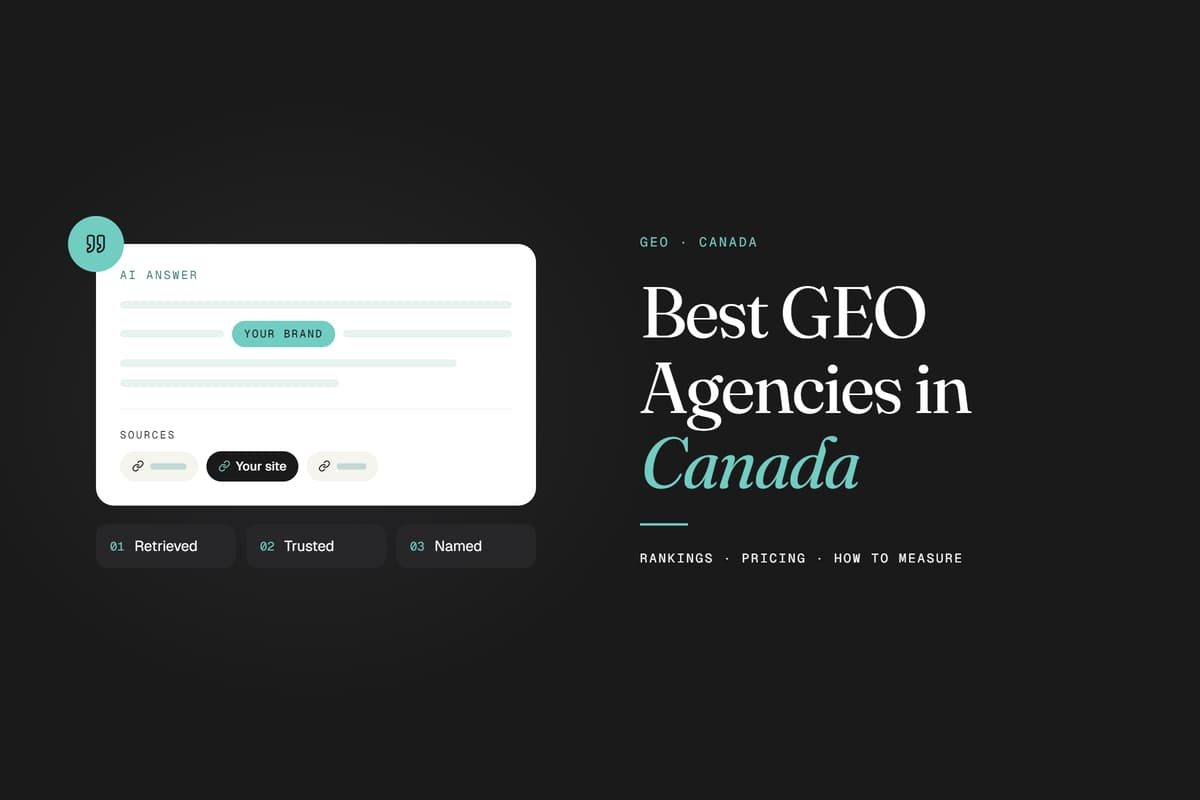
A buyer opens ChatGPT and types "best kitchen cabinet installer in the GTA." They get a paragraph naming three companies. They call one. They never open Google, never see a blue link, and never visit the other twelve businesses that spent years earning page one.
That is the problem Generative Engine Optimization solves, and it is why GEO has become the fastest-moving discipline in Canadian search marketing. This guide ranks the best GEO agencies in Canada for 2026, explains what separates real technical GEO from repackaged SEO, and shows how to measure whether any of it is working.
We start with Mehrana Agency, then cover the other Canadian firms doing credible work in this space, with a comparison table and pricing benchmarks at the end.
If you want to know where you currently stand across the AI engines, request a free audit.
What Is Generative Engine Optimization and Why Does It Matter in Canada?
Generative Engine Optimization is the practice of structuring your website, content and entity data so that AI systems retrieve you, trust you, and name you inside the answers they generate.
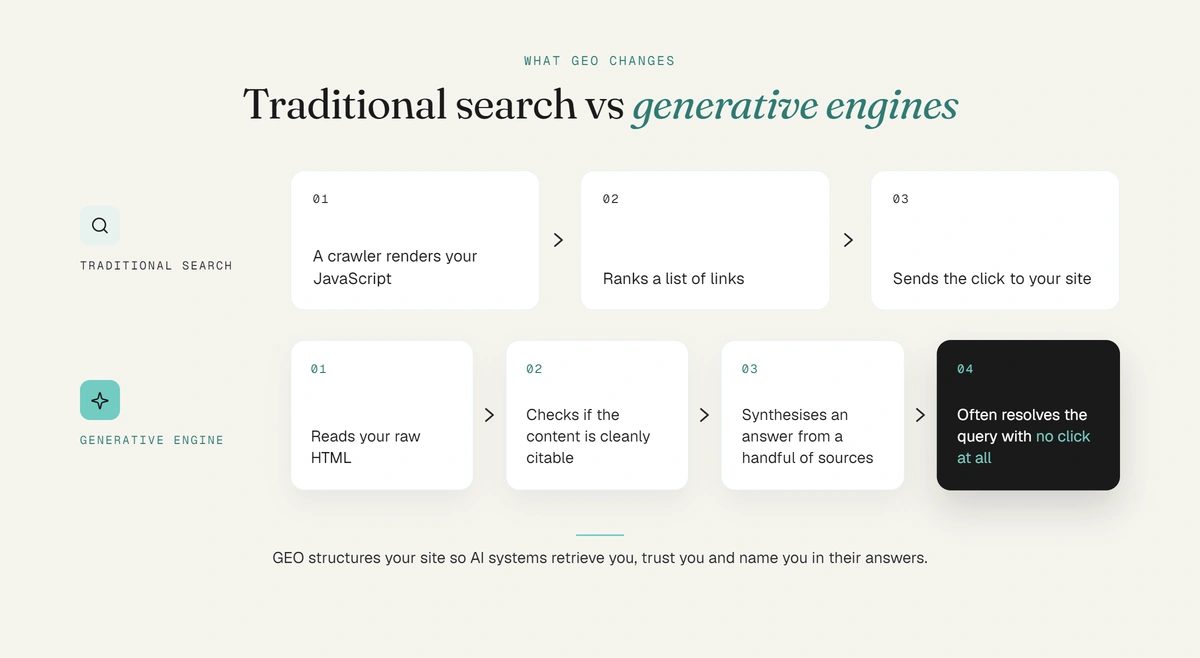
The mechanical difference from traditional search is the part most people miss. Google sends a crawler that renders JavaScript, then ranks a list of links and sends the click to you. A generative engine does something else: it reads raw HTML, decides whether your content is cleanly citable, synthesises an answer from a handful of sources, and often resolves the query without any click at all. You are no longer competing for a position. You are competing to be the source the model chooses to mention.
For Canadian businesses this matters more than the raw traffic numbers suggest:
- AI referrals are free first-touch traffic. No CPC, no bidding war, and very few Canadian competitors are optimizing for it yet.
- The buyers arrive warmer. They have already heard your value proposition summarized by a source they trust. It reads like a referral, not a cold pitch.
- The window is open now. In two years this will be as contested as SEO in 2015. Today most Canadian service businesses have not even checked whether GPTBot can read their site.
GEO vs AEO vs SEO: What Is the Actual Difference?
These three terms get used interchangeably by agencies selling all of them. They are not the same job.
SEO earns you a blue link in a ranked list. The output is a position on a results page.
GEO earns you a mention inside the generated answer. The output is your brand name appearing in a paragraph written by ChatGPT, Perplexity, Claude or Gemini. The levers are entity clarity, schema coverage, server-rendered HTML, citable formatting and authority signals the model can verify.
AEO narrows further to direct answers: the featured snippet, the People Also Ask box, the voice readback, and the Google AI Overview card sitting above your organic result. The levers are FAQ schema, HowTo markup and properly structured question-and-answer pages.
They overlap on foundations. Crawlability, internal linking and clean technical hygiene serve all three. But an agency that only does the SEO layer and calls it GEO is selling you the foundation and skipping the building.
How to Choose a GEO Agency in Canada
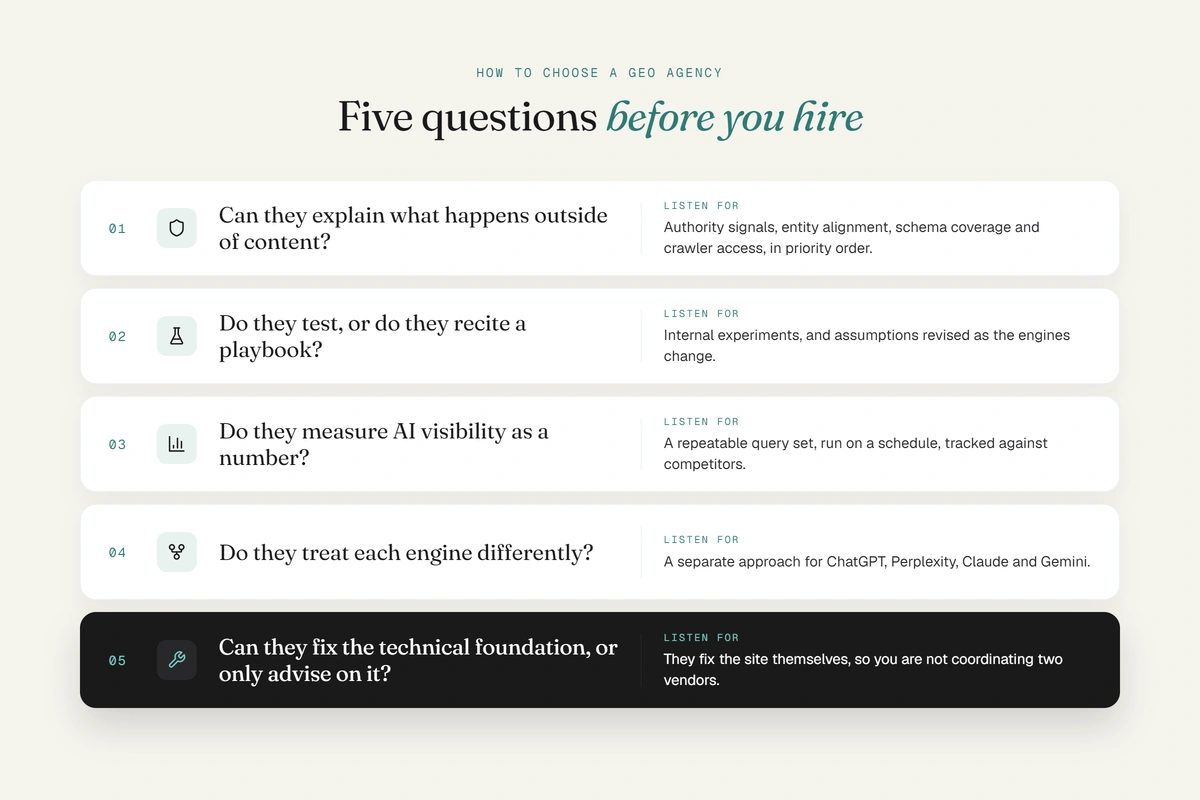
GEO is new enough that credentials are a weak signal. A twenty-year SEO track record does not mean an agency understands how retrieval-augmented generation picks sources. Here is what actually separates capable firms.
1. Can they explain what happens outside of content? Content is the easy half. Ask about authority signals, entity and knowledge-graph alignment, schema coverage, crawler access control and the order in which they prioritise these. A vague answer here means they are writing blog posts and hoping.
2. Do they test, or do they recite a playbook? The engines change monthly. Strong GEO teams run internal experiments and revise assumptions. Fixed methodologies from 2024 are already stale.
3. Do they measure AI visibility as a number? Ask exactly how they will show you progress. If the answer is anecdotal screenshots of one lucky ChatGPT response, that is not measurement. You want a repeatable query set, run on a schedule, tracked against competitors.
4. Do they treat each engine differently? ChatGPT, Perplexity, Claude and Gemini have different crawlers, different blocking rates, different formatting preferences and different source-selection behaviour. One undifferentiated strategy across all four is a red flag.
5. Can they fix the technical foundation, or only advise on it? Most GEO failures are not content failures. They are a site that renders copy in JavaScript, has no schema, and blocks AI crawlers by accident. If the agency cannot rebuild or fix the site itself, you will be stuck coordinating two vendors.
The Best GEO Agency in Canada for 2026
Mehrana Agency
Best for:
Canadian service businesses, clinics, law firms, contractors and local brands that need to be named in AI answers and rank in local search at the same time.
Headquarters:
120 Eglinton Ave E, Toronto Track record: operating since 2012, 700+ clients, 2,000+ projects, 5.0 Google rating Key GEO services: generative engine optimization, answer engine optimization, Perplexity optimization, schema engineering, llms.txt, server-rendered rebuilds, quarterly four-engine visibility audits
Mehrana's GEO practice is built on a position most agencies avoid stating plainly: GEO is primarily an engineering problem, not a content problem. You cannot write your way into an AI answer from a site the model cannot cleanly parse.
That is why the work is split into technical layers that ship, rather than a monthly content quota.

The Four Technical Pillars of Mehrana's GEO Work
1. Full Schema markup. LocalBusiness, Service, FAQPage, BreadcrumbList, Article and Author on every page. Structured data is the first thing a generative engine parses, and it is how a model resolves "this business" into a specific entity with a location, a service list and an author behind the content. Ambiguous entities do not get cited.
2. 100% server-rendered HTML. Every word a crawler needs arrives in the first response, with time to first byte under 220ms. No lazy-loaded copy, no JavaScript requirement, no hydration dependency. This single item disqualifies a large share of Canadian websites from AI citation, and most owners have no idea it is happening.
3. llms.txt and crawler access control. A root-level llms.txt file telling AI crawlers which pages to read and in what order, paired with a robots.txt tuned specifically for GPTBot, ClaudeBot, PerplexityBot and Google-Extended. Plenty of sites are accidentally blocking the exact bots they want to attract.
4. Quarterly four-platform visibility audit. Every 90 days, the same 30 buying-intent queries in your category are run through ChatGPT, Claude, Perplexity and Gemini. Mentions, surrounding context and sentiment are recorded and charted against your competitors. This turns AI visibility from a feeling into a tracked metric.
Engine-by-Engine Strategy, Not One Generic Approach
Each generative engine behaves differently, and Mehrana tunes for each separately.
- Perplexity. The easiest to reach and always displays its sources, so a brand mention converts to immediate visible reach. Covered in more depth under Perplexity SEO.
- ChatGPT. The hardest. Highest blocking rate, strongest preference for FAQ and HowTo schema, and the least forgiving of unstructured pages.
- Claude. Rewards long-form depth and clearly cited sources. Thin content does not survive here.
- Gemini. Inherits Google's index but weights E-E-A-T signals separately, and powers the AI Overview card sitting above your organic result. This is where GEO and traditional SEO most directly overlap.
The complete cross-engine program is packaged as AI SEO, with AEO handling the snippet, voice and AI Overview layer alongside it.
Where GEO Meets Local Search
This is the combination almost nobody else in Canada is running properly.
When someone asks an AI engine for a recommendation in a specific city, the model leans heavily on the same signals that drive local search: a complete and consistent Google Business Profile, clean citations across Canadian directories, and review volume and sentiment it can read. A business that is invisible in the Google Map Pack is usually invisible in the AI answer too, because the underlying entity data is thin.
So the local SEO program is not a separate product sold beside GEO. Google Business Profile management and citation building are inputs to both at once. For a Canadian service business, this is the highest-leverage version of GEO available.
Other Top GEO Agencies in Canada
Canada has a genuine and growing GEO field. Here are the other firms worth shortlisting.
Search Engine People
Location: Toronto (Pickering) One of the longest-running search firms in Ontario, now positioning strongly around GEO and publishing its own rankings of Canadian generative engine optimization providers. Strongest on data-driven, semantically built content strategy. Established enterprise and mid-market experience.
Major Tom
Location: Toronto and Vancouver A full-service digital agency working across Canada with enterprise clients, offering GEO within a broader cross-channel programme focused on brand authority and strategic alignment. Best suited to organisations that want AI visibility handled inside a larger multi-channel engagement rather than as a specialist project.
Seologist
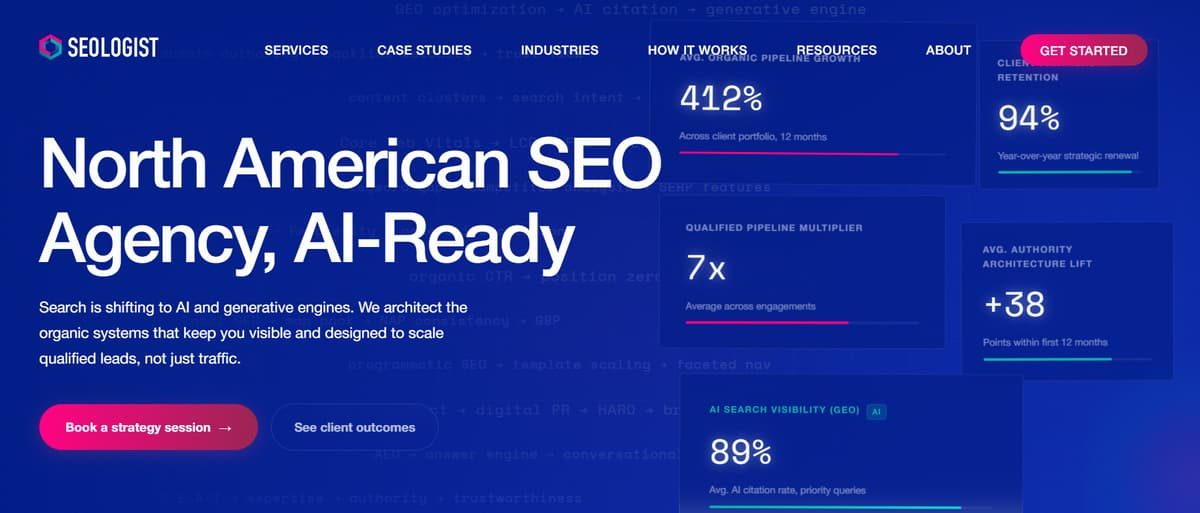
Location: Toronto Operating since 2003 and explicitly positioned on equal strength in SEO and GEO. Their stated GEO approach covers AI-ready content structuring, semantic markup, E-E-A-T reinforcement and data formatting for generative answers. A reasonable choice for brands wanting a long-established SEO shop that has taken GEO seriously rather than bolted it on.
Azuro Digital
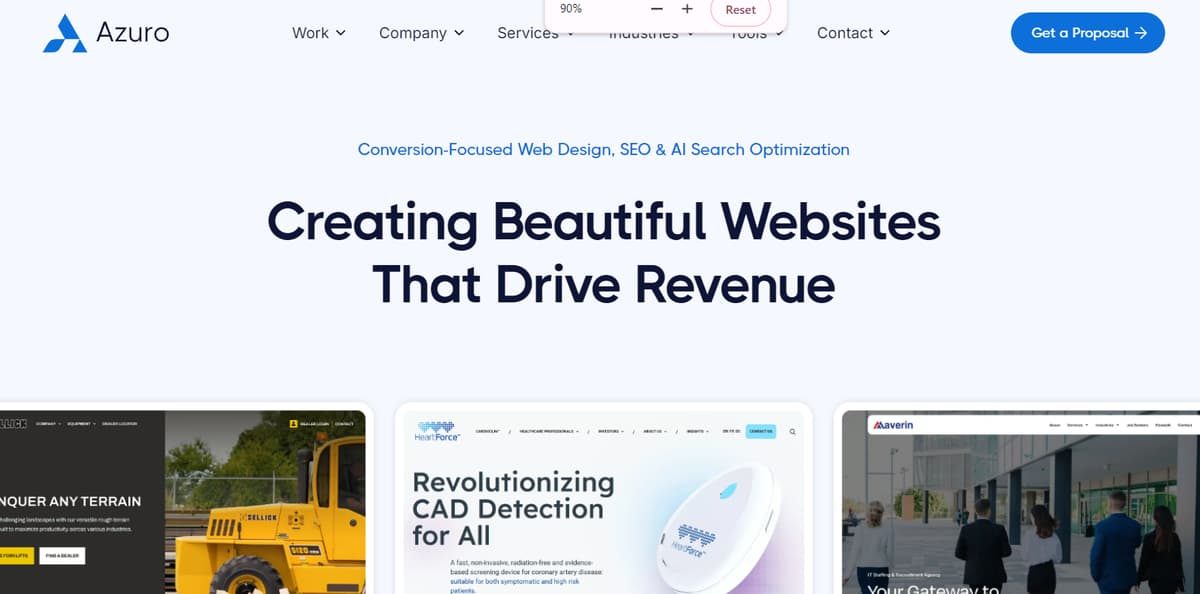
Location: Ottawa, Toronto and Calgary A boutique team of around eight people, praised by clients for AI search work alongside traditional rankings and web design. Small enough for high-touch delivery. Minimum project budgets place them out of reach for the smallest businesses.
Rivetline
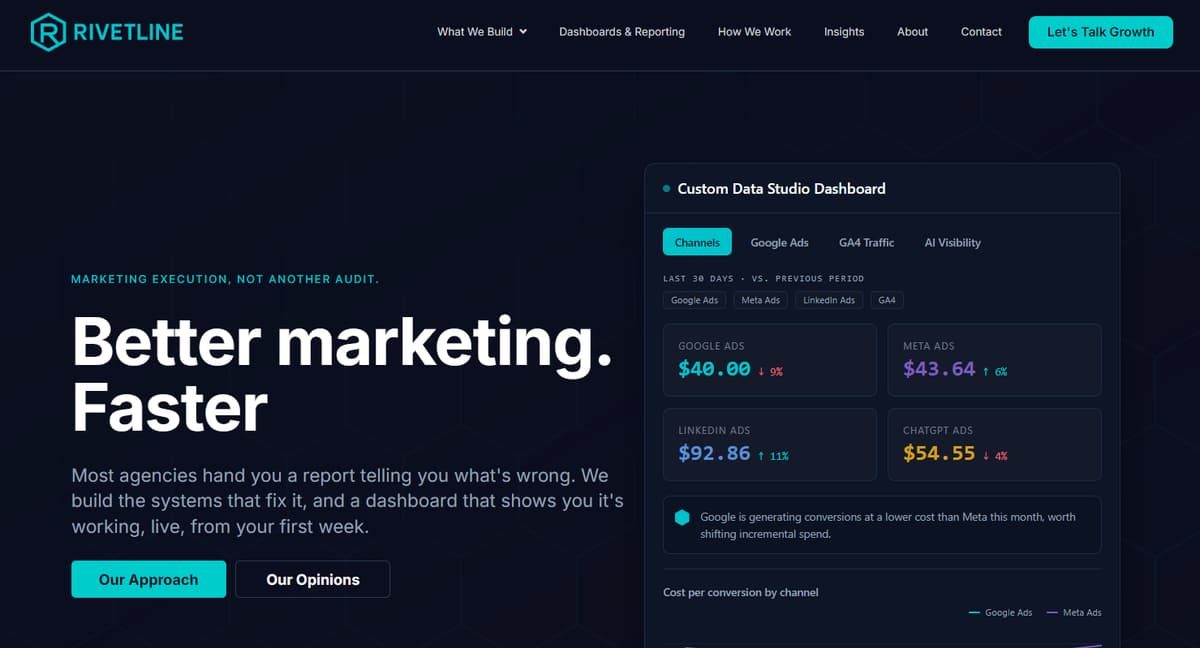
Location: Canada, B2B focused Specialises specifically in AEO, GEO and AI search visibility for B2B companies across ChatGPT, Perplexity, Gemini and Claude. Narrow and deep. A strong fit if your buyers are researching software or professional services through AI assistants, and a poor fit for local consumer services.
Prime Digital
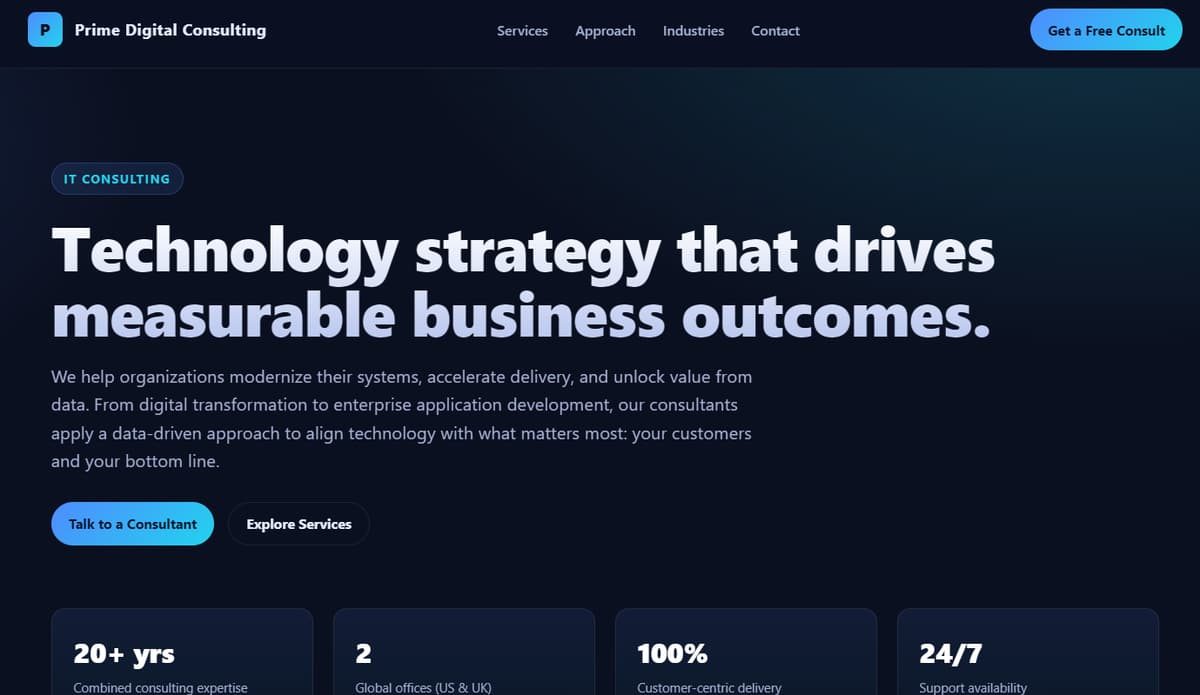
Location: Canada, bilingual delivery Delivers combined SEO and GEO programmes with an emphasis on automation, content operations and bilingual English and French delivery. Worth a look if you need to be cited in AI answers in both official languages, which is a genuinely underserved requirement in Quebec and federal-facing markets.
SearchBeyond
Location: Calgary Founded in 2018, with a dedicated generative engine optimization service launched out of work started in 2025. Alberta-focused with SEO, local SEO and paid advertising alongside the GEO offering. A regional option for Western Canadian businesses.

dNOVO Group
Location: Toronto, with US offices Legal and medical marketing specialists who have added AI search optimization across ChatGPT, Gemini, Copilot, Claude, Grok and Perplexity to their core offering. Deep vertical knowledge inside regulated professions. Less relevant outside law and healthcare.
Search + Gather
Location: Toronto A performance marketing agency now appearing in Canadian GEO listings, with strong analytics and paid media discipline. Best for DTC and SaaS brands wanting AI visibility measured with the same rigour they apply to paid acquisition. Not a technical rebuild partner.

Canadian GEO Agencies Compared
| Agency | Best for | GEO approach | Engine-specific strategy | Technical rebuild capability | Tracked AI visibility |
|---|---|---|---|---|---|
| Mehrana Agency | Canadian service businesses and local brands | Engineering-led: schema, SSR, llms.txt, entity data | Yes, four engines tuned separately | Yes, in-house custom builds | Yes, quarterly audit plus live dashboard |
| Search Engine People | Mid-market and enterprise | Content and semantic strategy led | Partial | Partial | Partial |
| Major Tom | Enterprise, multi-channel | GEO inside broader brand authority work | Partial | Yes | Partial |
| Seologist | Established brands wanting SEO plus GEO | Content structuring, semantic markup, E-E-A-T | Partial | Partial | Partial |
| Azuro Digital | Mid-sized businesses, $10k+ budgets | AI search plus SEO and web design | Partial | Yes | Partial |
| Rivetline | B2B and SaaS | AEO and GEO specialist | Yes | No | Yes |
| Prime Digital | Bilingual and automation-heavy programmes | SEO plus GEO with content ops | Partial | Partial | Partial |
| SearchBeyond | Western Canadian businesses | GEO added to core SEO offering | Partial | Partial | Partial |
| dNOVO Group | Law firms and medical clinics | AI search optimization in regulated verticals | Yes | Yes | Partial |
| Search + Gather | DTC and SaaS | Analytics-led AI visibility | Partial | No | Yes |
Capabilities in this field change quickly and most agencies do not publish their methodology in detail. Treat this table as a shortlisting aid and ask each firm the five questions above directly.
How Much Does GEO Cost in Canada?
GEO pricing is less settled than SEO pricing because the deliverables vary so widely. Broad benchmarks:
- GEO audit or one-time technical remediation: roughly $2,000 to $8,000, depending on site size and how much needs rebuilding.
- Ongoing GEO retainers: roughly $1,500 to $5,000 per month for small and mid-sized Canadian businesses, usually bundled with SEO rather than sold alone.
- Enterprise and specialist B2B programmes: $5,000 to $15,000+ per month.
- Boutique agencies with minimum project budgets: several Canadian GEO firms set floors around $10,000 per engagement.
One warning. If an agency quotes GEO as a cheap monthly add-on with no technical scope attached, ask what is actually being shipped. Adding an FAQ block to existing pages is not generative engine optimization.
How to Measure GEO Results
This is where most programmes quietly fail, because the obvious metrics do not work. Traffic from AI engines is undercounted, referrer data is inconsistent, and a citation that never produces a click still influenced the buyer.
What to track instead:
- Citation rate across a fixed query set. Pick 20 to 30 buying-intent questions in your category. Run them across ChatGPT, Perplexity, Claude and Gemini on a fixed schedule. Record whether you are named.
- Share of voice against named competitors. Being mentioned in three of thirty answers means little until you know your competitor is in eighteen.
- Sentiment and context. Being named as the budget option is a different outcome from being named as the specialist. The model's framing is part of the result.
- Crawler access logs. Are GPTBot, ClaudeBot, PerplexityBot and Google-Extended actually reaching your pages? A surprising number of Canadian sites are blocking them.
- Assisted conversions and direct or branded traffic lift. AI-influenced buyers frequently arrive as direct or branded search rather than as a trackable referral.
Frequently Asked Questions
Is GEO just a rebranding of SEO? No, though it shares foundations. SEO optimizes for ranked links. GEO optimizes for being retrieved and cited inside a generated answer, which depends heavily on entity clarity, schema, raw-HTML readability and crawler access rather than ranking position alone.
How long does GEO take to work? Technical fixes such as server-rendered HTML, schema and llms.txt can change crawler behaviour within weeks. Meaningful movement in citation rate across a query set usually shows up over one to two quarters, which is why quarterly measurement is the sensible cadence.
Do I need GEO if my SEO is already strong? Often, yes. Strong Google rankings do not guarantee AI citation, because the engines read your pages differently. A site that ranks well but renders content in JavaScript can still be almost invisible to generative engines.
Can a small business in Canada compete here? Currently yes, and this is the most important point in this guide. The field is young enough that a well-structured small business site with clean entity data can outperform a large competitor whose site is technically hostile to AI crawlers.
What is llms.txt? A root-level file that tells AI crawlers which pages on your site to read and in what order. It is a young convention, not a universal standard, but it costs almost nothing to implement and is part of any serious GEO program.
Should I choose a GEO specialist or a full-service agency? If your only gap is AI visibility and your site is technically clean, a specialist is efficient. If your site needs rebuilding, or you also need local search and lead follow-up handled, a partner who can do both avoids the two-vendor coordination problem.
Continue reading
Read the latest issues


Discussion